




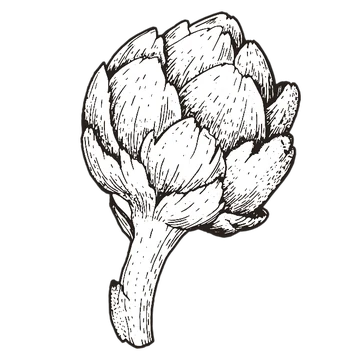

At 6:50 a.m. on December 21, 1935, police trumpeters woke the workers at the Bronx Terminal Market in New York City. Mayor Fiorello LaGuardia climbed onto a vegetable truck and announced a ban on the sale, display and possession of baby artichokes. The ban was aimed at an extortion racket that had controlled the city's artichoke trade for years, a racket tied to the gangster known as the Artichoke King, Ciro Terranova. Here is how a vegetable became a matter for the mayor, and what an artichoke actually is.
From Italian farms in California to New York
Italian immigrant farmers introduced the globe artichoke to the fields south of San Francisco in the late 1800s, and commercial growing was under way by around 1900. Today about 99 percent of the artichokes grown commercially in the United States still come from the central California coast, most of them from Monterey County.
Growers shipped their crop east to Boston, Philadelphia and New York. By the 1920s, refrigerated railcars carried nearly every artichoke grown in the United States, and in the eastern cities each shipment passed through wholesalers before it reached a shop or a restaurant.
The Artichoke King
Ciro Terranova was born in Sicily in 1888. According to the Mob Museum, he was a half-brother of Giuseppe Morello, and the family settled in New York in 1897 after living in Louisiana and Texas. The Morello and Terranova family, one of the first large Mafia operations in New York, began to take an interest in the artichoke trade in the 1910s, starting with the points where the rail lines brought produce into the city.
Terranova's men required market wholesalers to buy their artichokes only from him, and National Geographic reports that they raised prices by as much as 30 percent. Vendors paid whatever price the gangsters set. The Mob Museum estimates that Terranova earned about a million dollars a year from roughly 1925 to 1935, and his hold on the New York artichoke market earned him the name Artichoke King.
Pressure on both coasts
Vendors who tried to buy directly from wholesalers had their crates smashed, their tires slashed and their families threatened. Railcars and trucks carrying California artichokes were hijacked, and drivers who refused to sell through the racket's channels were threatened or beaten.
The pressure reached the growers too. National Geographic describes farmers in San Mateo County arming themselves with shotguns and machetes, men with machetes hacking rival artichoke fields to pieces, and rumors that New York gangsters were dropping gas bombs on California farms from small planes. By 1935, Monterey County's artichoke crop grossed about $666,000 a year.
A mayor on a vegetable truck
Fiorello LaGuardia had been elected mayor on a promise to fight corruption, including the extra payments that gangsters extorted on fruit and vegetables during the Depression. Baby artichokes were sold mainly in the city's Italian neighborhoods, and the police did not track that trade. LaGuardia treated the baby artichoke trade as a central business of the Morello family and set out to remove Terranova from it.
On the morning of December 21, 1935, LaGuardia stood on a truck at the Bronx Terminal Market and declared that baby artichokes posed “a serious and threatening emergency” in the city. As the Pittsburgh Press reported it, he told the dealers that he knew they were honest men and that no racketeer, thug or punk would intimidate them while he was mayor. A New York Herald Tribune reporter covering the ban wrote: “It is impossible not to conclude that the world today is a bit mad.”
The ban is lifted
According to the New York City Municipal Archives, three days later the extortion racket in the baby artichoke trade had been broken, and the ban was lifted. National Geographic says the ban was lifted within a week. Because the gangs threatened farms in California as well as dealers in New York, the racket was an interstate matter, and the archives hold the telegrams LaGuardia sent to the FBI about it.
LaGuardia then asked New York restaurants to serve more baby artichokes, and the Wil-Low Cafeteria chain wrote to offer its support. In 1935 the Artichoke Growers of California sent the mayor a telegram of thanks, and reports from the city's Department of Markets in January 1937 described the market as healthy.
Terranova's control of the trade had already been passing to other gangsters since 1931, and National Geographic credits the ban with hastening the end of his monopoly. He died on February 20, 1938, at Columbus Hospital in New York, aged 49. The official cause of death was heart failure, after two strokes earlier that month.
What a baby artichoke is
The artichokes at the center of the 1935 ban were not a separate variety, and in the United States they are not picked young. Baby artichokes grow on the same plants as the large ones, lower down on the stalk, below the larger heads. They stay small, about 2 to 4 ounces, and they never develop the fuzzy choke that has to be scraped out of a large artichoke.
On each plant, the bud at the top of a stem is harvested first, and the buds on the side shoots mature later. Growers cut each bud once it has reached full size but before its bracts begin to spread open.
Rooted Leaf Deep Dive: inside an artichoke head
An artichoke is a flower bud. The globe artichoke belongs to the composite family, the family of daisies and sunflowers, and it is a close relative of the thistles. The part we cook is its immature flower head, picked before it opens.
The large green scales are involucral bracts, modified leaves that wrap the bud. Their fleshy lower ends are one of the two parts you eat. Inside them, the bud sits on a shallow, dish-shaped base called the receptacle, and the receptacle is the heart. On top of the heart are hundreds of tiny undeveloped flowers, each with a ring of fine hairs called a pappus, with tiny bracts called chaff between them. Together they make up the choke. If the bud is left on the plant, those flowers open into a bluish to rose-lavender head about six inches across.
Rooted Leaf Deep Dive: inulin, and water that tastes sweet
Artichoke heads store a large share of their carbohydrate as inulin. A 2010 study put it at about 50 to 70 grams of inulin-type fructan per kilogram of fresh artichoke. Inulin is a chain of fructose units joined in a straight line, usually with one glucose unit at its end. In six artichoke cultivars studied in 2006, the average chain was between about 5 and 17 sugar units long. In storage, the chains slowly break down into free fructose and sucrose, faster at room temperature than in the cold.
An artichoke also changes how the next thing you taste comes across. In 1972, Linda Bartoshuk and colleagues reported in Science that after the tongue is exposed to artichoke, plain water can taste sweet. They identified the salts of two compounds in artichoke, chlorogenic acid and cynarin, as the main active components. The artichoke adds no sugar to the water; it changes the tongue's response for a short time.
Artichoke and Peak Bloom
Artichoke has quite a life beyond the dinner plate. It's also one of the two plants we ferment in-house for Peak Bloom, alongside agave. Looking more closely at its flower buds and their chemistry is part of the pleasure of working with this remarkable plant.
Sources
Kilkelly, M. B. Behold the Baby Artichoke, or, Power to the Punies. New York City Municipal Archives, 2017. The account of December 21, 1935, the mayor's words as reported by the Pittsburgh Press, the lifting of the ban and the records held by the archives are from this post.
The Mob Museum: Eighty years ago, Ciro “Artichoke King” Terranova died of a broken heart. Terranova's family, the income estimate and his death.
National Geographic: Why the mafia fought a bicoastal gang war over artichokes. The racket's methods, events in California and the New York Herald Tribune quotation.
Hay, M. In 1930s New York, the Mayor Took on the Mafia by Banning Artichokes. Atlas Obscura, 2020, as republished by Bunk History.
The plant and its harvest: Globe artichoke, Texas A&M AgriLife Extension; harvesting artichokes, University of California Statewide IPM Program; the bracts and the choke, Botanist in the Kitchen; baby artichokes and regular artichokes, America's Test Kitchen.
Inulin: Leroy, G., and colleagues. Changes in inulin and soluble sugar concentration in artichokes (Cynara scolymus L.) during storage. Journal of the Science of Food and Agriculture 90 (2010): 1203 to 1209. Read the paper. Schütz, K., and colleagues. Separation and quantification of inulin in selected artichoke cultivars and dandelion roots. Biomedical Chromatography 20 (2006): 1295 to 1303. Read the paper. On the structure of inulin, a 2025 review of inulin and agavin fructans in Molecules.
Bartoshuk, L. M., Lee, C. H., and Scarpellino, R. Sweet taste of water induced by artichoke (Cynara scolymus). Science 178 (1972): 988 to 989. Read the paper
Share:
Sage at the Roots of Western Medicine
Bats, Blossoms & Tequila