




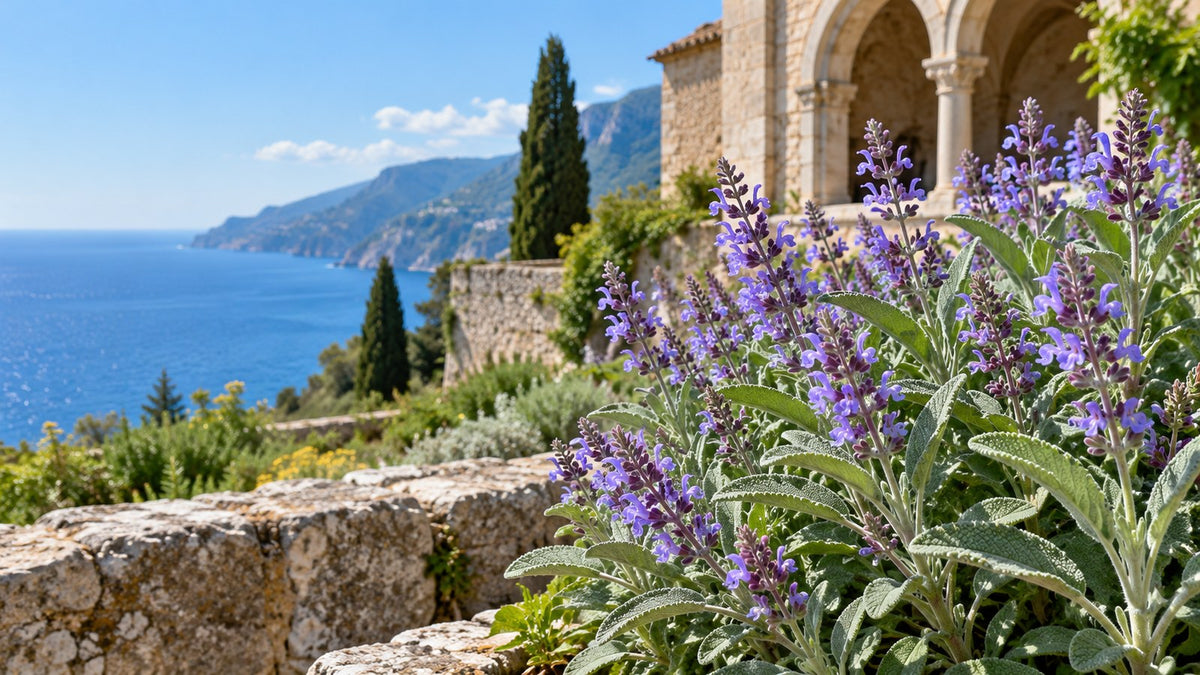
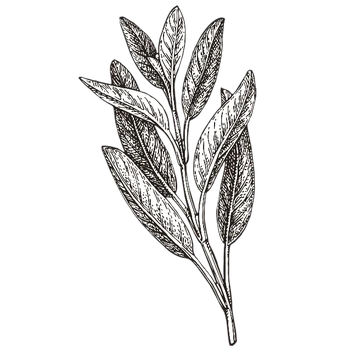

The Regimen sanitatis Salernitanum, a medieval Latin poem of advice on diet and daily health from the medical school of Salerno, in southern Italy, gives sage a chapter of its own. The chapter opens with a question: “Cur moriatur homo cui salvia crescit in horto?”, “Why should a man die when sage grows in his garden?” The poem was copied, printed and translated for centuries. In the Latin text that John Ordronaux translated into English in 1870, the next line answered the question: against the power of death, there is no medicine in the gardens.
A medical school in Salerno
John Ordronaux, a professor of medical jurisprudence at Columbia College in New York, wrote in 1870 that the medical school of Salerno dates back to the ninth century, while noting that writers disagree widely about its origin. A 2004 history in the journal Neurosurgery traces its fame through the tenth century, describes it as best known in the eleventh and at its height in the middle of the twelfth, and calls it the oldest medical school of modern civilization. Salerno helped shape the medical curriculum of medieval universities. Women practiced medicine there, and the best known of them was Trotula de Ruggiero.
A poem addressed to a king of England
The school's most famous work was the Regimen sanitatis, a Latin poem of rules on diet, hygiene and daily habits. Its first line reads “Anglorum regi scribit schola tota Salerni”: the whole school of Salerno writes to the king of England. Ordronaux identified the king as Robert, Duke of Normandy, who was treated at Salerno while traveling home through Italy after the Crusade, and who never took the English throne. The poem has often been credited to John of Milan, but Ordronaux read its first line as evidence that the whole faculty wrote it.
By Ordronaux's count the original poem ran to 362 lines, and his edition, with verses added by later writers, reached 744. He listed 163 editions, 107 in Latin and 56 in translation. A 2021 history in Acta Biomedica counts more than 300 editions in many languages up to 1846.
The chapter on sage
In Ordronaux's edition, sage is the subject of chapter 60. After the opening question, the Latin calls the plant “salvia salvatrix, naturae conciliatrix”: sage the savior, the reconciler of nature. The chapter credits sage with strengthening the nerves, steadying shaking hands and driving out acute fever. Ordronaux put the opening line into English verse as “Why should he die, whose garden groweth sage?” These lines record the medical beliefs of a medieval school, written as poetry to be memorized.
The line after the question
In Ordronaux's edition, the second line of the chapter reads “Contra vim mortis, non talis medicamen in hortis”: against the power of death, there is no such medicine in the gardens, meaning that no other garden plant compares with sage. In a footnote, Ordronaux explains that he changed one word. The original, he wrote, has est, not talis, so the line reads: against the power of death, there is no medicine in the gardens.
Ordronaux made the change because, in his words, the original “plainly contradicts the preceding line.” In the Latin as he found it, the first line is a question about why anyone with sage in the garden should die, and the second line states that no garden plant can prevent death.
A name from the Latin for saving
The genus name Salvia comes from the Latin salvere, “to save” or “to be in good health,” according to a University of California Master Gardener fact sheet. The species name officinalis comes from officina, the Latin word for a workshop. In pharmacy, an officinal drug was one that apothecaries kept in stock.
A 2016 assessment by the European Medicines Agency records that sage leaf is mentioned in the writings of Hippocrates, Paracelsus and Hildegard von Bingen, and that sage has been grown in northern Europe since medieval times. The plant is an evergreen subshrub of the mint family with woolly, grayish leaves, native to the Mediterranean region and especially to the area around the Adriatic Sea.
History, not advice
The Salerno verses record what physicians in the Middle Ages believed about sage. They are history, not medical advice, and nothing in this article recommends sage for any condition. Modern regulators take a more cautious view of the plant. In its 2016 assessment, the European Medicines Agency noted that the essential oil of sage contains thujone and camphor, which have toxic effects in high doses, and that thujone may cause seizures at high doses, as shown in animal studies and indicated by case reports.
Rooted Leaf Deep Dive: the oil glands on a sage leaf
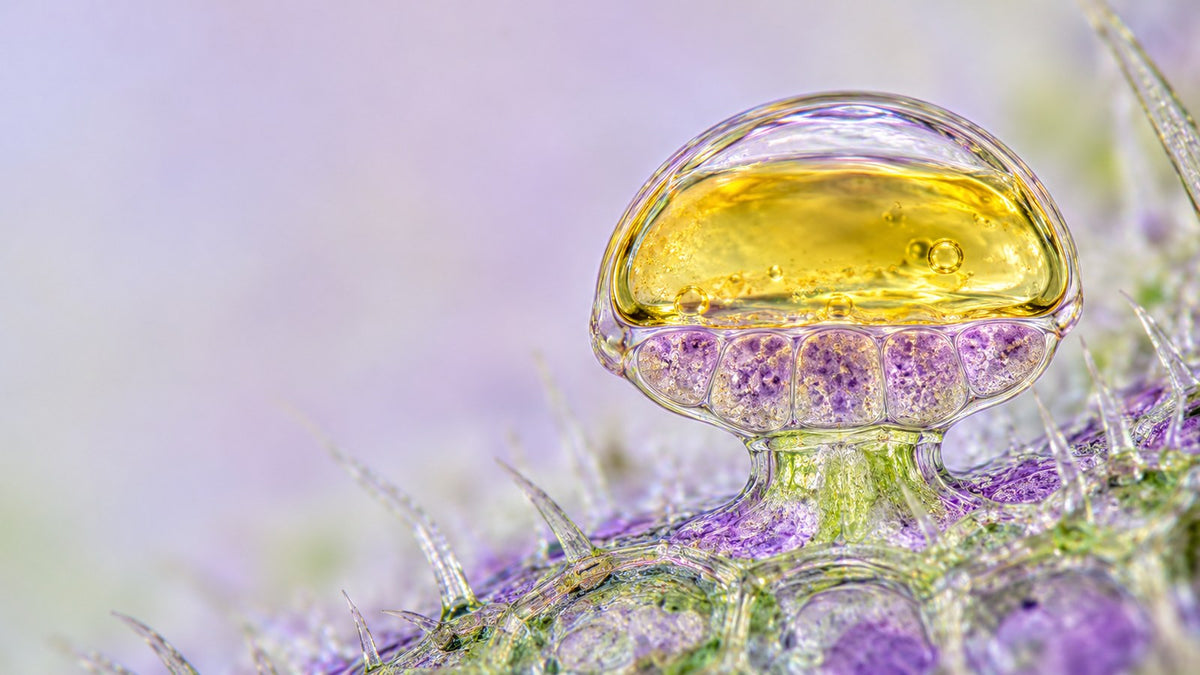
The woolly surface of a sage leaf carries tiny oil glands, a kind of plant hair called a glandular trichome. A 1984 study at Washington State University, using a scanning electron microscope, found two basic types on sage leaves: a stalked gland with a stalk of several cells topped by a single secretory cell, and a short gland on a one-cell stalk whose head has anywhere from one to twelve secretory cells. The oil collects in a space beneath the gland's outer skin, the cuticle. The study found that each type of gland could make all four of the main families of monoterpenes characteristic of sage.
That oil makes up as much as 3 percent of the leaf, according to the composition summarized by the European Medicines Agency. Its main compounds are alpha-thujone, at 10 to 60 percent of the oil, beta-thujone at 4 to 36 percent, camphor at 5 to 20 percent and 1,8-cineole at 1 to 15 percent. The agency notes that the ranges are wide because published analyses vary with harvest time, the chemical type of the plant and the method of analysis.
Rooted Leaf Deep Dive: the acids in a sage leaf
A sage leaf also holds a range of organic acids. Rosmarinic acid, which the European Medicines Agency classes as a dimer of caffeic acid, makes up as much as 3.3 percent of the leaf. Ursolic acid, a triterpene acid, reaches as much as 3.5 percent, and oleanolic acid, a related triterpene acid, up to 0.4 percent. Carnosic acid, a phenolic diterpene, reacts readily with oxygen to form carnosol, which breaks down in turn into further related compounds. Smaller amounts of simpler acids, such as caffeic acid, p-hydroxybenzoic acid and syringic acid, are present as well.
Sage and Lush Green
Those small silver leaves hold a chemistry worth getting to know. We ferment sage alongside aloe for Lush Green, which carries its nitrogen as amino acids, with carbon built into the same molecules. Sage gives us plenty to admire, even in a single leaf.
Sources
Code of Health of the School of Salernum, translated by John Ordronaux. Philadelphia: J. B. Lippincott, 1870. Chapter 60, “Of Sage,” and the introduction. Read the book at the Internet Archive
The school of Salerno: de Divitiis, E., Cappabianca, P., and de Divitiis, O. The schola medica salernitana: the forerunner of the modern university medical schools. Neurosurgery 55 (2004): 722 to 745. Longobardi, U., Mitaritonno, M., and Cervellin, G. Salernitan Medical School or Langobardic Medical School? Acta Biomedica 92 (2021).
The plant and its name: University of California Master Gardener Program, Know What You Grow: Sage; the word officinal in Webster's Revised Unabridged Dictionary (1913).
History, composition and safety: European Medicines Agency, Assessment report on Salvia officinalis L., folium and Salvia officinalis L., aetheroleum (EMA/HMPC/150801/2015, 2016).
The oil glands: Venkatachalam, K. V., Kjonaas, R., and Croteau, R. Development and essential oil content of secretory glands of sage (Salvia officinalis). Plant Physiology 76 (1984): 148 to 150.
Share:
Aloe Joins the Circuit
Artichokes & Organized Crime