


Orthosilicic acid
Cryo Sil supplies plant-available silicon from potassium silicate. Plants take it up as orthosilicic acid.
Plant-available silicon form
Featured


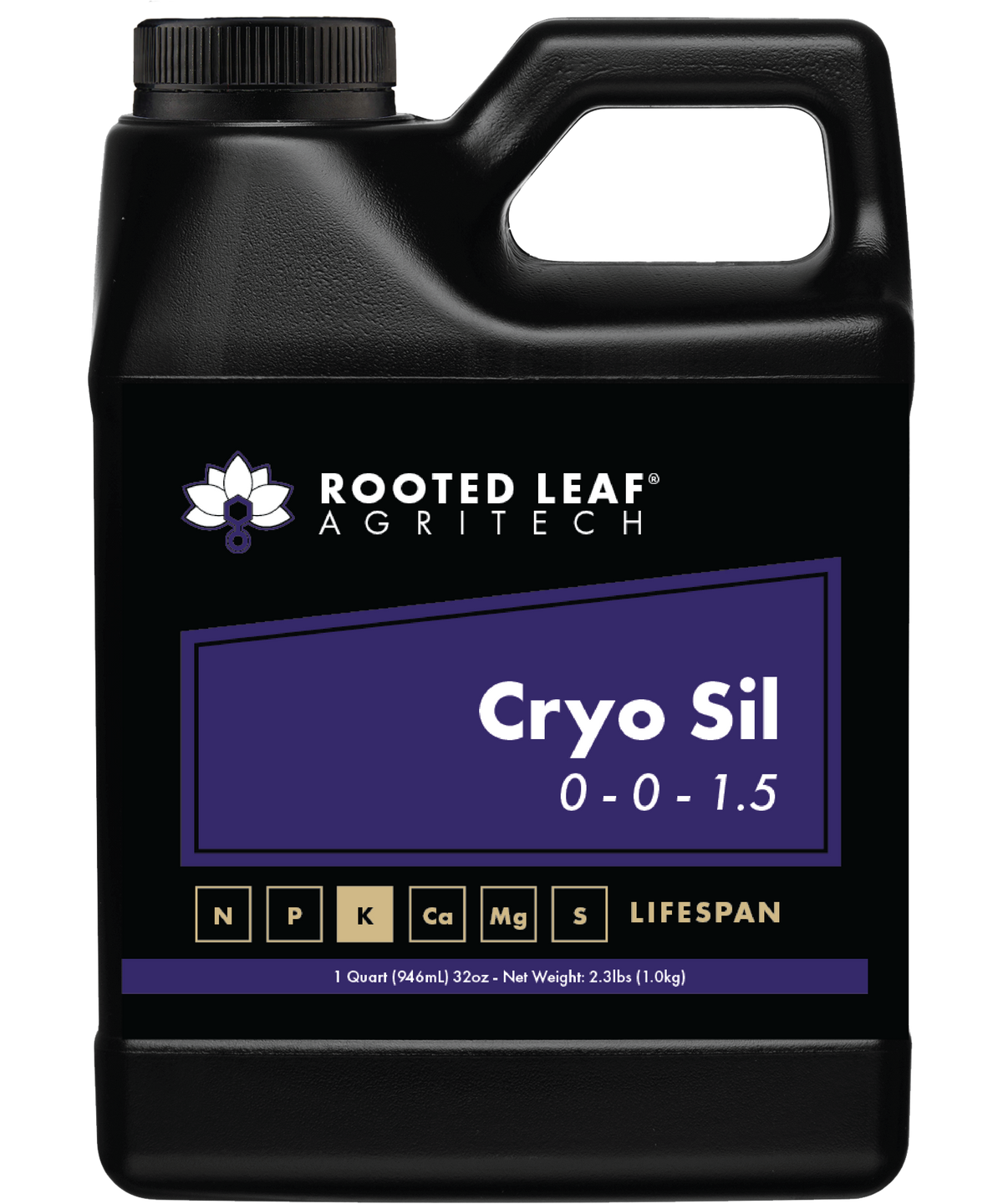
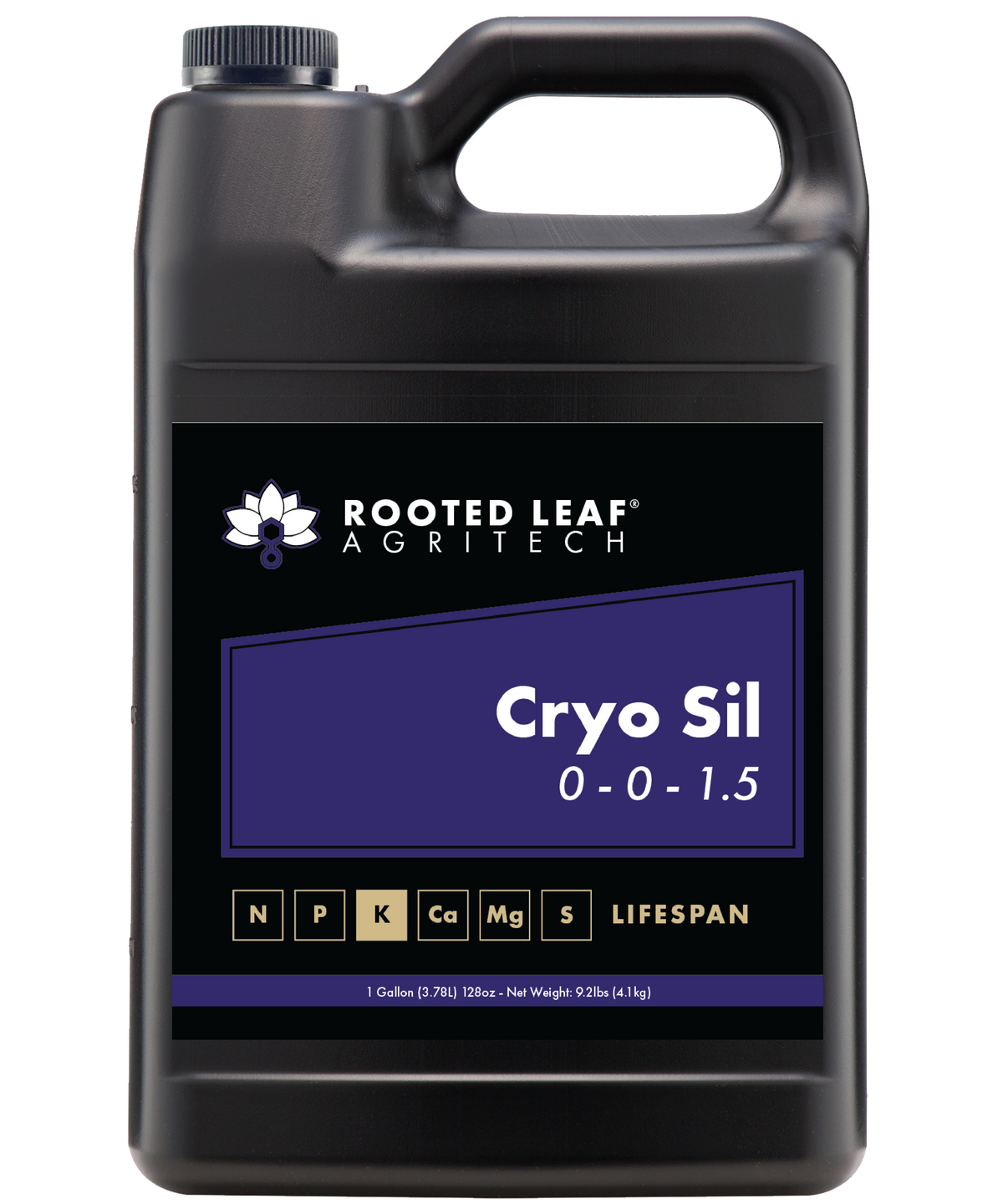

Soluble Silicon · Powered by Plants
Cryo Sil is a unique source of soluble silicon: potassium silicate carried in a functional carbon matrix of fermented safflower and hibiscus. It is designed to be used throughout the lifespan of the plant, in both vegetative and bloom stages.
Silicon is the one input that saves the plant carbon. Silica costs a plant roughly a tenth to a twentieth of what lignin costs to build with, so structure reinforced with silicon uses less carbon, and that carbon stays available for everything else.
Keeping it available is the hard part. Free silicic acid above roughly 100 ppm falls out of solution, and a loaded reservoir only speeds that up. The organic acid complex is designed to hold silicon in the one form a root can take up, from the tank to the plant.
 Soluble Silicon
4.0%
 Soluble Potash
1.5%
 Carbon
9.0%
Ships within 1-2 business days
Instant answers from GNOME, our grow assistant. Or email info@rootedleaf.com
Cryo Sil
Carbon, from organic acids
CO₂ equivalent, per mL
Concentrate weight
Cryo Sil: Silicon Supplement
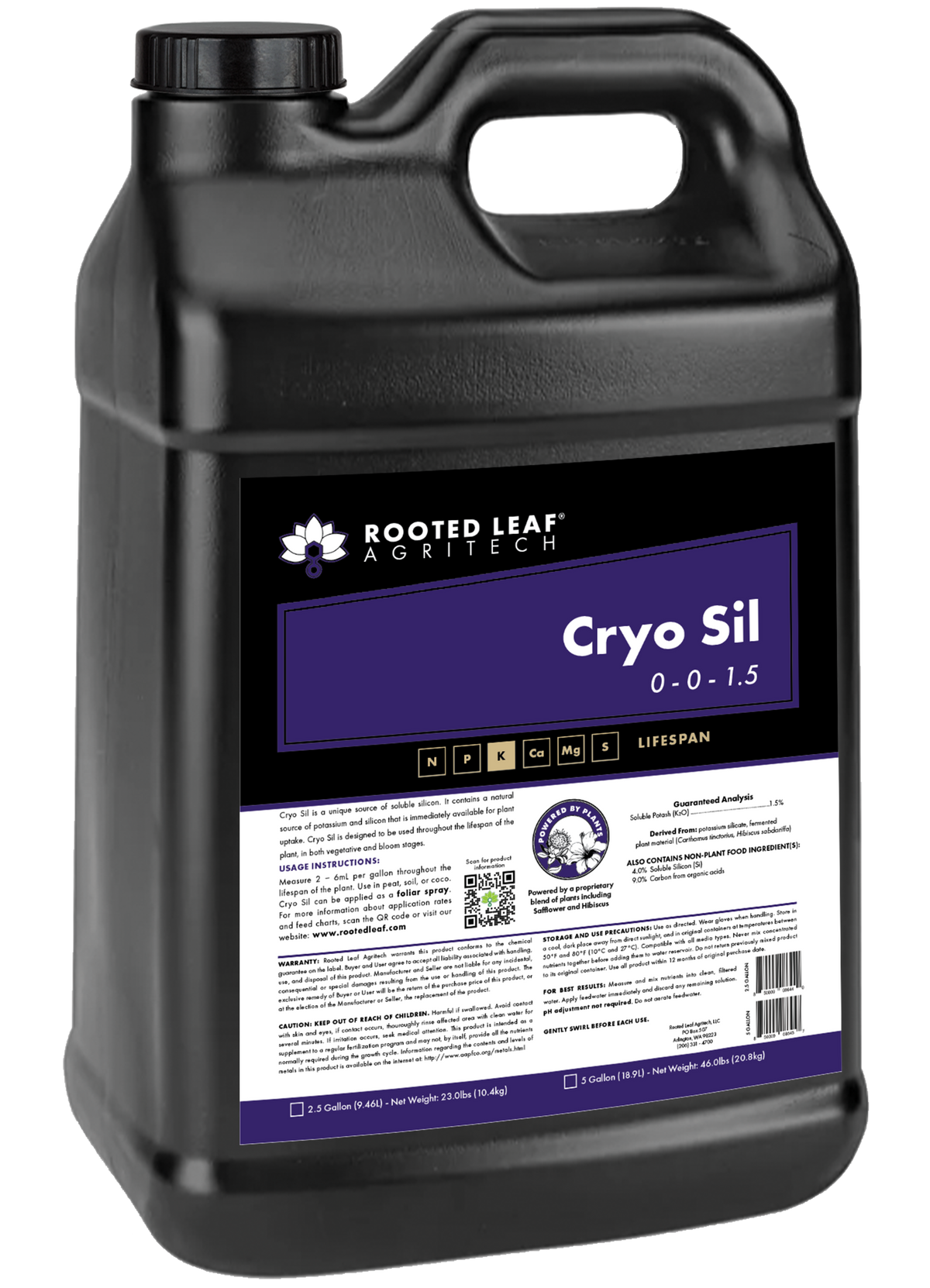
Derived From: potassium silicate, fermented plant material (Carthamus tinctorius, Hibiscus sabdariffa)
Also Contains Non-Plant Food Ingredient(s):
4.0% Soluble Silicon (Si) from potassium silicate
9.0% Carbon (from organic acids)
Application Rate
Root zone (all mediums): 1 to 6 mL/gal
Foliar: 10 to 20 mL/gal
Product Details
Solubility: 100% Water Soluble
pH: No Adjustment Needed
Shelf Life: 12 Months
pH adjustment not required. Compatible with all media types.
How to use it
Measure 1 to 6 mL per gallon at the roots in any medium, or 10 to 20 mL per gallon as a foliar spray, throughout the lifespan. Mix well, no pH adjustment or aeration needed, then apply immediately and discard any leftover solution.
| Application | Rate | Notes |
|---|---|---|
| Root feed (all mediums) | 1 to 6 mL/gal | Per gallon of feedwater |
| Foliar spray | 10 to 20 mL/gal | Per gallon of spray; apply immediately |
pH: No adjustment needed
Feed chart builder
These are starting points. Your water, medium, and growth stage change the math. Get exact numbers for your grow, free, in about two minutes.

Powered By Plants
Cryo Sil begins as fermented plant material: safflower and hibiscus. It breaks down to the organic acids that carry potassium silicate, and keep its silicon in the form a root can take up.
Powered By Plants

Fermented whole plants. That is the active ingredient.
Silicon in plant nutrition
Meet orthosilicic acid, the silicon form roots take up, and the safflower and hibiscus we ferment into Cryo Sil’s organic-acid matrix.
Cryo Sil supplies plant-available silicon from potassium silicate. Plants take it up as orthosilicic acid.
Plant-available silicon form
Drag to rotate. Scroll or use +/- to zoom.

Carthamus tinctorius
Safflower
One of the oldest cultivated crops, safflower has long been grown for its colorful florets. It is one of the two source plants Cryo Sil is fermented from.

Hibiscus sabdariffa
Hibiscus
Hibiscus is known for its richly colored calyces and their tart character. It is one of the two source plants Cryo Sil is fermented from.
Cryo Sil delivers soluble silicon the plant builds into its own cell walls.

01 Problem
A plant builds stiffness, barriers and repair capacity from carbon-rich chemistry. Cellulose, lignin, phenolics, waxes and protective proteins all require carbon skeletons, reducing power, ATP and time. Under high light, heat, dry air or mechanical strain that cost rises exactly when demands compete. The underlying problem is the carbon and energy cost.
The visible symptom may be weak tissue, abrasion, collapse, excess repair, or reduced stress tolerance. Underneath it, the plant is relying on organic metabolism alone to supply every unit of structure and every round of recovery.
The next panel shows what happens inside the plant.
Soluble silicic acid travels in the transpiration stream. Where water leaves the leaf, it condenses as hydrated amorphous silica lining the wall and filling the trichome. Schematic.
02 Mechanism
Silicon begins as soluble silicic species moving with water. As it reaches leaves, walls, cuticles and trichomes, and as water is lost, those species can condense into hydrated amorphous silica. Silicon that traveled unseen in the water stream becomes part of a mineral-organic composite that does not replace the wall but shares its mechanical load.
That deposited phase can increase hardness, reinforce protective surfaces, and make deformation or penetration more difficult. By taking on part of that load, silicon can save carbon and redox capacity that would otherwise be committed to additional structure, emergency defense, or repeated repair.
So Rooted Leaf built the formula to work with the plant.
soluble silicon
carbon, from organic acids

03 Solution
Cryo Sil supplies plant-available silicon from potassium silicate. Plants take it up as orthosilicic acid. The formulation combines this silicon source with fermented safflower and hibiscus in a plant-derived organic-acid matrix.
The benefit goes beyond stronger stems. The composite matters most under stress, and the design goal is more structural and stress-response capacity when the environment becomes demanding.
The label below shows what is in it.
Evidence Epstein (2009) and Tayade et al. (2022)
Powered By Plants
Two stories about the plants Cryo Sil is fermented from.
HibiscusHibiscus sabdariffa
Pigments from roselle hibiscus can show when fish is losing freshness. In a 2025 laboratory study, researchers in Iran mixed red anthocyanins from roselle into a packaging film made of gluten and carboxymethyl cellulose. As stored salmon spoiled, it released alkaline nitrogen gases. The film absorbed them and changed from red to green, because anthocyanins take a different form, and a different color, as conditions turn alkaline. It was a laboratory test on salmon, not a guaranteed food-safety check.
SafflowerCarthamus tinctorius
In a 2012 laboratory study, researchers in India steeped fresh safflower flowers in boiling water and added the yellow infusion to a solution of dissolved gold. Within 30 minutes the mixture turned deep brown. Under an electron microscope it held crystalline gold particles: spheres 40 to 60 nanometers across and triangles about 200 nanometers wide. All of the gold came from the added solution; the flower extract turned the dissolved gold ions into solid metal.
The chemistry, and the price
Silicon is the one nutrient with a genuinely narrow chemical window, and almost nobody in the category tells you where it is. Cryo Sil is built around it.
Free silicic acid works best in a narrow range of concentrations. Below about 2.4 ppm, uptake runs at half speed; above about 100 ppm, it falls out of solution as gel. Cryo Sil's root-zone rate of 1 to 6 mL per gallon delivers about 12 to 70 ppm of soluble silicon, inside the window. Its organic-acid matrix is designed to keep silicon soluble past the 100 ppm ceiling at the foliar rate of 10 to 20 mL per gallon, about 116 to 233 ppm.
Plants can reach maturity in silicon-free solution, which is why the textbooks once filed silicon under non-essential. But a garden is not a nutrient beaker: under real stress, silicon proves useful, and the plant scientist who studied it longest, Emanuel Epstein, settled on a better word for it: quasi-essential.
Whatever the label lists, what crosses the root is monosilicic acid, the small soluble molecule. Left free, it condenses above roughly 100 ppm into oligomers, then particles, then gel, and the salts and amino acids in a full reservoir only speed that up. Holding silicon in that one usable form, even at the concentration a foliar spray needs, is the main challenge, and it is the job the organic-acid matrix is designed to do.
Silicon is the same element in every bottle, so the useful question is what it costs to put a given amount of it on the plant. Two numbers decide that: price, and how much silicon a milliliter actually carries. Cryo Sil runs about a tenth the price per milliliter of the leading monosilicic acid product, and holds close to half again as much soluble silicon in that milliliter besides. Put together, at each product's strong recommended rate, the silicon Cryo Sil delivers costs roughly a fifteenth as much per gram. The molecule that reaches the root is the same; this is the cost of getting it there.
~$0.36
per gram of soluble silicon delivered. Cryo Sil is 4.0% Si, about $16 a liter ($59.97 a gallon).
~$5.40
per gram of silicon delivered. The leading monosilicic acid product, about 2.2% Si and roughly $160 a liter.
Basis, at each product's high recommended root-zone rate: Cryo Sil uses 1 to 6 mL per gallon at the roots. At $59.97 a gallon, Cryo Sil costs about 1.6 cents per mL and, at 9.2 lb per gallon and 4.0% soluble silicon, carries roughly 44 mg of silicon per mL, so a 6 mL per gallon feed delivers about 70 ppm for roughly 9.5 cents, near 36 cents per gram of silicon. The benchmark at about $160 per liter, 11.3 lb per gallon and 2.2% soluble silicon carries roughly 30 mg per mL, so a 1 mL per gallon feed delivers about 8 ppm for roughly 16 cents, near $5.40 per gram. Cost per gram of silicon does not change with dose. The benchmark also supplies a light N-P-K charge; this compares soluble silicon alone. Prices vary by retailer and pack size.
Throughout the lifespan, vegetative and bloom. Use 1 to 6 mL per gallon at the roots, or 10 to 20 mL per gallon as a foliar spray.
Because there is only one molecule to deliver. Xylem tracing finds a single silicon species going into a plant, so the question is never whose silicon is better, only whose is still soluble when it reaches the root. We get there from potassium silicate and organic acids instead of buying stabilized silicic acid, so by the liter it lands at roughly a tenth the price of the leading monosilicic acid product, and holds more soluble silicon per bottle besides.
Unopened products can be returned within 15 days of delivery for a refund of the item price; original shipping isn't refunded. Email info@rootedleaf.com first for a return authorization. Opened products can't be returned. If your order arrives damaged, email us pictures and we'll send a replacement within 1-2 business days of confirming it.
That's what GNOME is for: it knows the whole Rooted Leaf line, plant science, plant nutrition science, and feed programs for 150+ crops. Tap the Ask GNOME button below and ask away. Prefer a person? Email info@rootedleaf.com or call (206) 331-4700.
The Rooted Leaf lineup


Part B of the base feed every program builds on: nitrogen, phosphorus and calcium.

Policies and reference
Guidance from GNOME and this page is educational and general. Plant results vary with crop, environment, water, and program, and nothing here is a guarantee of specific results.
100% made by us, from whole plant to final bottle. We manufacture all of our own chelates and complexes from scratch, and quality-check every batch. If an order arrives damaged or is not right, contact us and we will make it right.
Shipping policy · Refund and returns · Terms of service · Safety data sheet · Heavy metals test results
Guaranteed Analysis Soluble Potash (K₂O) 1.5%
Derived From: potassium silicate, fermented plant material (Carthamus tinctorius, Hibiscus sabdariffa)
Also contains non-plant food ingredient(s) 4.0% Soluble Silicon (Si) from potassium silicate
9.0% Carbon (from organic acids)
1 Gallon (3.78L) 128oz. Net weight 9.2lbs (4.1kg).
This product is intended as a supplement to a regular fertilization program and may not, by itself, provide all the nutrients normally required during the growth cycle.
Storage and use Store in a cool, dark place away from direct sunlight, in the original container, between 50°F and 80°F (10°C and 27°C). Compatible with all media types.
Mixing Never mix concentrated nutrients together before adding them to the reservoir. pH adjustment is not required. Do not aerate feedwater. Gently swirl before each use. Apply immediately and discard any remaining solution.
Use all product within 12 months of the original purchase date.
Processing Orders ship within 1-2 business days and typically arrive within 5 days in the US. We ship to the US, Canada and the other countries listed at checkout.
Methods Standard, 2-Day and Overnight shipping, with the rate for your address shown at checkout. International orders ship with duties and import taxes paid at checkout.
Storage Store in a cool, dry place away from direct sunlight. Shelf life: 12 months.
Note With Standard, 2-Day or Overnight shipping, the 5 gal size ships as two 2.5 gal jugs. With Freight, offered at checkout on larger orders, it ships as one 5 gal jug.
Shipping, returns, and product questions: the fastest answer is GNOME. Tap the Ask GNOME button below.
Shipping
Orders ship within 1-2 business days and typically arrive within 5 in the US. Choose Standard, 2-Day or Overnight shipping at checkout. International orders ship with duties and import taxes paid at checkout.
With Standard, 2-Day or Overnight shipping, the 5 gal size ships as two 2.5 gal jugs. With Freight, offered at checkout on larger orders, it ships as one 5 gal jug.
Returns & Damaged Orders
Unopened products: return within 15 days of delivery for a refund of the item price; original shipping isn't refunded. Email us first for a return authorization. If your order arrives damaged, email pictures and we'll send a replacement within 1-2 business days of confirming it.
Talk to Us
Ask GNOME in the chat for instant answers, or reach the team at info@rootedleaf.com / (206) 331-4700.
Cryo Sil
Grown with Cryo Sil? Tell other growers how it went.
Be the first grower to say how Cryo Sil worked for you. We'll email you a review link for your order.