4%

Carbon, from organic acids

38 ppm

CO₂ equivalent, per mL

10.5 lb/gal

Concentrate weight

Guaranteed Analysis

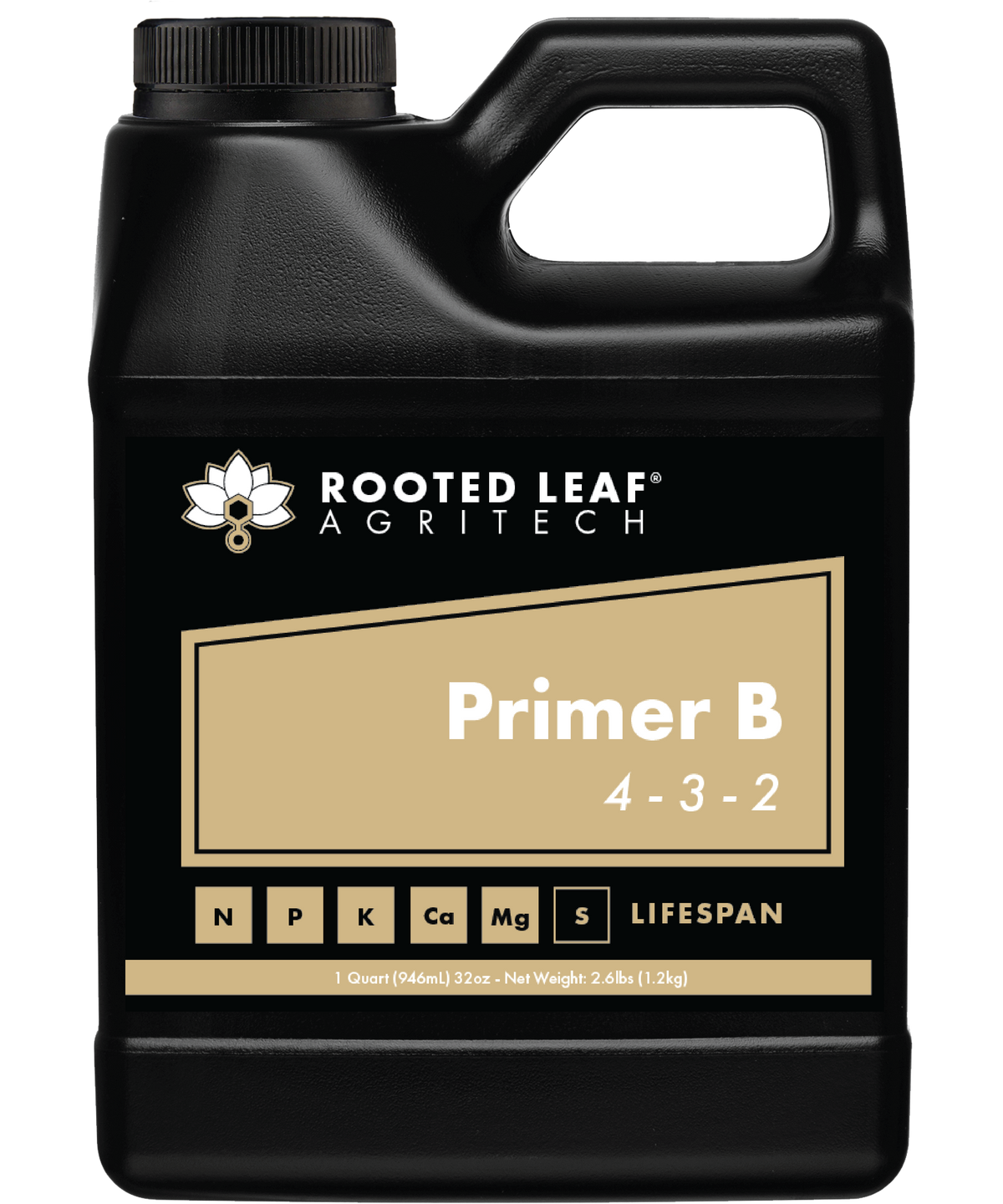
Primer B: Two-Part Base Nutrient (Part B)

Total Nitrogen (N) 4.0%
4.0% Nitrate Nitrogen
Available Phosphate (P₂O₅) 3.0%
Soluble Potash (K₂O) 2.0%
Calcium (Ca) 4.5%
Magnesium (Mg) 0.2%

Derived From: fermented plant material (Juniperus communis, Lavandula angustifolia), calcium acetate, magnesium acetate, calcium nitrate, magnesium nitrate, potassium hydroxide, phosphoric acid

Also Contains Non-Plant Food Ingredient(s):

4% Carbon (from organic acids)

Application Rate

Soil / Coco: 2 to 14 mL/gal

Foliar: 1 to 2 mL/gal (each part)

Product Details

Solubility: 100% Water Soluble

pH: No Adjustment Needed

Shelf Life: 12 Months

pH adjustment not required. Compatible with all media types.

How to use it

Use rates and storage

Measure 2 to 14 mL per gallon of each part at the roots throughout the lifespan, using equal parts Primer A and Primer B. For a foliar spray, use 1 to 2 mL per gallon of each part, using equal parts Primer A and Primer B. Mix well, no pH adjustment or aeration needed, then apply immediately and discard any leftover solution.

Application RateNotes
Soil, peat, or coco 2 to 14 mL/gal Per gallon of feedwater
Foliar spray 1 to 2 mL/gal (each part) Per gallon of spray; apply immediately

pH: No adjustment needed

Feed chart builder

These are starting points. Your water, medium, and growth stage change the math. Get exact numbers for your grow, free, in about two minutes.

You know the how. Here's the why.

Powered By Plants

Two Plants With Structural Adaptations

Juniper’s wax-coated cones and lavender’s trichome-studded flower spikes show how much chemistry lives in a plant’s structure. We ferment juniper and lavender to create the botanical matrix around Primer B’s mineral formula.

Powered By Plants

Powered by Plants seal: fermented from juniper and lavender

Fermented whole plants supply the organic-acid buffer and carbon matrix.

Inside the bottle

Special Attributes

Explore calcium acetate and magnesium acetate, two organic-acid nutrient forms named on Primer B's label.

Calcium acetate

An organic-acid calcium species in the formulation's buffered matrix. The matrix is designed to help maintain calcium in solution alongside phosphate across the working pH range. In plants, calcium supports pectin cross-linking in developing cell walls.

From the label: calcium acetate

Molecular structure

Drag to rotate. Scroll or use +/- to zoom.

C₄H₆CaO₄

Organic-acid buffered calcium.

Juniperus communis

Juniper

Juniper (Juniperus communis) is a resinous evergreen conifer whose needle-like leaves grow in whorls of three, each carrying a visible band of stomata and a resin canal running along its length. Its small cones mature over two to three years into fleshy, blue-black "berries" coated in a waxy, silvery bloom (technically fused, modified seed scales, not a true berry). That resin and wax layer is part of the plant's own structural chemistry, sealing tissue against moisture loss.

Signature molecule: Organic acids

Lavandula angustifolia

Lavender

Lavender (Lavandula angustifolia) is a low, woody Mediterranean shrub adapted to thin, alkaline, free-draining soils and long dry summers, with narrow silvery-gray leaves that reduce water loss in full sun. Its dense flower spikes are covered in tiny glandular trichomes, microscopic surface structures that manufacture and store the plant's characteristic monoterpene-rich essential oil. Both the leaf's silvering and the trichome layer are structural adaptations to an exposed, moisture-scarce habitat.

Signature molecule: Monoterpenes

The nutritional science

Primer B carries the nitrogen, phosphorus and calcium half of a two-part foundation.

Illustration of a root tip among sandy mineral particles, with few dispersed nutrient markers.

01 Problem

Nutrients can all be present and still fail to work together.

A label can confirm that every required element is in the bottle. It cannot guarantee they stay soluble at concentrate strength or reach the root as one balanced solution. Calcium, phosphate and sulfate are valuable because they are reactive, and that same reactivity makes them react with each other in a concentrated bottle. The problem is keeping them in solution together, not supplying them.

What the grower sees is the result: a complete feed that behaves inconsistently, mineral partners that leave solution too early, or nutrition treated as isolated percentages when the root actually meets hydrated ions, competing charges, ligands, activities and gradients all at once.

The next panel shows what happens inside the plant.

TIE-UP ORGANIC-ACID BUFFER AVAILABLE ACROSS pH Ca PO₄ calcium and phosphate tie up and settle out Mg PO₄ acidic alkaline held in true solution, available across the range taken up at the root hair Ca organic-acid buffering keeps calcium and phosphorus available across pH

Calcium and phosphate meet and settle out. Organic-acid buffering holds calcium, magnesium and phosphorus in true solution across the working pH range. Schematic.

02 Mechanism

Roots respond to chemistry and charge, not to a guaranteed analysis.

For every charged nutrient, chemical activity and electrical potential act together, and the root responds to both. At full strength some partners must stay apart. After dilution, water increases the distance between them, ligand interactions change, and the complete nutrient solution forms in the water around the roots, where uptake happens. Keeping the parts apart protects the chemistry, and dilution brings them together.

Primer B is the calcium-rich half of that foundation. Calcium builds cell walls and carries signals, while the plant keeps its free calcium under tight control. Phosphate moves through ATP, sugar phosphates, nucleotides and membranes, and nitrogen becomes the proteins and enzymes that do the work. Calcium and phosphate are exactly the partners that settle out of a concentrated bottle together, so Primer B holds them in solution with organic-acid buffering and keeps them apart from Primer A until both meet in the water.

So Rooted Leaf built the formula to work with the plant.

4%

Functional Carbon

2 to 14 mL/gal

Dose Per Part

2 botanicals

Source Plants

Illustration of a root tip with longer visible root hairs among sandy particles and dispersed nutrient markers.

03 Solution

Primer A and B are one base feed, sold as two concentrates so that each stays stable.

Primer B carries the nitrogen, phosphorus and calcium side. Primer A carries the potassium and magnesium side. They are kept apart while concentrated, then combine in irrigation water as the complete mineral and carbon baseline. Splitting the feed keeps it stable without making it harder to use.

Fermented juniper and lavender provide the supporting botanical matrix around the mineral formula. What arrives at the root is one solution, which the plant then uses for membranes, gradients, cell walls, chlorophyll, ATP and growth.

The label below shows what is in it.

Evidence Maathuis (2009) and Igamberdiev (2018)

Powered by Plants seal: fermented from juniper and lavender

Powered By Plants

Did you know?

Two stories about the plants Primer B is fermented from.

LavenderLavandula angustifolia

Lavender's Hidden Laboratories

Lavender's familiar scent begins in microscopic glands on the calyx, the small cup around each flower. In Lavandula angustifolia, a disk of eight secretory cells makes aromatic compounds, and oil collects above them beneath a thin cuticle. Linalool and linalyl acetate are prominent in that oil, and researchers have identified an enzyme that converts linalool into linalyl acetate. A standardized oral lavender-oil preparation, Silexan, has been tested in human anxiety trials.

JuniperJuniperus communis

Juniper in the Navy’s Fuel Lab

Eastern redcedar is not a true cedar: it is a juniper, Juniperus virginiana, and in the United States cedarwood oil has been distilled from the wood of junipers. In 2017, U.S. Navy chemists published a way to turn that oil into fuel. They hydrogenated commercial cedarwood oil, rich in thujopsene and cedrene, and the result held more than 12 percent more energy per gallon than JP-8, the military's kerosene-based jet fuel. It is a laboratory fuel, and it is much thicker than JP-8 in the cold.

True-Solution Chemistry

Calcium and Phosphorus, Held in True Solution

Calcium and phosphate can form poorly soluble compounds when conditions favor precipitation. Part B binds its calcium, magnesium, and phosphorus to an organic-acid buffer designed to help maintain all three in true solution across the working pH range.

4.5%

soluble calcium

  • True-solution Ca and P

    Soluble calcium and phosphate are carried together in the same organic-acid buffered form, designed to resist one precipitating out before the plant takes it up.

  • No added pH adjustment

    The organic-acid buffer is designed to maintain solubility across the working pH range without a separate adjustment step.

  • Calcium built for the cell wall

    Its guaranteed calcium ships in a form structured to stay available for pectin cross-linking in the growing cell wall, designed to resist locking up as calcium phosphate.

  • Phosphorus in its working form

    Phosphorus is carried as soluble orthophosphate, the same ionic form roots take up directly, rather than a mineral salt that has to dissolve first.

Why Ca and P Don't Usually Travel Together

Unbuffered calcium and phosphate blends may form poorly soluble compounds as water chemistry, mixing order, or pH changes. Part B is formulated as an organic-acid buffered true solution designed to resist that interaction.

May precipitate

Unbuffered Ca + P mineral blends

Organic-acid buffered true solution

Part B, organic-acid buffered

Comparison describes the general chemical behavior of calcium and phosphate ions in unbuffered mineral blends; actual precipitation depends on water chemistry, tank-mix order, and pH.

Quick Answers

Why does the base nutrient come in two parts?

A complete base feed is more nutrition than one concentrate can hold, so we split it into two parts. The ratio in each part is chosen for chemical compatibility in the bottle and for what plants need. Dose them together in equal parts: 2 to 14 mL/gal each at the roots, or 1 to 2 mL/gal each as a foliar spray.

Do I need to adjust pH before using Part B?

Part B's organic-acid buffer is designed to hold calcium, magnesium, and phosphorus in solution across the working pH range without a separate pH-adjustment step.

Won't calcium and phosphorus just react in the tank?

That's the normal risk with straight mineral blends. Part B's organic-acid buffering is designed to keep its calcium and phosphate dissolved and available, resisting the formation of insoluble compounds.

Can I use Part B across different grow mediums?

Part B is designed to be compatible with a range of grow mediums. Follow the label directions and confirm compatibility with your water and system.

What's actually supplying the calcium and phosphorus in Part B?

Calcium and magnesium are delivered in soluble, organic-acid buffered forms, and phosphorus ships as soluble orthophosphate, the same ionic forms plants take up directly.

How do I store it?

Cool and dark, in the original container, between 50F and 80F. Use it within 12 months of purchase. Gently swirl before use.

What's your return policy?

Unopened products can be returned within 15 days of delivery for a refund of the item price; original shipping isn't refunded. Email info@rootedleaf.com first for a return authorization. Opened products can't be returned. If your order arrives damaged, email us pictures and we'll send a replacement within 1-2 business days of confirming it.

I have a question you haven't answered here.

That's what GNOME is for: it knows the whole Rooted Leaf line, plant science, plant nutrition science, and feed programs for 150+ crops. Tap the Ask GNOME button below and ask away. Prefer a person? Email info@rootedleaf.com or call (206) 331-4700.

Ask GNOME instead

Instant, product-specific answers from our grow assistant. Tap the Ask GNOME button below to start.

The Rooted Leaf lineup

Complete Your Program

Primer A
Primer A

The potassium-rich other half. Mix A and B into the same water, never together.

From $9.97
CalMag Fuel
CalMag Fuel

Calcium and magnesium for new growth, with no added nitrogen.

From $14.97
Cryo Sil
Cryo Sil

Silicon, which the base does not carry, for stronger cell walls.

From $11.97
Micro Flow
Micro Flow

Five micronutrients in one bottle to round out the feed.

From $14.97

Policies and reference

Disclaimers

Guidance from GNOME and this page is educational and general. Plant results vary with crop, environment, water, and program, and nothing here is a guarantee of specific results.

100% made by us, from whole plant to final bottle. We manufacture all of our own chelates and complexes from scratch, and quality-check every batch. If an order arrives damaged or is not right, contact us and we will make it right.

Shipping policy · Refund and returns · Terms of service · Safety data sheet · Heavy metals test results

Full guaranteed analysis

Guaranteed Analysis Total Nitrogen (N) 4.0%
4.0% Nitrate Nitrogen
Available Phosphate (P₂O₅) 3.0%
Soluble Potash (K₂O) 2.0%
Calcium (Ca) 4.5%
Magnesium (Mg) 0.2%

Derived From: fermented plant material (Juniperus communis, Lavandula angustifolia), calcium acetate, magnesium acetate, calcium nitrate, magnesium nitrate, potassium hydroxide, phosphoric acid

Also contains non-plant food ingredient(s) 4% Carbon (from organic acids)

1 Gallon (3.78L) 128oz. Net weight 10.5 lbs (4.8kg).

This product is intended as a supplement to a regular fertilization program and may not, by itself, provide all the nutrients normally required during the growth cycle.

Technical Data

Storage and use Store in a cool, dark place away from direct sunlight, in the original container, between 50°F and 80°F (10°C and 27°C). Compatible with all media types.

Mixing Never mix concentrated nutrients together before adding them to the reservoir. pH adjustment is not required. Do not aerate feedwater. Gently swirl before each use. Apply immediately and discard any remaining solution.

Use all product within 12 months of the original purchase date.

pH range
No adjustment needed
Solubility
100% water-soluble liquid solution
Shelf life (months)
12
Shipping & Storage

Processing Orders ship within 1-2 business days and typically arrive within 5 days in the US. We ship to the US, Canada and the other countries listed at checkout.

Methods Standard, 2-Day and Overnight shipping, with the rate for your address shown at checkout. International orders ship with duties and import taxes paid at checkout.

Storage Store in a cool, dry place away from direct sunlight. Shelf life: 12 months.

Note With Standard, 2-Day or Overnight shipping, the 5 gal size ships as two 2.5 gal jugs. With Freight, offered at checkout on larger orders, it ships as one 5 gal jug.

Primer B

Grower reviews

Grown with Primer B? Tell other growers how it went.

No reviews yet

Be the first grower to say how Primer B worked for you. We'll email you a review link for your order.