


Citric acid
Citric acid has three carboxyl groups that can bind metal ions through their oxygen atoms. These interactions help keep metal nutrients in solution and available for exchange at the root.
Represents the label's organic acids
Featured


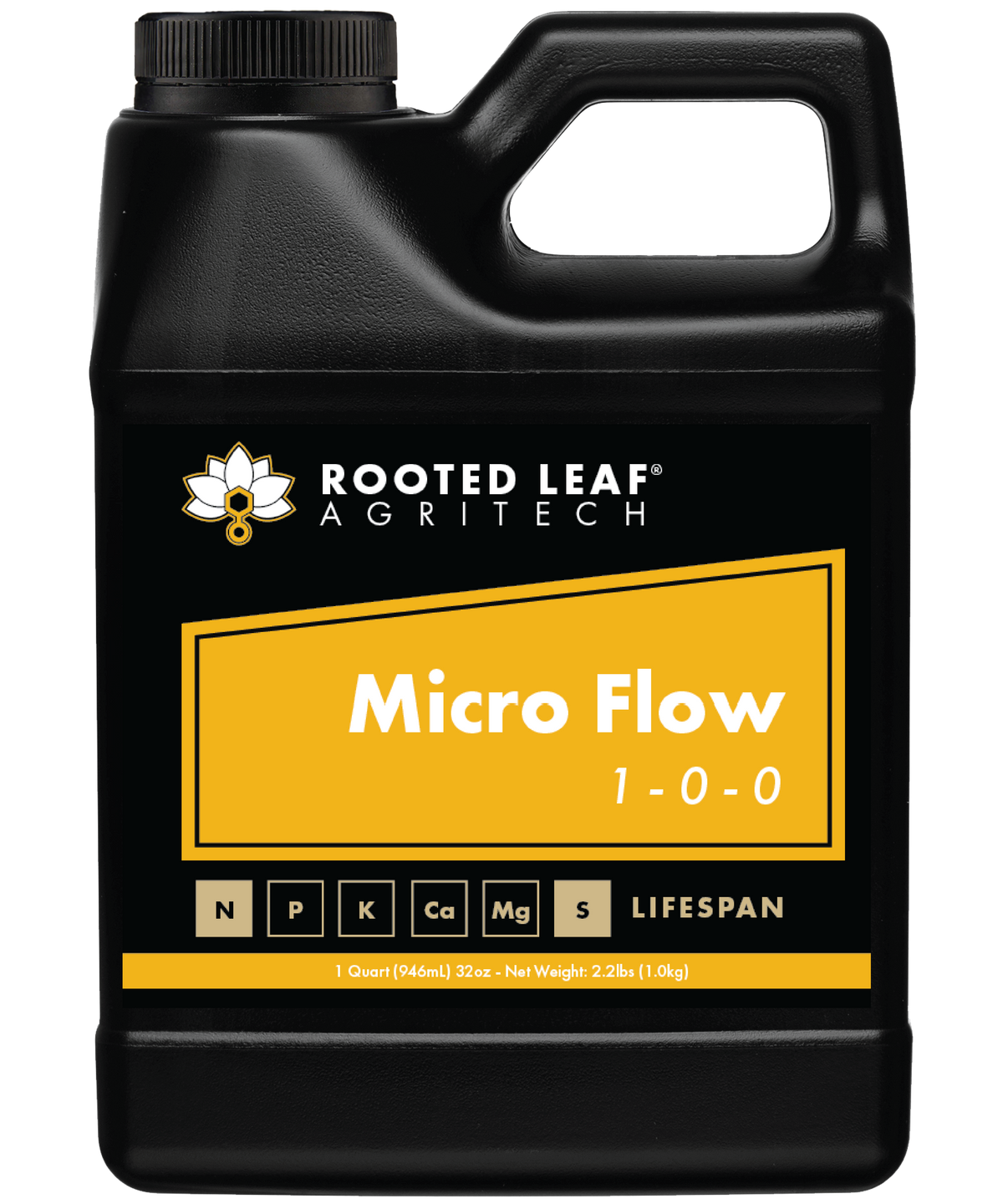
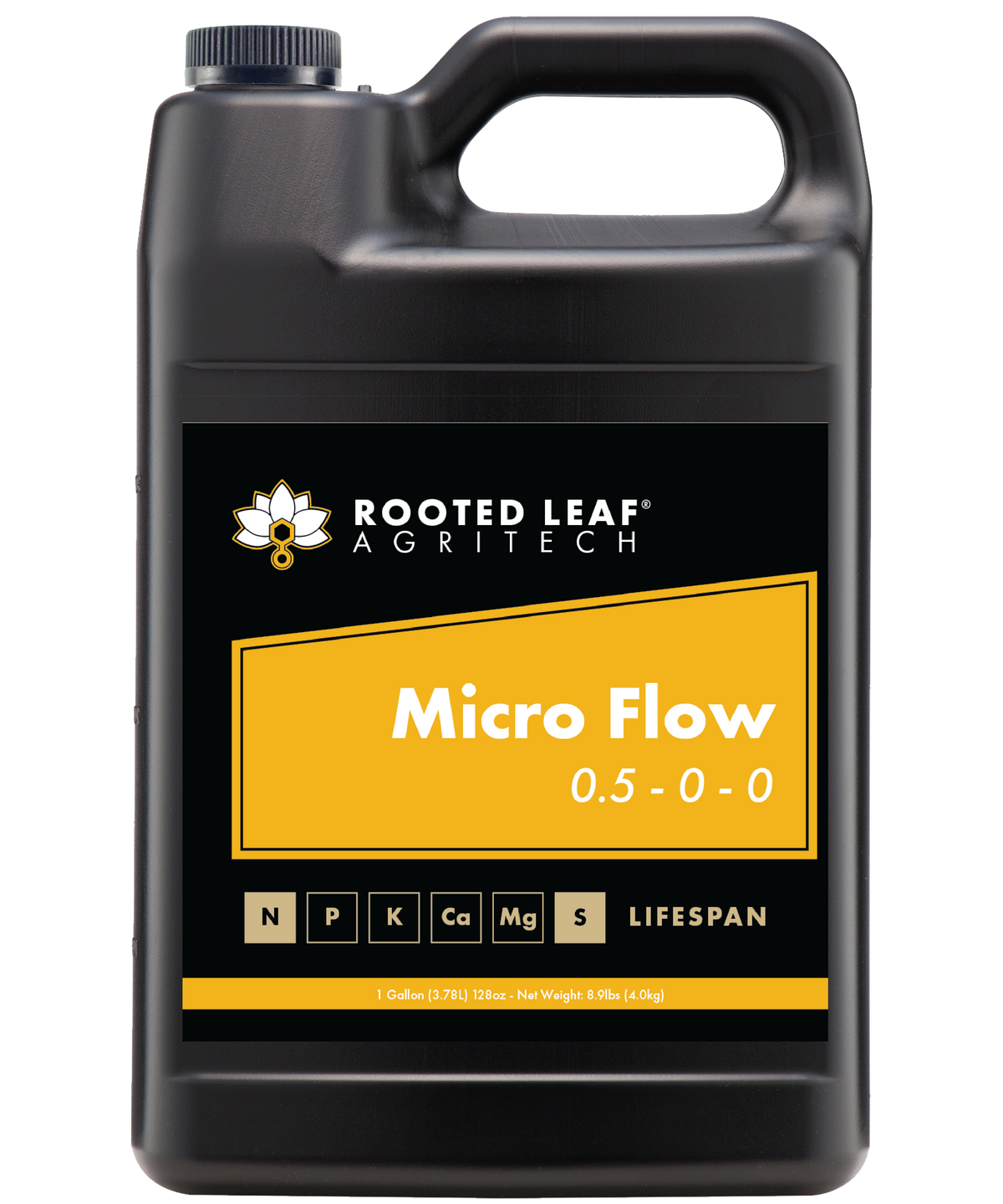
Micronutrient Supplement · Powered by Plants
Iron, manganese, zinc, boron, and copper are needed in only trace amounts, but shifting soil pH and mineral chemistry can pull them out of reach of the root fast. Micro Flow complexes each element with amino and organic acids instead of synthetic chelates, a functional carbon matrix designed to keep the blend soluble and available for uptake. Built for soil drench or foliar use in high-intensity cultivation, where micronutrient demand can be high.
 Iron
0.5%
 Manganese
0.3%
 Zinc
0.2%
Ships within 1-2 business days
Instant answers from GNOME, our grow assistant. Or email info@rootedleaf.com
Micro Flow
Carbon, from organic acids and hydrolyzed vegetable protein
CO₂ equivalent, per mL
Concentrate weight
Micro Flow: Micronutrient Supplement
Derived From: fermented plant material (Moringa oleifera, Phyllanthus emblica), amino acids (hydrolyzed vegetable protein), ferrous sulfate, manganese sulfate, zinc sulfate, boric acid, copper sulfate
Also Contains Non-Plant Food Ingredient(s):
11% Carbon from organic acids and hydrolyzed vegetable protein
Application Rate
Soil / Coco: 0.1 to 1.0 mL/gal
Foliar: 1 to 2.5 mL/gal
Product Details
Solubility: 100% Water Soluble
pH: No Adjustment Needed
Shelf Life: 12 Months
pH adjustment not required. Compatible with all media types.
How to use it
Two rates: 0.1 to 1.0 mL per gallon into the medium at the roots, and a foliar 1 to 2.5 mL per gallon on the leaf. Micro Flow is concentrated, so measure carefully. Mix well, no pH adjustment or aeration needed, then apply immediately and discard any leftover solution.
| Application | Rate | Notes |
|---|---|---|
| Soil, peat, or coco | 0.1 to 1.0 mL/gal | Per gallon of feedwater |
| Foliar spray | 1 to 2.5 mL/gal | Per gallon of spray; apply immediately |
pH: No adjustment needed
Feed chart builder
These are starting points. Your water, medium, and growth stage change the math. Get exact numbers for your grow, free, in about two minutes.

Powered By Plants
Across the plant kingdom, organic acids do this same job inside living tissue. Moringa oleifera's leaves and Phyllanthus emblica's (amla) fruit each concentrate their own organic acids and mineral-binding compounds as part of ordinary plant chemistry, the same kind of chemistry used in Micro Flow's amino- and organic-acid complexed blend.
Powered By Plants

Fermented whole plants supply the amino- and organic-acid complexing matrix.
Inside the bottle
Micro Flow uses plant-derived amino acids and organic acids to chelate and complex its metal nutrients. Explore the mineral-binding chemistry, its boric-acid boron source, and the moringa and amla behind the formulation.
Citric acid has three carboxyl groups that can bind metal ions through their oxygen atoms. These interactions help keep metal nutrients in solution and available for exchange at the root.
Represents the label's organic acids
Glycine is the simplest amino acid. Its amino and carboxyl groups can bind a metal ion at two sites to form a chelate ring, helping keep that metal in a soluble form.
Represents the label's amino acids
Boric acid is the direct source of boron in this blend and the precursor of the borate ion, which plants use to cross-link pectin (via rhamnogalacturonan-II) into the cell wall, supporting structural integrity as the wall is built.
From the label: boric acid
Drag to rotate. Scroll or use +/- to zoom.

Moringa oleifera
Moringa
Moringa oleifera grows as a fast-growing tree across South Asia and East Africa, and botanically its leaves are notable for a dense concentration of vitamins, minerals, and organic acids. That leaf tissue accumulates calcium, iron, and vitamin C alongside chlorogenic and other organic acids, part of the same class of carbon compounds the plant uses internally to bind and move minerals through its own cells.
Signature molecule: Organic acids
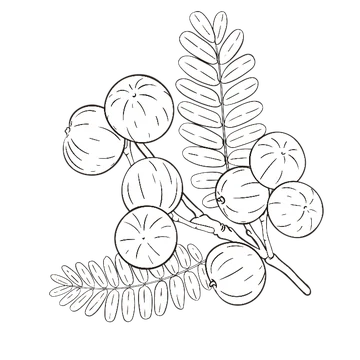
Phyllanthus emblica
Amla
Phyllanthus emblica, the amla or Indian gooseberry, is a small deciduous tree native to South Asia whose translucent green fruit is distinctive for its vitamin C and hydrolyzable tannin content. Those tannins and organic acids build up in the fruit's pulp as it ripens, part of the plant's own chemistry for binding and stabilizing minerals within its tissue.
Signature molecule: Tannins
Micro Flow keeps iron, manganese, zinc, boron and copper soluble on the way to the root.

01 Problem
Raise light, carbon dioxide, irrigation precision and macronutrient supply, and the plant's metabolic rate rises with them. Under those conditions an element needed in tiny amounts can limit a very large flow of metabolism, because it sits at an active site, an electron carrier or a structural junction. A micronutrient can be present and still become the bottleneck.
The challenge is not only quantity. Reactive metals can hydrolyze, precipitate, adsorb to surfaces, shift speciation with pH, or catalyze unwanted redox chemistry before the plant can place them in the proteins that need them.
The next panel shows what happens inside the plant.
A bare metal ion ties up and locks out. The same ion held in an amino and organic-acid complex stays soluble and reaches the root. Schematic.
02 Mechanism
Amino-acid and organic-acid ligands form a temporary coordination shell around reactive minerals. Coordination can improve solution behavior, buffer free-metal activity and support transport while preserving the possibility of exchange at roots, walls, membranes and proteins. The carrier has to protect the metal without trapping it.
Each nutrient it protects has a specific job. Manganese helps split water in photosynthesis. Copper moves electrons through plastocyanin. Iron cycles through cytochromes, iron-sulfur clusters and ferredoxin. Zinc participates in carbonic anhydrase. Boron stabilizes rhamnogalacturonan II architecture in the growing wall. Their mass is small because a catalyst is used again and again, not because its work is small.
So Rooted Leaf built the formula to work with the plant.
Guaranteed micronutrients
Functional carbon

03 Solution
Micro Flow supplies iron, manganese, zinc and copper in a purpose-built amino- and organic-acid complexing system, with boron supplied as boric acid. It is designed for high-throughput plants: keep the metal nutrients coordinated in solution, available for exchange, and ready to enter the enzymes that keep a crop from being slowed by its smallest nutrient needs.
Fermented moringa and amla contribute a broad plant-derived matrix, and amla's high ascorbate content is especially relevant to iron redox and exchange chemistry.
The label below shows what is in it.
Evidence Assunção et al. (2022) and Connorton et al. (2017)
Powered By Plants
Two stories about the plants Micro Flow is fermented from.
MoringaMoringa oleifera
Moringa leaves store sulfur-containing compounds called glucosinolates, the same family found in broccoli and horseradish. When a leaf is crushed or cut, an enzyme in the leaf converts them into isothiocyanates, the compounds behind those plants' hot, sharp taste. In moringa, the isothiocyanates keep a sugar called rhamnose attached. In a 2014 Rutgers study, one of them was still fully intact after 30 days at room temperature, and the researchers proposed that the sugar explains the stability.
AmlaPhyllanthus emblica
The tower of the Lakshmana Temple at Khajuraho, in central India, is crowned by a flattened, bulb-shaped stone called an amalaka. The stone is named after amla, the fruit of Phyllanthus emblica, and an art historian writing for Smarthistory describes it as a symbol of abundance and growth. The temple was built in the tenth century by the Chandella kings. Amla itself is a small, round, very sour fruit, with six to eight pale lines running from its base to its tip.
The Complexing Matrix
Most micronutrient blends lean on synthetic chelators such as EDTA to keep iron, zinc, and manganese soluble in the tank and in the soil. Micro Flow takes a different route: every metal in this blend is complexed with amino acids and organic acids, functional carbon compounds that bind and carry micronutrients the way they move through plant and soil chemistry.
0
Synthetic Chelates
Glycine and related amino acids form direct bonds with metal cations, helping hold iron, manganese, zinc, and copper in a soluble form as pH shifts.
Citric acid and other organic acids add carboxyl groups that further stabilize each micronutrient in solution, functioning much like the humic and fulvic acid complexes found naturally in fertile soil.
Every complexing agent in this blend is an amino acid or organic acid, not a synthetic chelator, keeping the formulation aligned with a carbon-led nutrition program.
Boron is supplied as boric acid, the direct precursor of the borate ion plants use to cross-link pectin into the cell wall, dosed to stay within boron's narrow window between deficiency and excess.
Conventional micronutrient fertilizers commonly rely on synthetic chelates such as EDTA or DTPA to keep metals from precipitating out of solution. Micro Flow uses a different complexing approach, using amino and organic acids as its complexing agents.
EDTA / DTPA
Common Synthetic Chelators
Amino & Organic Acids
Micro Flow's Complexing Agents
Micro Flow's active micronutrients are derived from metal sulfates and boric acid. Complexation describes how those minerals are held in solution, not the elimination of mineral salts.
No. Micro Flow's iron, manganese, zinc, and copper are complexed with amino acids (such as glycine) and organic acids (such as citric acid) instead of EDTA or other synthetic chelators.
Yes. Micro Flow is formulated for both soil-drench and foliar application; see the product label for rates for your setup.
Amino- and organic-acid complexation is designed to help iron, manganese, zinc, and copper resist tie-up and stay soluble as pH rises, extending the window in which they remain available to the root. No complexing chemistry removes the need to monitor water and soil pH.
No. Micro Flow's micronutrients are derived from metal sulfates and boric acid. Complexation with amino and organic acids describes how those minerals are held in solution, not the removal of mineral salts.
Micro Flow is formulated as a general micronutrient supplement for high-intensity cultivation across a range of crops. See the label for full application guidance.
Cool and dark, in the original container, between 50F and 80F. Use it within 12 months of purchase. Gently swirl before use.
Unopened products can be returned within 15 days of delivery for a refund of the item price; original shipping isn't refunded. Email info@rootedleaf.com first for a return authorization. Opened products can't be returned. If your order arrives damaged, email us pictures and we'll send a replacement within 1-2 business days of confirming it.
That's what GNOME is for: it knows the whole Rooted Leaf line, plant science, plant nutrition science, and feed programs for 150+ crops. Tap the Ask GNOME button below and ask away. Prefer a person? Email info@rootedleaf.com or call (206) 331-4700.

The Rooted Leaf lineup


Part B of the base feed every program builds on: nitrogen, phosphorus and calcium.
Policies and reference
Guidance from GNOME and this page is educational and general. Plant results vary with crop, environment, water, and program, and nothing here is a guarantee of specific results.
100% made by us, from whole plant to final bottle. We manufacture all of our own chelates and complexes from scratch, and quality-check every batch. If an order arrives damaged or is not right, contact us and we will make it right.
Shipping policy · Refund and returns · Terms of service · Safety data sheet
Guaranteed Analysis Total Nitrogen (N) 1.0%
1.0% Water-Soluble Nitrogen
Sulfur (S) 0.6%
Iron (Fe) 0.5%
Manganese (Mn) 0.3%
0.3% Water Soluble Mn
Zinc (Zn) 0.2%
Boron (B) 0.05%
Copper (Cu) 0.03%
Derived From: fermented plant material (Moringa oleifera, Phyllanthus emblica), amino acids (hydrolyzed vegetable protein), ferrous sulfate, manganese sulfate, zinc sulfate, boric acid, copper sulfate
Also contains non-plant food ingredient(s) 11% Carbon from organic acids and hydrolyzed vegetable protein
1 Gallon (3.78L) 128oz. Net weight 9.2 lbs (4.2kg).
This product is intended as a supplement to a regular fertilization program and may not, by itself, provide all the nutrients normally required during the growth cycle.
Storage and use Store in a cool, dark place away from direct sunlight, in the original container, between 50°F and 80°F (10°C and 27°C). Compatible with all media types.
Mixing Never mix concentrated nutrients together before adding them to the reservoir. pH adjustment is not required. Do not aerate feedwater. Gently swirl before each use. Apply immediately and discard any remaining solution.
Use all product within 12 months of the original purchase date.
Processing Orders ship within 1-2 business days and typically arrive within 5 days in the US. We ship to the US, Canada and the other countries listed at checkout.
Methods Standard, 2-Day and Overnight shipping, with the rate for your address shown at checkout. International orders ship with duties and import taxes paid at checkout.
Storage Store in a cool, dry place away from direct sunlight. Shelf life: 12 months.
Note With Standard, 2-Day or Overnight shipping, the 5 gal size ships as two 2.5 gal jugs. With Freight, offered at checkout on larger orders, it ships as one 5 gal jug.
Shipping, returns, and product questions: the fastest answer is GNOME. Tap the Ask GNOME button below.
Shipping
Orders ship within 1-2 business days and typically arrive within 5 in the US. Choose Standard, 2-Day or Overnight shipping at checkout. International orders ship with duties and import taxes paid at checkout.
With Standard, 2-Day or Overnight shipping, the 5 gal size ships as two 2.5 gal jugs. With Freight, offered at checkout on larger orders, it ships as one 5 gal jug.
Returns & Damaged Orders
Unopened products: return within 15 days of delivery for a refund of the item price; original shipping isn't refunded. Email us first for a return authorization. If your order arrives damaged, email pictures and we'll send a replacement within 1-2 business days of confirming it.
Talk to Us
Ask GNOME in the chat for instant answers, or reach the team at info@rootedleaf.com / (206) 331-4700.
Micro Flow
Grown with Micro Flow? Tell other growers how it went.
Be the first grower to say how Micro Flow worked for you. We'll email you a review link for your order.