12%

Carbon, from organic acids

116 ppm

CO₂ equivalent, per mL

9.3 lb/gal

Concentrate weight

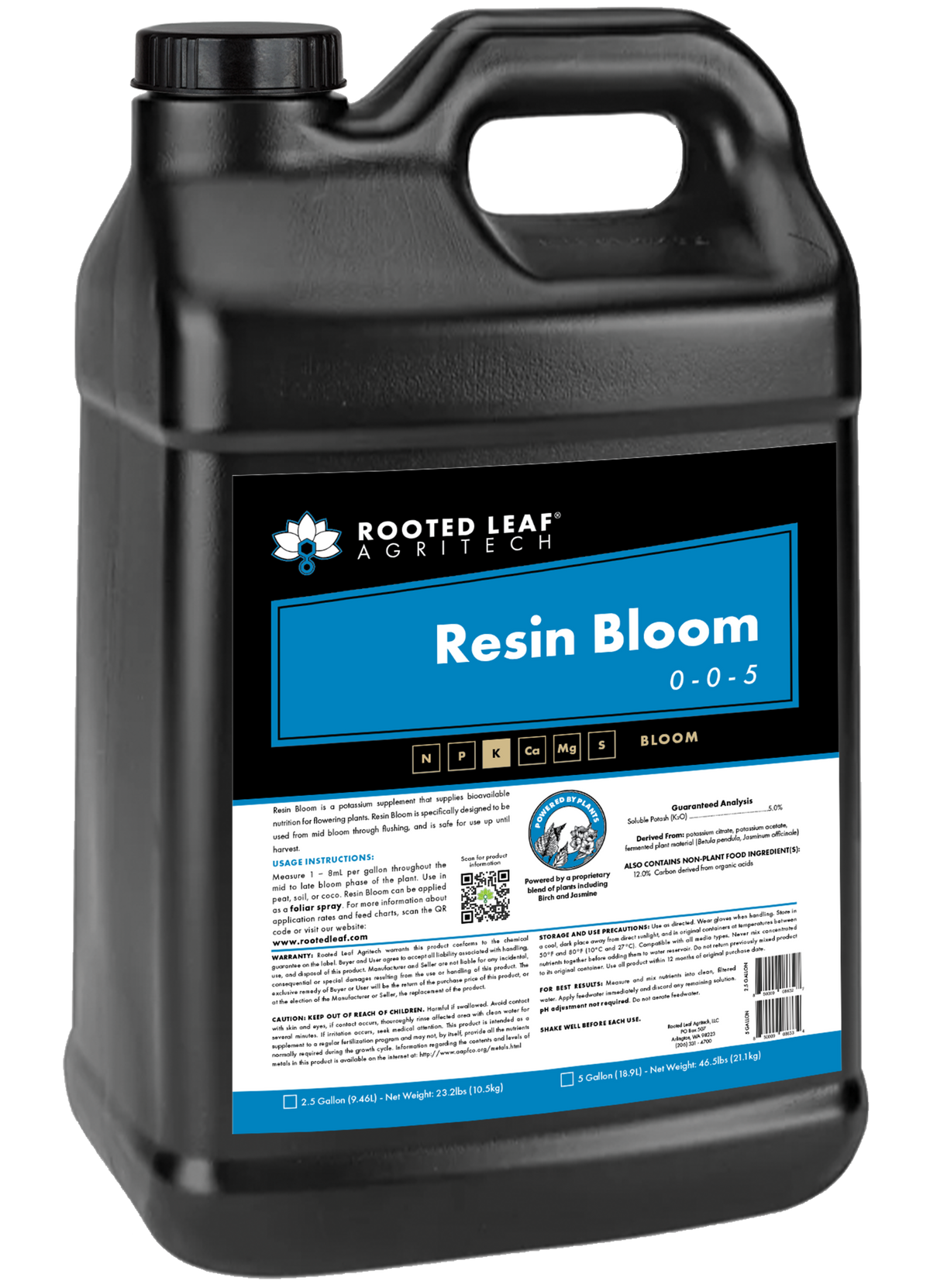
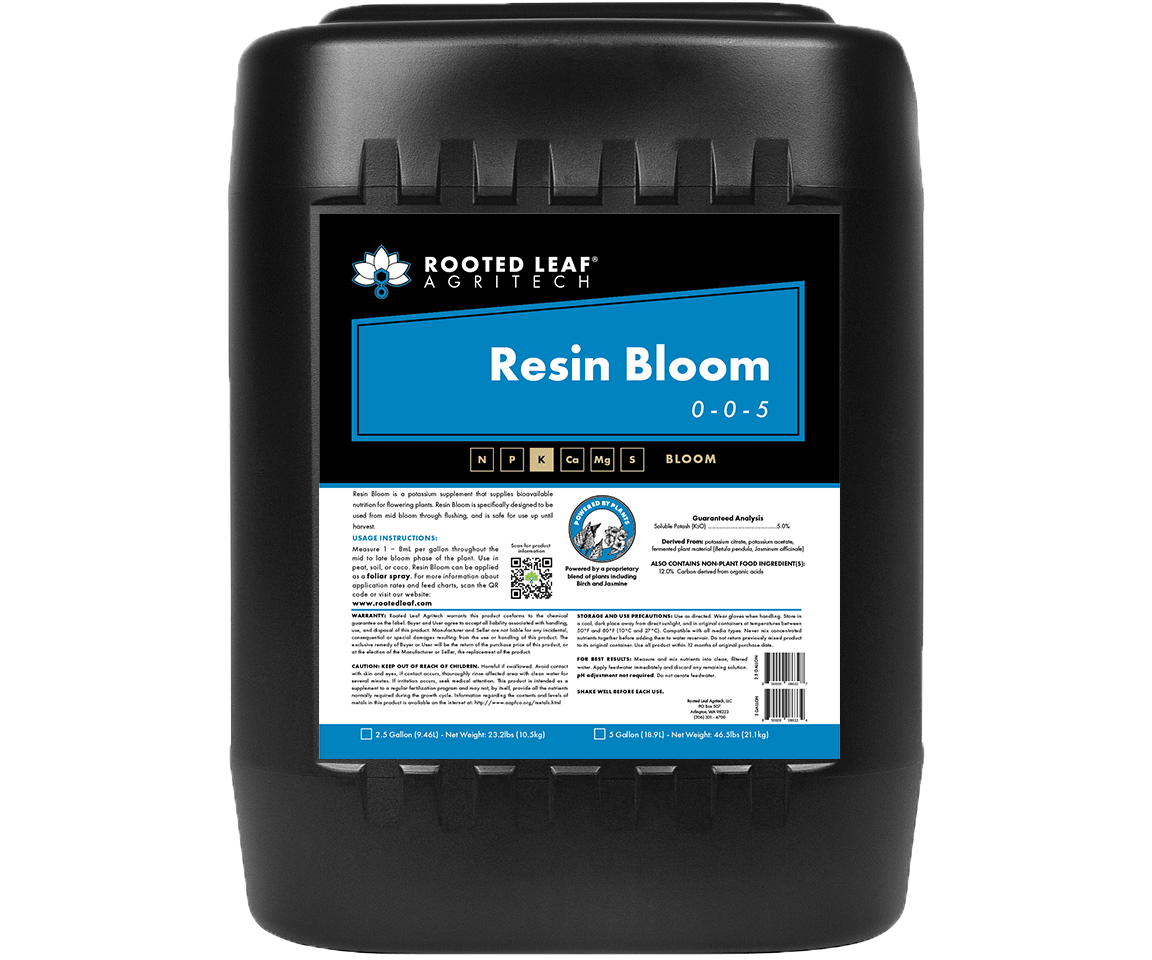
Guaranteed Analysis

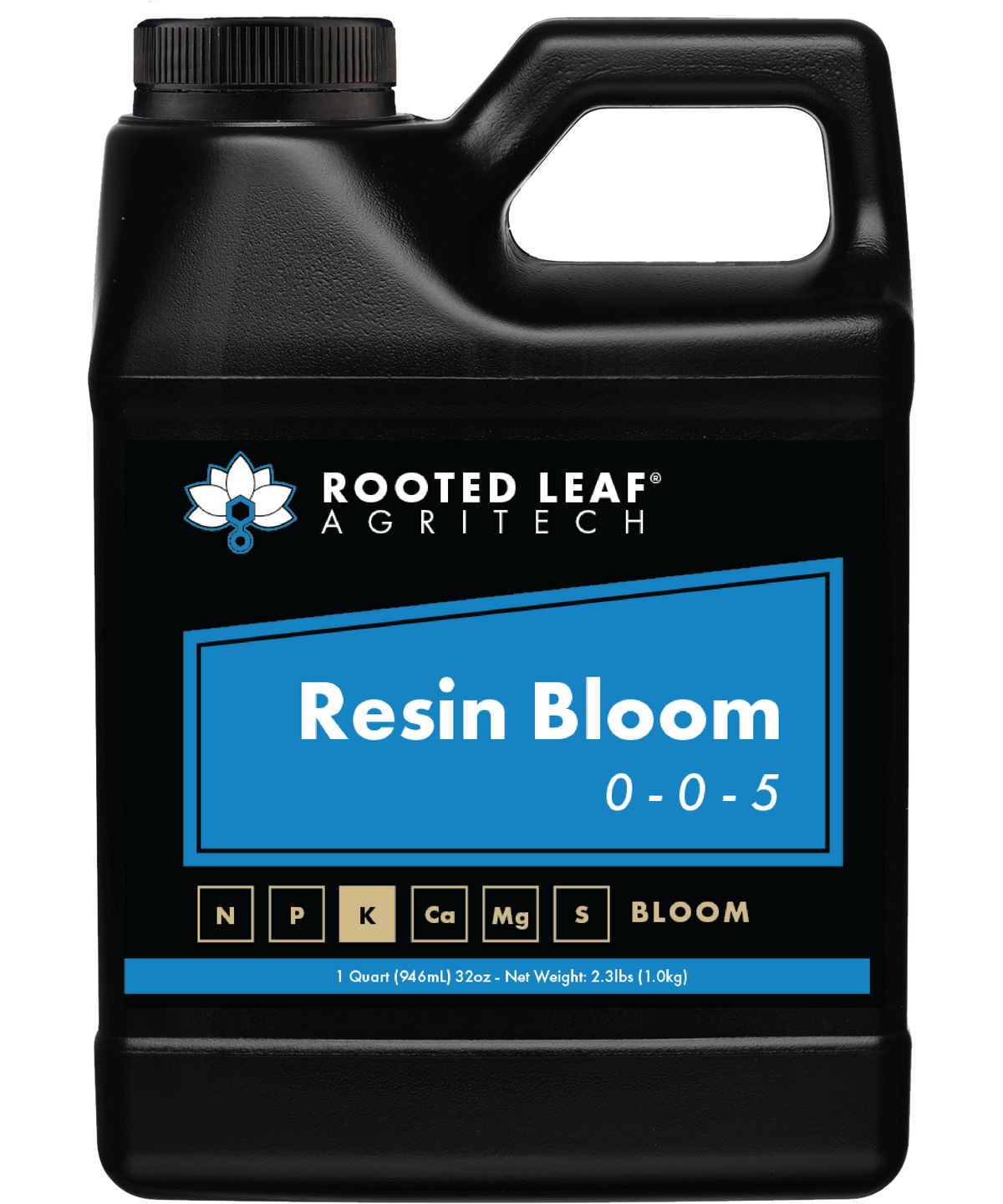
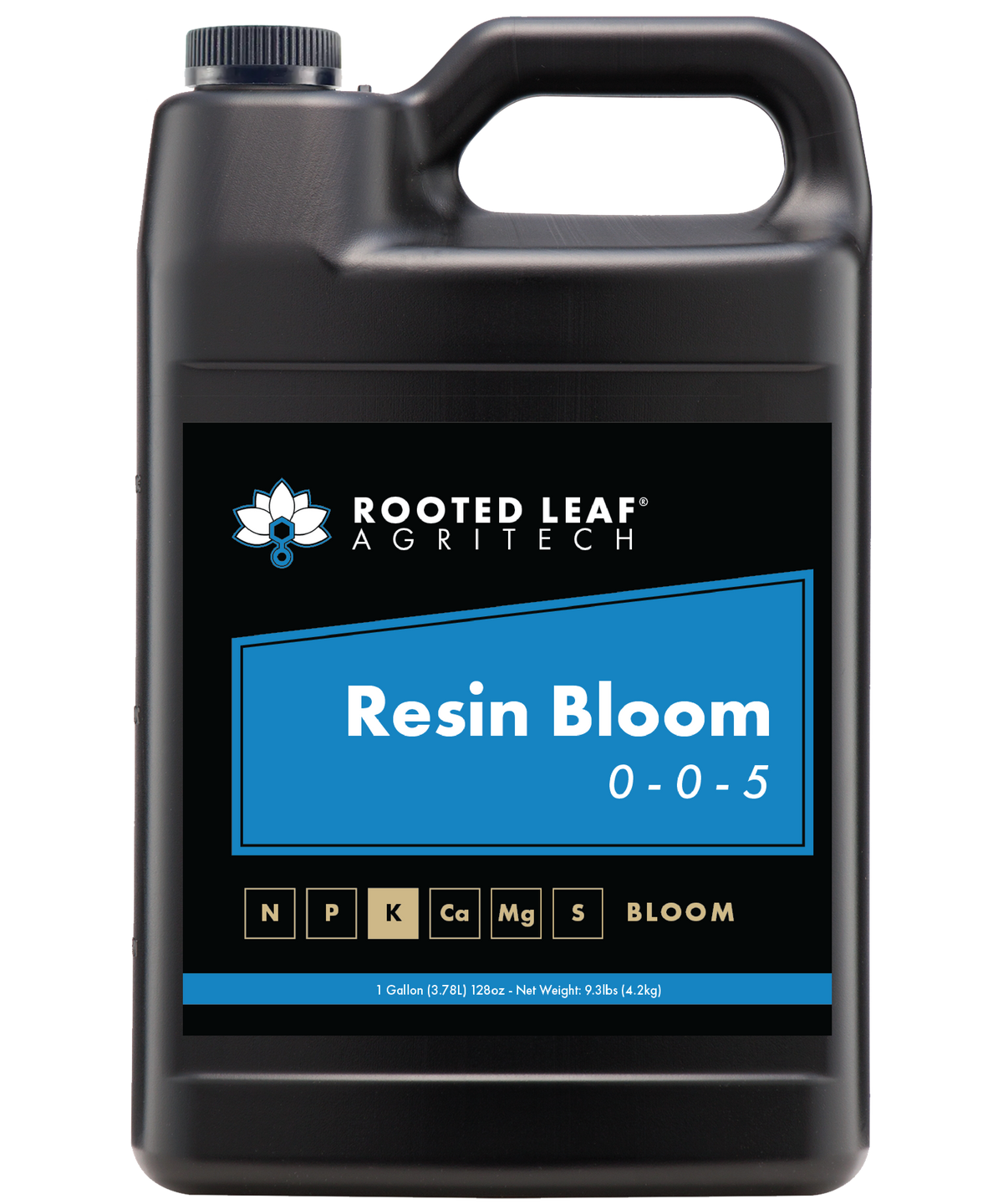
Resin Bloom: Potassium Finisher

Soluble Potash (K₂O) 5%

Derived From: fermented plant material (Betula pendula, Jasminum officinale), potassium fulvate, potassium citrate, potassium acetate

Also Contains Non-Plant Food Ingredient(s):

12% Carbon (from organic acids)

Application Rate

Soil / Coco: 1 to 8 mL/gal

Foliar: 10 to 20 mL/gal

Product Details

Solubility: 100% Water Soluble

pH: No Adjustment Needed

Shelf Life: 12 Months

pH adjustment not required. Compatible with all media types.

How to use it

Use rates and storage

Measure 1 to 8 mL per gallon throughout mid to late bloom, in peat, soil, or coco. For a foliar spray, use 10 to 20 mL per gallon. Mix well, no pH adjustment or aeration needed, then apply immediately and discard any leftover solution.

Application RateNotes
Soil, peat, or coco 1 to 8 mL/gal Per gallon of feedwater
Foliar spray 10 to 20 mL/gal Per gallon of spray; 2 to 3x per week until the start of week 3 of bloom, then apply immediately

pH: No adjustment needed

Feed chart builder

These are starting points. Your water, medium, and growth stage change the math. Get exact numbers for your grow, free, in about two minutes.

You know the how. Here's the why.

Powered By Plants

Two plants, one potassium complex.

Resin Bloom begins as fermented plant material: birch and jasmine, worked in-house into a potassium complex carried on organic acids. The fermented whole plants deliver potassium without a salt load.

Powered By Plants

Powered by Plants seal: fermented from birch and jasmine

Fermented whole plants supply the organic-acid carbon matrix.

Inside the bottle

Special Attributes

Explore potassium acetate and potassium citrate, two potassium forms named on Resin Bloom's label, alongside its birch and jasmine identity.

Potassium acetate

The simplest of the organic-acid forms Resin Bloom's potassium is carried in: one potassium ion paired with acetate, a two-carbon organic acid. In water the pair separates and the plant takes up the potassium ion. Potassium is the nutrient Resin Bloom is built to deliver through a plant's final weeks: it helps hold the membrane voltage that drives sugar loading in the phloem, and it maintains the osmotic balance and turgor behind ripening.

From the label: potassium acetate
Molecular structure

Drag to rotate. Scroll or use +/- to zoom.

C₂H₃KO₂

Potassium acetate supplies potassium for water balance and sugar transport during a plant's final weeks.

Betula pendula

Birch

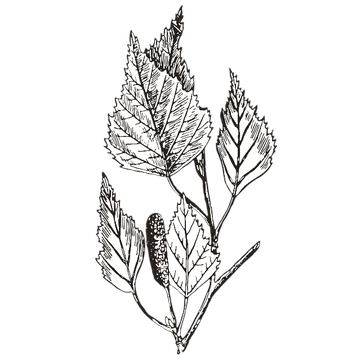
An iconic member of the birch family, silver birch (Betula pendula) is one of the oldest plants people have used. Its bark and leaves carry rare compounds, and its wood is the classic source of xylitol, a mildly sweet sugar alcohol with unusual properties.

Signature molecule: Xylitol

Jasminum officinale

Jasmine

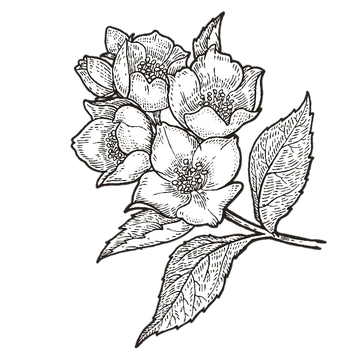
The fragrance of jasmine led scientists to a whole group of compounds fundamental to plant life, the jasmonates, first isolated from the oil of Jasminum grandiflorum, a close relative of true jasmine (Jasminum officinale). Native to Central Asia, true jasmine's night-blooming flowers have long been used in perfume, traditional medicine, and scenting tea.

Signature molecule: Jasmonic acid

The nutritional science

Resin Bloom keeps potassium moving sugar to the flowers through the final weeks.

Illustration of glandular trichomes on a leaf, with small translucent heads.

01 Problem

Final flower quality depends on a supply of sugars the flower does not control alone.

A reproductive sink can only build with what source tissues keep delivering. Sugars must leave mature leaves, enter the phloem, move under pressure, unload into floral tissue and be converted again into lipids, organic acids, pigments and aroma precursors. Late in the cycle it is tempting to treat quality as one more ingredient, but the real limit is how well sugars keep moving.

If source activity, stomatal control, osmotic pressure, charge balance or sink unloading falls behind, the chemistry of the finish is limited by supply no matter what else is added.

The next panel shows what happens inside the plant.

GLANDULAR TRICHOME (CROSS-SECTION) Stalk cell Secretory disc cellsStorage cavity: the resin head K⁺ moves the sugar and water supply underneath

A glandular trichome in cross-section: secretory disc cells build the plant's aromatic compounds under a swelling cuticle, while potassium runs the supply beneath. Schematic.

02 Mechanism

Potassium controls the sugar flow behind quality.

Potassium stays mobile and osmotically active. Guard cells accumulate and release it as stomata open and close. In source and vascular tissues it balances charge, regulates membrane potential and establishes the osmotic conditions behind phloem loading and unloading. Potassium does not become resin, aroma, sugar or color; it keeps the transport system supplying the cells that make them.

Glandular trichomes and floral tissues depend on continuous carbon skeletons, reducing power, membrane turnover, precursors and export capacity. Quality shows when that flow is maintained, which is why it matters that stomatal control, transpiration and cooling all depend on the same element.

So Rooted Leaf built the formula to work with the plant.

5% K₂O

soluble potash

12% Carbon

carbon, from organic acids

Illustration of glandular trichomes on a leaf, with fuller rounded heads and surrounding surface detail.

03 Solution

Resin Bloom supports the movement that allows reproductive tissues to finish.

Resin Bloom uses potassium inside a carbon- and organic-acid-rich finishing formula made with fermented birch leaf and jasmine flower. It is designed around the whole source-to-sink sequence: regulate the source, sustain transport, support unloading, and keep carbon and precursors arriving where flowers and trichomes can use them.

The botanicals bring plant chemistry related to defense, fragrance, phenolics and quality. The formula's job is to keep sugars and nutrients moving through the weeks when the plant uses them fastest.

The label below shows what is in it.

Evidence Wang and Wu (2017) and Tian et al. (2017)

Powered by Plants seal: fermented from birch and jasmine

Powered By Plants

Did you know?

Two stories about the plants Resin Bloom is fermented from.

BirchBetula pendula

Stone Age Gum Spills Its Secrets

About 5,700 years ago, someone at Syltholm, on the Danish island of Lolland, chewed a lump of birch pitch, an adhesive made by heating birch bark, and left it behind. Archaeologists found it in 2015. Researchers at the University of Copenhagen then sequenced a complete human genome from the DNA preserved inside it, the first, by their account, recovered from anything other than human bone. The DNA showed a female with likely dark skin, dark brown hair and blue eyes, along with traces of mouth bacteria, hazelnut and mallard duck.

JasmineJasminum officinale

Perfume With a Secret Message

In 1962, the chemists E. Demole, E. Lederer and D. Mercier published the structure of methyl jasmonate, a compound they had isolated from the oil of Jasminum grandiflorum, a close relative of true jasmine. It makes up less than 0.8 percent of jasmine absolute. In 1990, researchers at Washington State University found that methyl jasmonate released into the air of closed chambers caused tomato plants, and plants of two other species, to make defensive proteins that inhibit animals' digestive enzymes.

Purity

Potassium, with the salt left out.

Most potassium sources arrive as a mineral salt, and the counter-ion goes into the medium with it. Resin Bloom is built differently.

0 of 5

salt classes. Free of nitrate, phosphate, sulfate, carbonate, and chloride.

  • Free of five salt classes.

    100% free of nitrate, phosphate, sulfate, carbonate, and chloride salts. The potassium is carried on plant-derived organic acids, fulvate, citrate, and acetate, not on a mineral salt.

  • A low salt index.

    Organic-acid-complexed potassium carries a lower osmotic salt load than muriate or sulfate of potash. It is designed to be fed late without adding to the salt already in the medium.

  • 100% nitrate free.

    No nitrate means no late-season nitrogen pushing a plant back toward vegetative growth when you want it finishing. It is built as a finisher and nothing else.

  • Runs right up to harvest.

    Low salt index and no salt classes to leave behind, so it is designed to be used through the flush period and up to harvest without adding to the residual load.

How the potassium is carried.

Muriate and sulfate of potash deliver potassium as a mineral salt, and the counter-ion goes into the medium with it. Resin Bloom carries its potassium on organic acids instead.

5 salt classes

Muriate and sulfate of potash deliver K as a mineral salt: chloride or sulfate comes with it, adding to the medium's salt load.

0 salt classes

Resin Bloom delivers K on organic acids, fulvate, citrate, acetate, with a low salt index and none of the five.

Comparison is of ingredient class from each product's label, not of crop results.

Quick Answers

When do I run it?

Throughout mid to late bloom, through flushing and up to harvest. Soil or coco: 1 to 8 mL per gallon of feedwater. Foliar: 10 to 20 mL per gallon, 2 to 3 times a week until the start of week 3 of bloom.

What does Resin Bloom support in the final weeks?

We focus on the nutrition behind the finish. Resin Bloom’s potassium supports sugar transport, water balance and ripening during mid to late bloom. The plant develops its aroma and resin in its own glandular trichomes as flowers mature.

Can I mix it with my other nutrients?

Yes, it is compatible with all media types and needs no pH adjustment. As with any concentrate, never mix concentrated nutrients directly together, add each to the reservoir separately. Its low salt index makes it easy on a loaded tank.

Can I use it during flush or right before harvest?

Yes. It is 100% nitrate free and carries a low salt index with none of the five salt classes, so it is designed to run through the flush period and up to harvest without adding to the residual salt load.

What's your return policy?

Unopened products can be returned within 15 days of delivery for a refund of the item price; original shipping isn't refunded. Email info@rootedleaf.com first for a return authorization. Opened products can't be returned. If your order arrives damaged, email us pictures and we'll send a replacement within 1-2 business days of confirming it.

Ask GNOME instead

Instant, product-specific answers from our grow assistant. Tap the Ask GNOME button below to start.

The Rooted Leaf lineup

Complete Your Program

Peak Bloom
Peak Bloom

The phosphorus and potassium bloom feed that comes before Resin Bloom.

From $14.97
CalMag Fuel
CalMag Fuel

Calcium and magnesium for flowers, with no added nitrogen late in bloom.

From $14.97
Primer A
Primer A

Part A of the base feed every program builds on: potassium and magnesium.

From $9.97
Primer B
Primer B

Part B of the base feed every program builds on: nitrogen, phosphorus and calcium.

From $9.97

Policies and reference

Disclaimers

Guidance from GNOME and this page is educational and general. Plant results vary with crop, environment, water, and program, and nothing here is a guarantee of specific results.

100% made by us, from whole plant to final bottle. We manufacture all of our own chelates and complexes from scratch, and quality-check every batch. If an order arrives damaged or is not right, contact us and we will make it right.

Shipping policy · Refund and returns · Terms of service · Safety data sheet · Heavy metals test results

Full guaranteed analysis

Guaranteed Analysis Soluble Potash (K₂O) 5%

Derived From: fermented plant material (Betula pendula, Jasminum officinale), potassium fulvate, potassium citrate, potassium acetate

Also contains non-plant food ingredient(s) 12% Carbon (from organic acids)

1 Gallon (3.78L) 128oz. Net weight 9.3 lbs (4.2kg).

This product is intended as a supplement to a regular fertilization program and may not, by itself, provide all the nutrients normally required during the growth cycle.

Technical Data

Storage and use Store in a cool, dark place away from direct sunlight, in the original container, between 50°F and 80°F (10°C and 27°C). Compatible with all media types.

Mixing Never mix concentrated nutrients together before adding them to the reservoir. pH adjustment is not required. Do not aerate feedwater. Gently swirl before each use. Apply immediately and discard any remaining solution.

Use all product within 12 months of the original purchase date.

pH range
No adjustment needed
Solubility
100% water-soluble liquid solution
Shelf life (months)
12
Shipping & Storage

Processing Orders ship within 1-2 business days and typically arrive within 5 days in the US. We ship to the US, Canada and the other countries listed at checkout.

Methods Standard, 2-Day and Overnight shipping, with the rate for your address shown at checkout. International orders ship with duties and import taxes paid at checkout.

Storage Store in a cool, dry place away from direct sunlight. Shelf life: 12 months.

Note With Standard, 2-Day or Overnight shipping, the 5 gal size ships as two 2.5 gal jugs. With Freight, offered at checkout on larger orders, it ships as one 5 gal jug.

Resin Bloom

Grower reviews

Grown with Resin Bloom? Tell other growers how it went.

No reviews yet

Be the first grower to say how Resin Bloom worked for you. We'll email you a review link for your order.