


Potassium acetate
Root Anchor supplies potassium with acetate, an organic acid form. Plants use potassium to regulate water balance and transport sugars.
From the label: potassium acetate
Featured




Humic Soil Conditioner · Powered by Plants
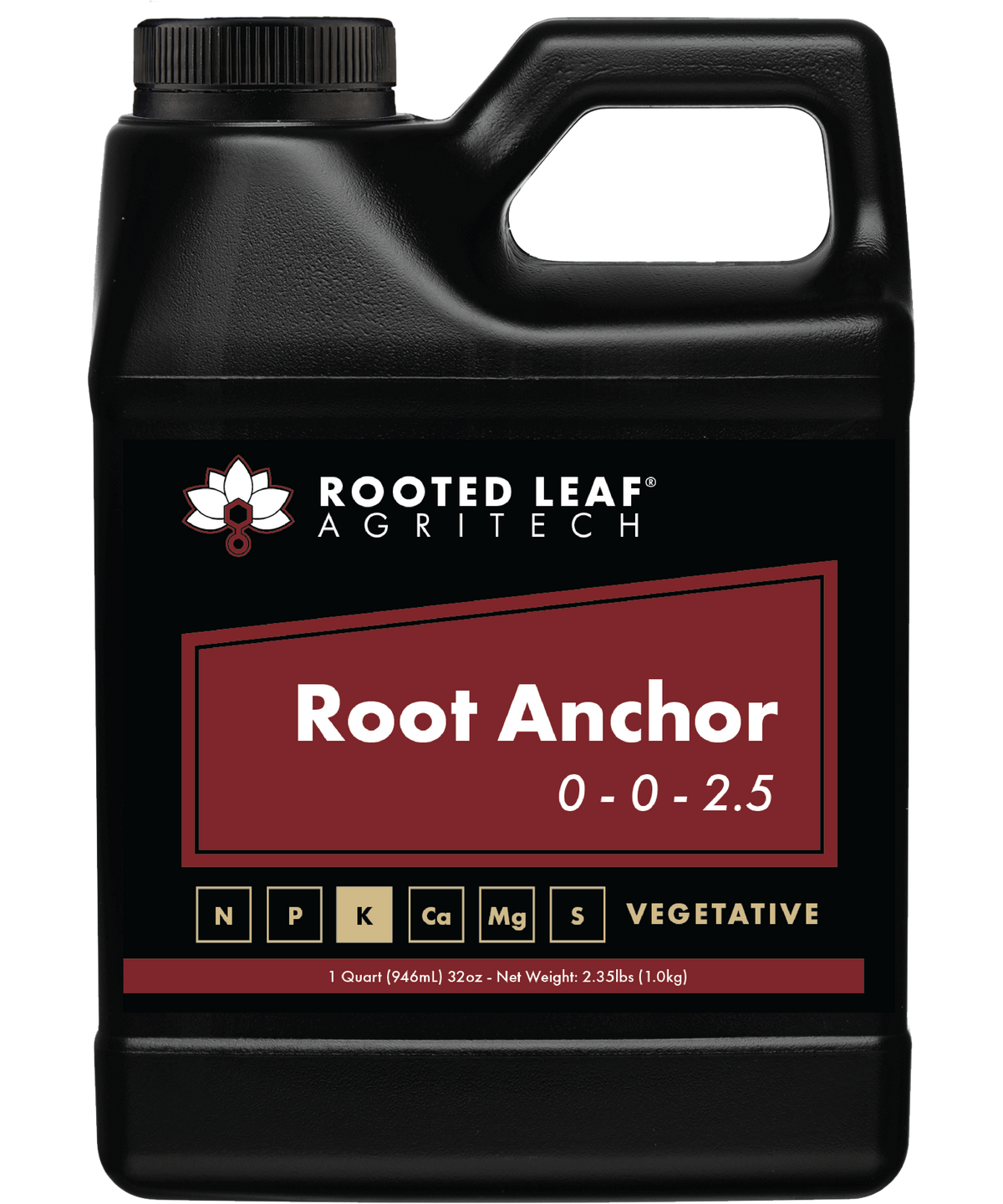
Root Anchor is a humic acid soil conditioner: a full-spectrum humic extract carried in a functional carbon matrix of fermented licorice root and cacao. It is designed to condition the medium itself, so the nutrition already there reaches the plant.
As a crop grows it draws nutrients from the medium faster than the medium can replace them, and feeding those nutrients straight back can impair its ability to hold and release them. That leads to salt buildup and lock-out. Root Anchor is built to keep the medium working: to improve root architecture and free up the nutrition a grower has already paid for.
Every gallon carries the equivalent of more than ten pounds of raw humic acid, one of the most concentrated liquid humics you can buy. We make the extract ourselves from unoxidized North American humic, fermented in-house with organic licorice root and high-grade cacao.
 Carbon
17%
 Soluble Potash
2.5%
 Humic Acids
4.0%
Ships within 1-2 business days
Instant answers from GNOME, our grow assistant. Or email info@rootedleaf.com
Root Anchor
Carbon, from organic acids
CO₂ equivalent, per mL
Concentrate weight
Root Anchor: Humic Acid Soil Conditioner
Derived From: fermented plant material (Glycyrrhiza glabra, Theobroma cacao), potassium fulvate, potassium citrate, potassium acetate
Also Contains Non-Plant Food Ingredient(s):
4.0% Humic Acids from carbonaceous shale
17% Carbon (from organic acids)
Application Rate
Soil / Coco: 1 to 4 mL/gal
Foliar: 1 to 2.5 mL/gal
Product Details
Solubility: 100% Water Soluble
pH: No Adjustment Needed
Shelf Life: 12 Months
pH adjustment not required. Compatible with all media types.
How to use it
Measure 1 to 4 mL per gallon throughout vegetative and early bloom, in peat, soil, or coco. For a foliar spray, use 1 to 2.5 mL per gallon. Mix well, no pH adjustment or aeration needed, then apply immediately and discard any leftover solution.
| Application | Rate | Notes |
|---|---|---|
| Soil, peat, or coco | 1 to 4 mL/gal | Per gallon of feedwater |
| Foliar spray | 1 to 2.5 mL/gal | Per gallon of spray; apply immediately |
pH: No adjustment needed
Feed chart builder
These are starting points. Your water, medium, and growth stage change the math. Get exact numbers for your grow, free, in about two minutes.

Powered By Plants
Root Anchor begins as fermented plant material: licorice root and cacao, worked in-house into a full-spectrum humic extract. The fermented whole plants are carried on unoxidized North American humic.
Powered By Plants

Fermented whole plants. That is the active ingredient.
Inside the bottle
Explore potassium acetate and potassium citrate, two potassium forms named on Root Anchor's label. Cacao and licorice are its two source plants.
Root Anchor supplies potassium with acetate, an organic acid form. Plants use potassium to regulate water balance and transport sugars.
From the label: potassium acetate
Root Anchor supplies potassium with citrate, an organic acid form. Potassium contributes to water balance, enzyme activity and sugar transport in plants.
From the label: potassium citrate
Drag to rotate. Scroll or use +/- to zoom.

Glycyrrhiza glabra
Licorice
Licorice is a perennial legume with deeply developed roots. Those roots are one of the two source plants Root Anchor is fermented from.

Theobroma cacao
Cacao
A member of the mallow family, revered for over four thousand years in Mesoamerica. The fermented and ground bean, rare Ecuadorian Arriba Nacional here, carries the alkaloids and fatty acids once prized as a food of the gods.
Root Anchor builds a root zone that holds nutrients where roots can reach them.

01 Problem
Soil biology is often discussed as a head count: more bacteria, more fungi, more life. But organisms do not live in a uniform bucket of soil solution. They occupy mineral faces, organic coatings, pores, root surfaces and water films that can disappear across a few micrometers. The real limit is contact with roots and surfaces, not population.
Roots need water and nutrients to reach their surfaces. Bacteria need protected microsites and accessible carbon. Fungal hyphae need pores they can cross and particles they can bind. If those interfaces are poorly wetted, structurally disconnected or chemically monotonous, adding organisms does not create the habitat they need, and a root zone stocked with organisms still underperforms.
The next panel shows what happens inside the plant.
One interface in close-up: humic carboxyl and hydroxyl surfaces holding a reservoir of cations, and the root's proton pump driving the exchange that releases them. Schematic.
02 Mechanism
Humic assemblies interact with minerals, organic compounds, roots and microbial cells. Amphiphilic saponin chemistry can influence wetting and contact at complex surfaces, and structurally diverse carbon changes the range of substrates and coatings around soil particles. Together they shape aggregation, adsorption, water-film continuity and the microsites where microbial communities form.
Bacteria cluster and form biofilms where soluble carbon and root exudates concentrate. Fungi extend hyphae through a different geometry, bridging pores and connecting microsites beyond the root hair. A well-conditioned interface can support both strategies without reducing soil health to a competition between them.
So Rooted Leaf built the formula to work with the plant.
carbon, from organic acids
humic acids

03 Solution
Root Anchor combines humic carbon with fermented licorice root and raw cacao, and is designed around habitat chemistry: wetting, adsorption, aggregation, carbon diversity and root contact. It does not ask the grower to choose between bacteria and fungi, because it builds a more useful interface for both.
Licorice contributes saponin-rich plant chemistry; cacao contributes lipid-associated and chemically diverse carbon. As roots branch, bacteria colonize protected surfaces, and fungal threads cross the pore network, more of the soil becomes reachable by roots and microbes.
The label below shows what is in it.
Evidence Olivares et al. (2017) and Chen et al. (2024)
Powered By Plants
Two stories about the plants Root Anchor is fermented from.
CacaoTheobroma cacao
In parts of Mesoamerica, cacao beans were counted out as money. Classic Maya artwork shows rulers receiving far more cacao as tribute than a palace could make into chocolate. In 1502, when Columbus's crew went through a trading canoe off Honduras, its paddlers scrambled to pick up spilled cacao beans. A 1545 price list from Tlaxcala, in central Mexico, valued a good turkey hen at 100 beans and a fully ripe avocado at one. The beans used as money were fermented and dried first.
LicoriceGlycyrrhiza glabra
In 1907, the United States granted Alexandre Laurent of St. Petersburg a patent for a hand fire extinguisher that sprayed foam instead of liquid. Inside it, a soda solution and a dilute acid reacted to release carbon dioxide, and extract of licorice root made the mixture foam. For burning liquids such as petroleum, the patent called for just 0.05 percent licorice extract. The foam comes from glycyrrhizin, the same compound that makes licorice root taste sweet.
What is not in it
The most widely used potassium fertilizer is potassium chloride, sold as muriate of potash. Root Anchor's potassium comes from potassium fulvate, potassium citrate and potassium acetate, so the potassium goes in and no chloride salt goes in with it.
0%
Chloride salts. Root Anchor's potassium is fulvate, citrate and acetate.
Potassium chloride adds chloride in the same dose as its potassium. None of Root Anchor's potassium comes from a chloride salt.
The label's mixing directions say pH adjustment is not required. Add it to the reservoir at label rates and apply it right away.
The guaranteed analysis counts 17% carbon from organic acids, the same class of compound as the citrate and acetate that hold its potassium.
We combine 4.0% humic acids with fermented licorice root and cacao in one soil conditioner.
Potassium chloride, called muriate of potash, is the usual source of supplemental potassium, and every dose of it adds chloride along with the potassium. Root Anchor takes its potassium from fulvate, citrate and acetate instead, which is why no chloride salt appears on its label.
Potassium chloride
Delivers potassium as a chloride salt: chloride comes with it.
Organic-acid potassium
Potassium as fulvate, citrate and acetate: no chloride salt.
Comparison is of ingredient class from each product's label, not of crop results.
Through vegetative growth and early bloom, at the same dose throughout: 1 to 4 mL per gallon into the medium, or 1 to 2.5 mL per gallon as a foliar spray.
Because it is a concentrate, not a diluted humate. We make a full-spectrum extract in-house from unoxidized North American humic, then ferment it with licorice root and cacao. Measured against raw humic acid, every gallon carries the equivalent of more than ten pounds, which is why a soil dose is only 1 to 4 mL per gallon.
Unopened products can be returned within 15 days of delivery for a refund of the item price; original shipping isn't refunded. Email info@rootedleaf.com first for a return authorization. Opened products can't be returned. If your order arrives damaged, email us pictures and we'll send a replacement within 1-2 business days of confirming it.
That's what GNOME is for: it knows the whole Rooted Leaf line, plant science, plant nutrition science, and feed programs for 150+ crops. Tap the Ask GNOME button below and ask away. Prefer a person? Email info@rootedleaf.com or call (206) 331-4700.

The Rooted Leaf lineup


Part B of the base feed every program builds on: nitrogen, phosphorus and calcium.
Policies and reference
Guidance from GNOME and this page is educational and general. Plant results vary with crop, environment, water, and program, and nothing here is a guarantee of specific results.
100% made by us, from whole plant to final bottle. We manufacture all of our own chelates and complexes from scratch, and quality-check every batch. If an order arrives damaged or is not right, contact us and we will make it right.
Shipping policy · Refund and returns · Terms of service · Safety data sheet · Heavy metals test results
Guaranteed Analysis Soluble Potash (K₂O) 2.5%
Derived From: fermented plant material (Glycyrrhiza glabra, Theobroma cacao), potassium fulvate, potassium citrate, potassium acetate
Also contains non-plant food ingredient(s) 4.0% Humic Acids from carbonaceous shale
17% Carbon (from organic acids)
1 Gallon (3.78L) 128oz. Net weight 9.5lbs (4.3kg).
This product is intended as a supplement to a regular fertilization program and may not, by itself, provide all the nutrients normally required during the growth cycle.
Storage and use Store in a cool, dark place away from direct sunlight, in the original container, between 50°F and 80°F (10°C and 27°C). Compatible with all media types.
Mixing Never mix concentrated nutrients together before adding them to the reservoir. pH adjustment is not required. Do not aerate feedwater. Gently swirl before each use. Apply immediately and discard any remaining solution.
Use all product within 12 months of the original purchase date.
Processing Orders ship within 1-2 business days and typically arrive within 5 days in the US. We ship to the US, Canada and the other countries listed at checkout.
Methods Standard, 2-Day and Overnight shipping, with the rate for your address shown at checkout. International orders ship with duties and import taxes paid at checkout.
Storage Store in a cool, dry place away from direct sunlight. Shelf life: 12 months.
Note With Standard, 2-Day or Overnight shipping, the 5 gal size ships as two 2.5 gal jugs. With Freight, offered at checkout on larger orders, it ships as one 5 gal jug.
Shipping, returns, and product questions: the fastest answer is GNOME. Tap the Ask GNOME button below.
Shipping
Orders ship within 1-2 business days and typically arrive within 5 in the US. Choose Standard, 2-Day or Overnight shipping at checkout. International orders ship with duties and import taxes paid at checkout.
With Standard, 2-Day or Overnight shipping, the 5 gal size ships as two 2.5 gal jugs. With Freight, offered at checkout on larger orders, it ships as one 5 gal jug.
Returns & Damaged Orders
Unopened products: return within 15 days of delivery for a refund of the item price; original shipping isn't refunded. Email us first for a return authorization. If your order arrives damaged, email pictures and we'll send a replacement within 1-2 business days of confirming it.
Talk to Us
Ask GNOME in the chat for instant answers, or reach the team at info@rootedleaf.com / (206) 331-4700.
Root Anchor
Grown with Root Anchor? Tell other growers how it went.
Be the first grower to say how Root Anchor worked for you. We'll email you a review link for your order.