


Potassium citrate
Potassium citrate supplies potassium with citrate, an organic acid plants make in their own cells. Plants use potassium to regulate water balance, activate enzymes and transport sugars.
From the label: potassium citrate
Featured


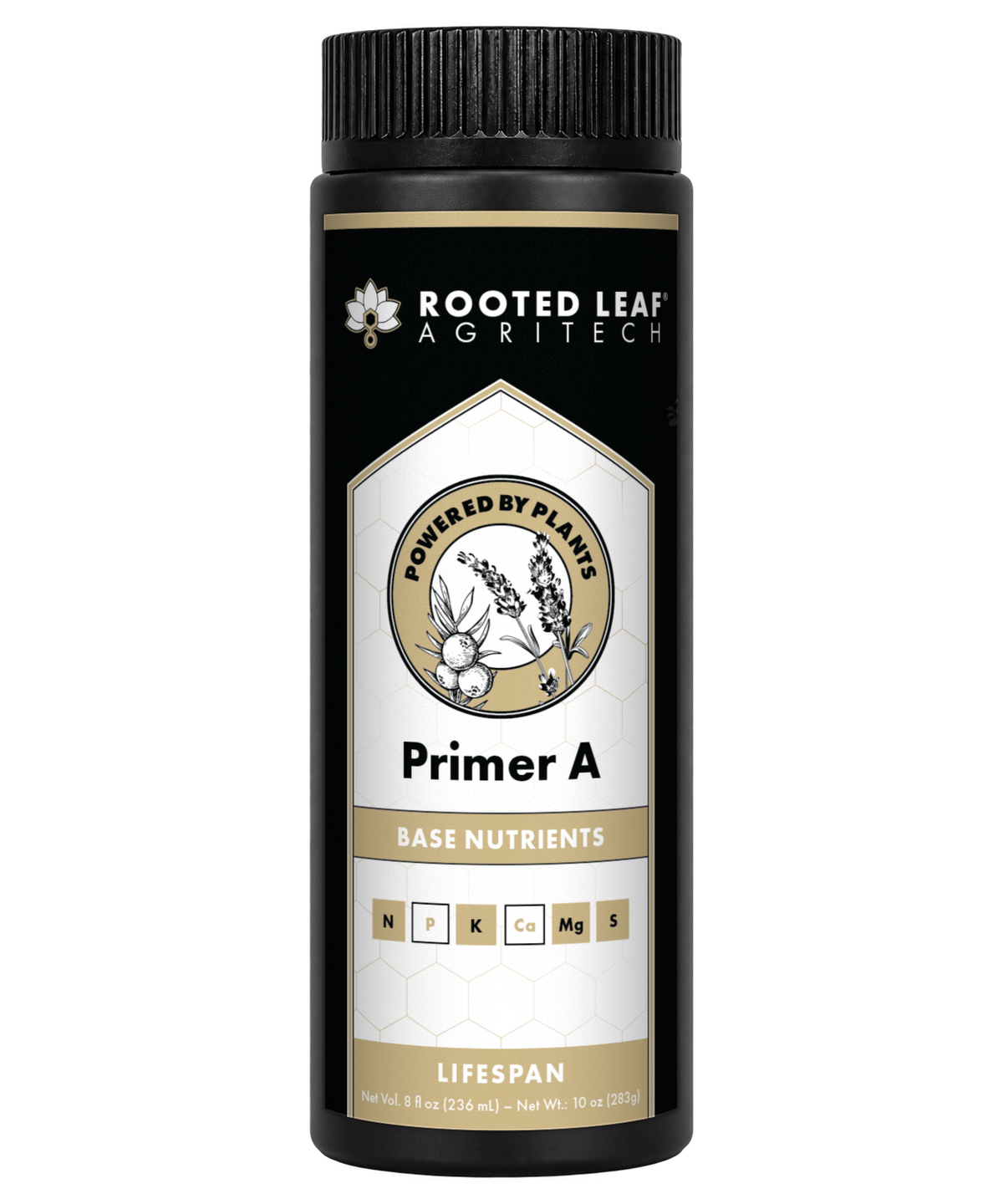
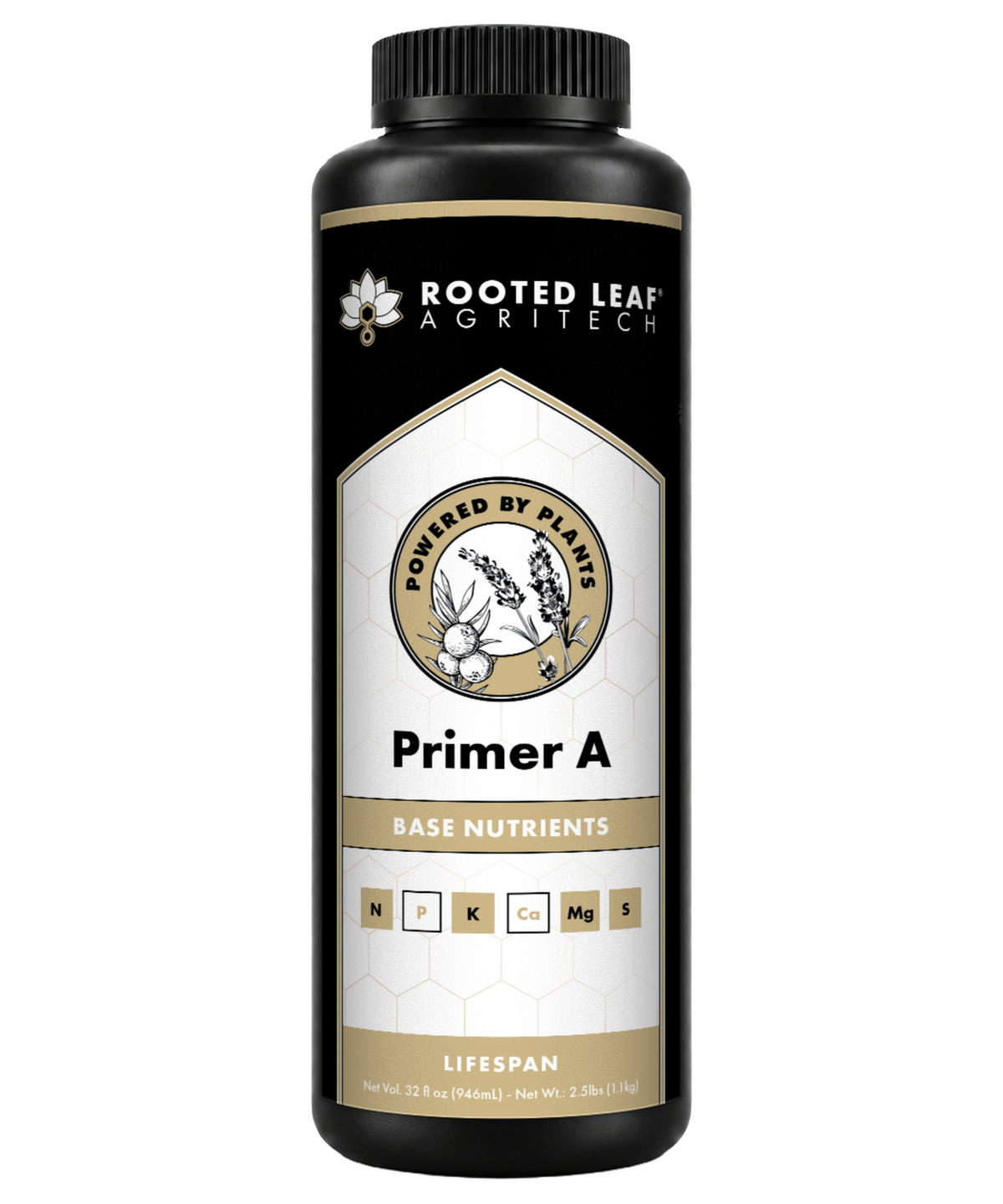
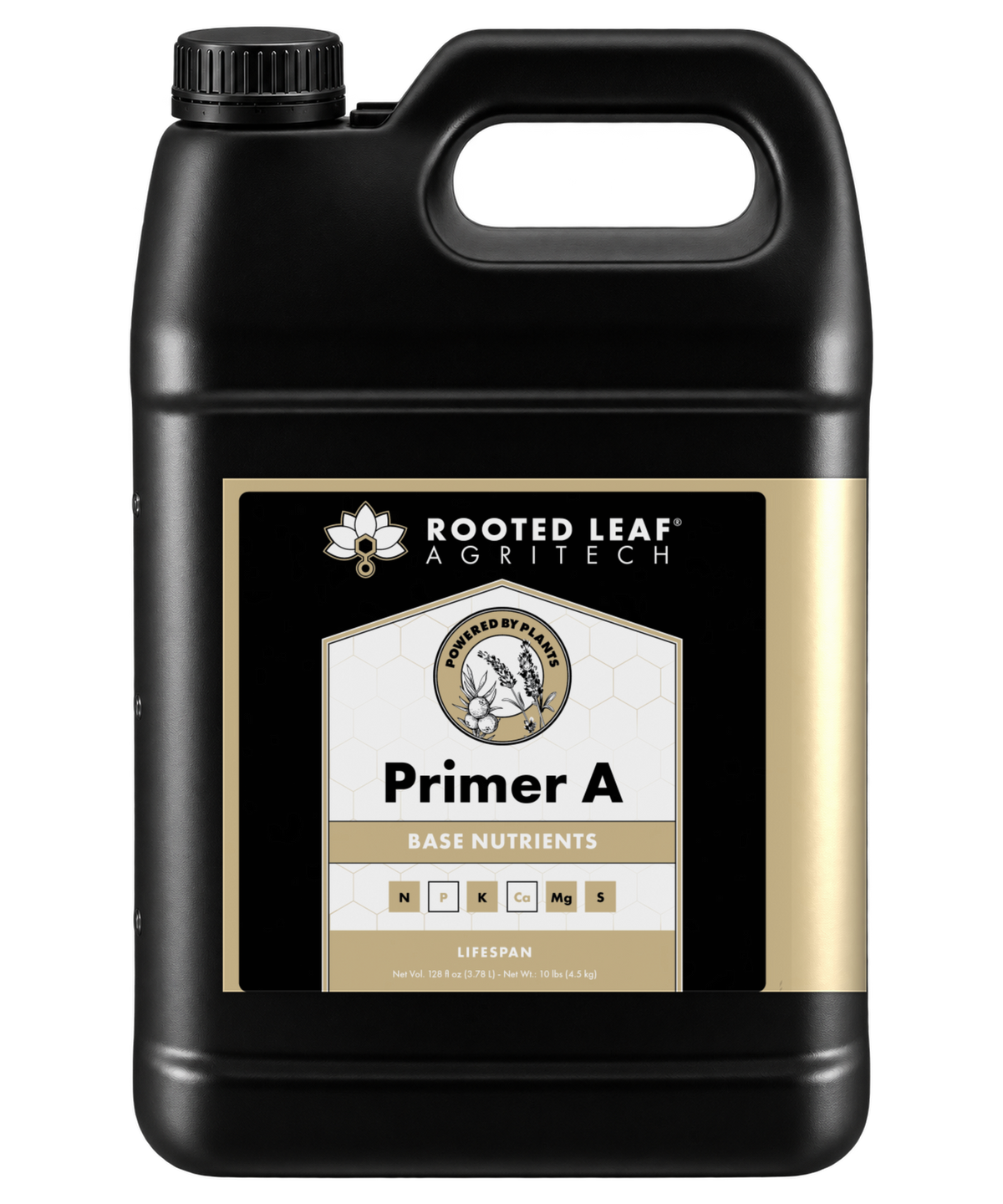
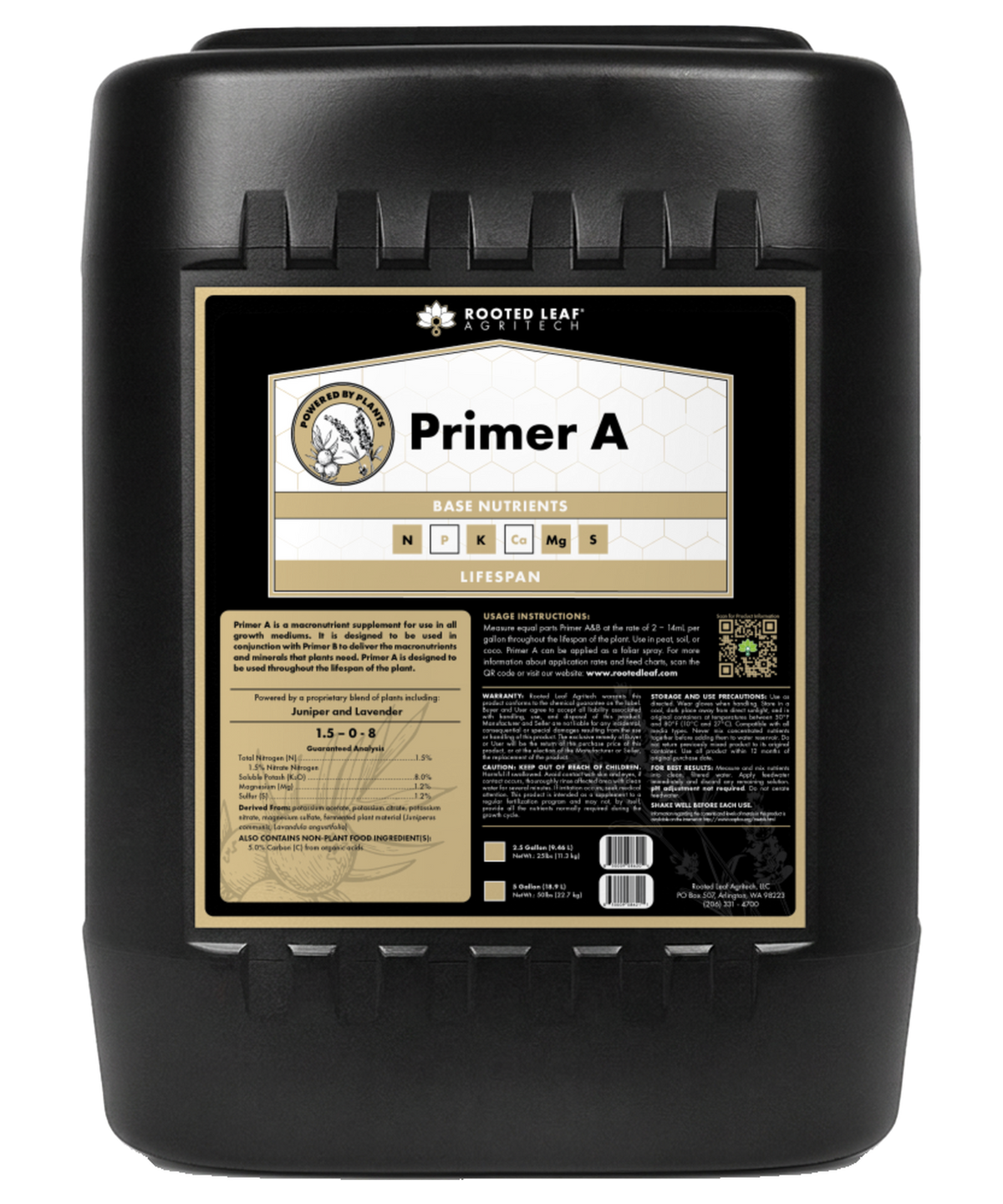

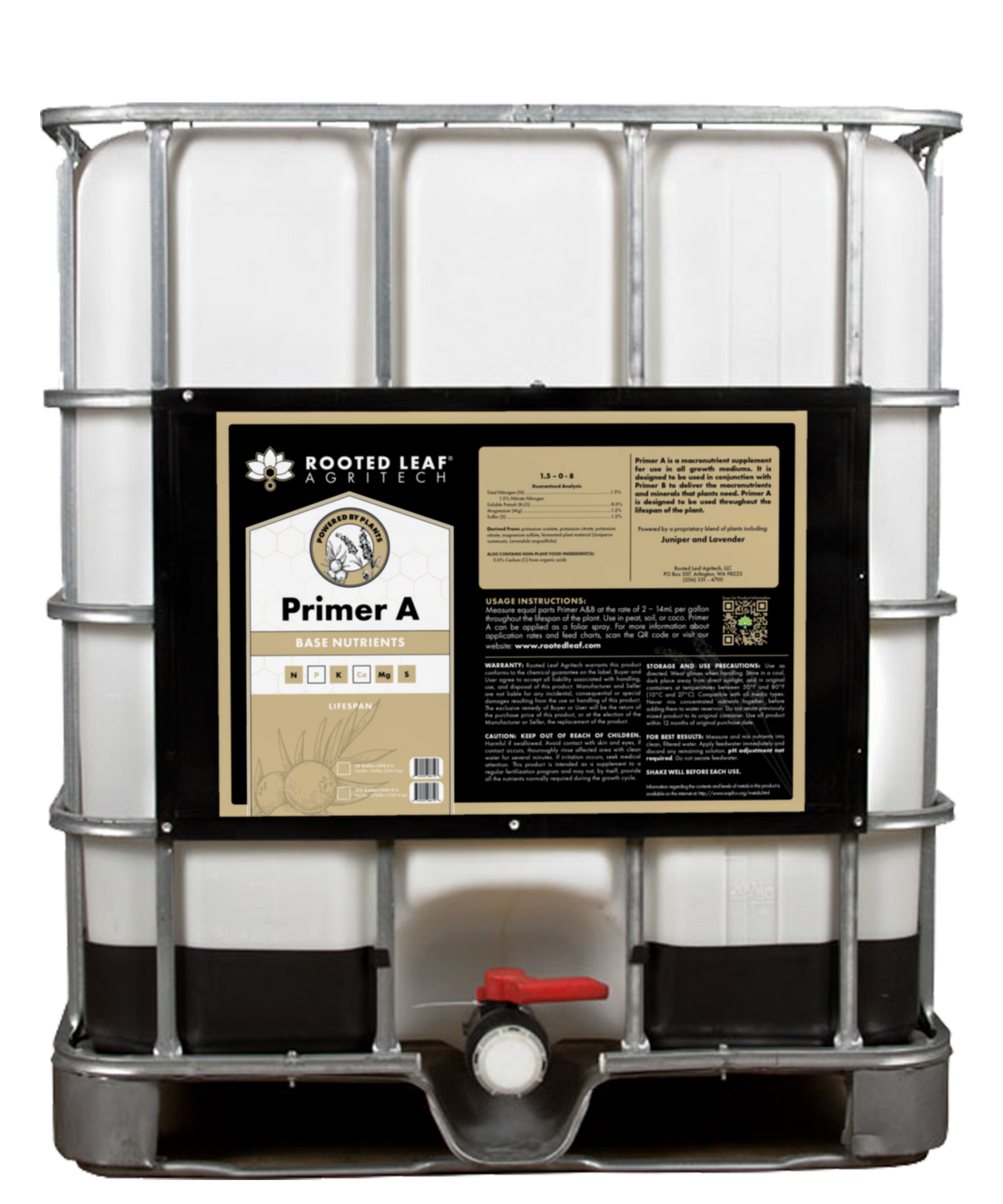
Two-Part Base Nutrient (Part A) · Powered by Plants
Primer A is the potassium-and-magnesium half of our two-part base nutrient system. Use it with Primer B from vegetative growth through bloom. We carry part of its potassium on an organic-acid carbon matrix, supporting sugar transport and cell turgor while keeping the nitrogen contribution low relative to potassium.
 Soluble Potash
8%
 Nitrogen
1.5%
 Carbon
5%
Your free Cryo Sil quart is in your cart. Use Add to cart, then check out from your cart, and the quart ships with your order.
Ships within 1-2 business days
Instant answers from GNOME, our grow assistant. Or email info@rootedleaf.com
Primer A
Carbon, from organic acids
CO₂ equivalent, per mL
Concentrate weight
Primer A: Two-Part Base Nutrient (Part A)
Derived From: fermented plant material (Juniperus communis, Lavandula angustifolia), potassium acetate, potassium citrate, potassium nitrate, magnesium sulfate
Also Contains Non-Plant Food Ingredient(s):
5% Carbon (from organic acids)
Application Rate
Soil / Coco: 2 to 14 mL/gal
Foliar: 1 to 2 mL/gal (each part)
Product Details
Solubility: 100% Water Soluble
pH: No Adjustment Needed
Shelf Life: 12 Months
pH adjustment not required. Compatible with all media types.
How to use it
Measure 2 to 14 mL per gallon of each part at the roots throughout the lifespan, using equal parts Primer A and Primer B. For a foliar spray, use 1 to 2 mL per gallon of each part, using equal parts Primer A and Primer B. Mix well, no pH adjustment or aeration needed, then apply immediately and discard any leftover solution.
| Application | Rate | Notes |
|---|---|---|
| Soil, peat, or coco | 2 to 14 mL/gal | Per gallon of feedwater |
| Foliar spray | 1 to 2 mL/gal (each part) | Per gallon of spray; apply immediately |
pH: No adjustment needed
Feed chart builder
These are starting points. Your water, medium, and growth stage change the math. Get exact numbers for your grow, free, in about two minutes.

Powered By Plants
We ferment juniper and lavender for the botanical matrix around Primer A’s mineral formula. Potassium citrate and potassium acetate bring organic-acid potassium forms into our two-part base system.
Powered By Plants

Fermented whole plants supply the organic-acid potassium and carbon matrix.
Inside the bottle
Explore potassium citrate and potassium acetate, two organic-acid potassium forms named on Primer A's label.
Potassium citrate supplies potassium with citrate, an organic acid plants make in their own cells. Plants use potassium to regulate water balance, activate enzymes and transport sugars.
From the label: potassium citrate
Potassium acetate supplies potassium with acetate, a small organic acid. Potassium supports water balance and sugar transport throughout plant growth.
From the label: potassium acetate
Drag to rotate. Scroll or use +/- to zoom.
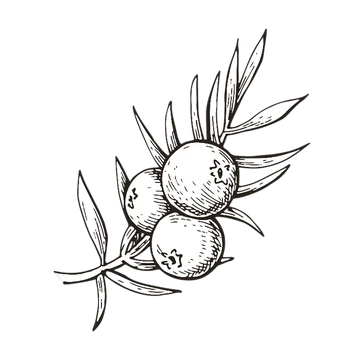
Juniperus communis
Juniper
Juniper (Juniperus communis) is a slow-growing conifer whose blue-black female cones, commonly called berries, take two to three years to ripen. As they mature, the berries contain monoterpenes, organic acids, and fermentable sugars.
Signature molecule: Organic acids
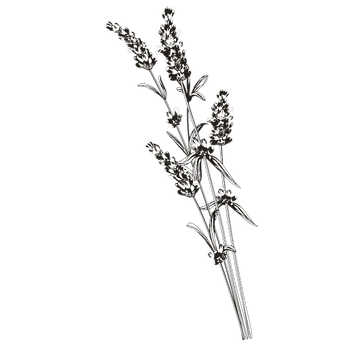
Lavandula angustifolia
Lavender
Lavender (Lavandula angustifolia) is a Mediterranean shrub built for full sun and lean, well-drained soil. Its narrow flower spikes are covered in glandular trichomes that produce a volatile terpene profile led by linalool, the plant's own chemistry behind its scent and part of its defense against heat and herbivory.
Signature molecule: Monoterpenes
Primer A carries the potassium and magnesium half of a two-part foundation.
01 Problem
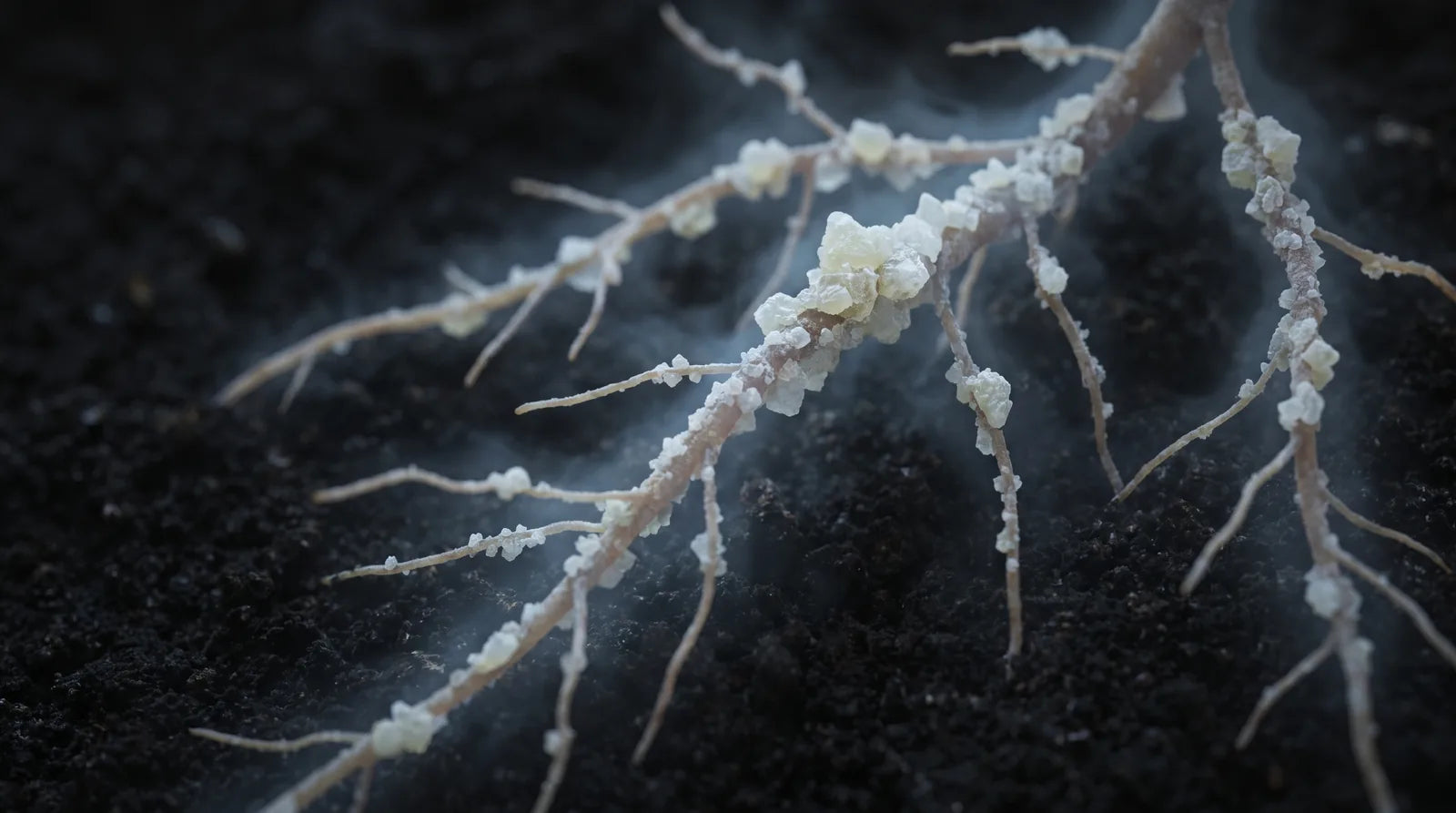
A label can confirm that every required element is in the bottle. It cannot guarantee they stay soluble at concentrate strength or reach the root as one balanced solution. Calcium, phosphate and sulfate are valuable because they are reactive, and that same reactivity makes them react with each other in a concentrated bottle. The problem is keeping them in solution together, not supplying them.
What the grower sees is the result: a complete feed that behaves inconsistently, mineral partners that leave solution too early, or nutrition treated as isolated percentages when the root actually meets hydrated ions, competing charges, ligands, activities and gradients all at once.
The next panel shows what happens inside the plant.
Potassium nitrate carries a nitrate counter-ion. Organic-acid potassium carries a carbon-based counter-ion, so that portion of the potassium supply adds no nitrate. Schematic.
02 Mechanism
For every charged nutrient, chemical activity and electrical potential act together, and the root responds to both. At full strength some partners must stay apart. After dilution, water increases the distance between them, ligand interactions change, and the complete nutrient solution forms in the water around the roots, where uptake happens. Keeping the parts apart protects the chemistry, and dilution brings them together.
Primer A is the potassium-rich half of that foundation. Potassium is used for charge balance, turgor, enzyme activation and the loading of sugar into the phloem, so a growing plant draws on it constantly. Magnesium sits at the center of every chlorophyll molecule and inside the MgATP complexes that supply energy for metabolism. Primer A delivers part of its potassium on organic-acid carriers, supplying potassium from first leaves to late flower without adding nitrate for that portion.
So Rooted Leaf built the formula to work with the plant.
Soluble potash
Functional carbon
Nitrogen
03 Solution
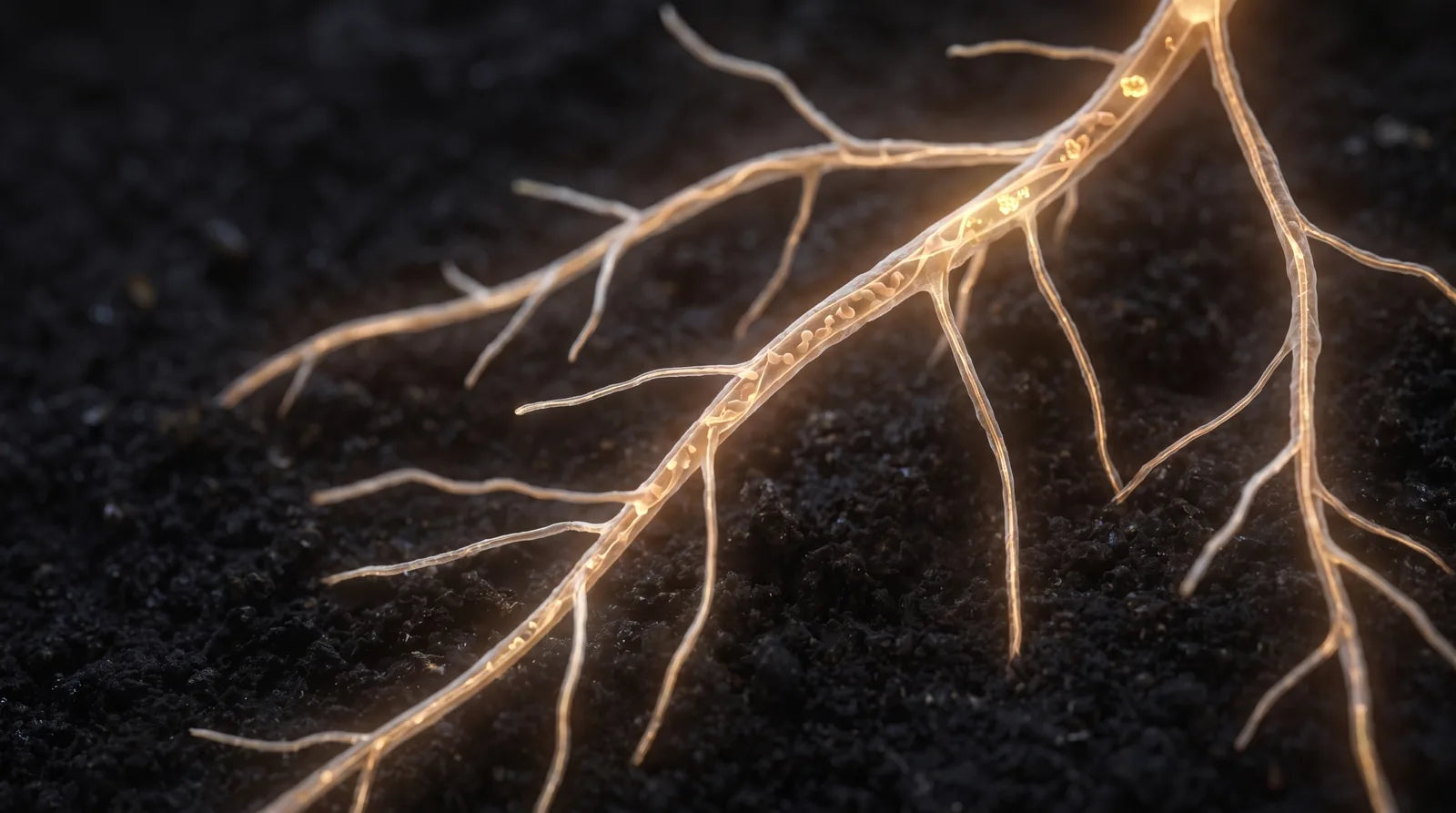
Primer A carries the potassium and magnesium side. Primer B carries the nitrogen, phosphorus and calcium side. They are kept apart while concentrated, then combine in irrigation water as the complete mineral and carbon baseline. Splitting the feed keeps it stable without making it harder to use.
Fermented juniper and lavender provide the supporting botanical matrix around the mineral formula. What arrives at the root is one solution, which the plant then uses for membranes, gradients, cell walls, chlorophyll, ATP and growth.
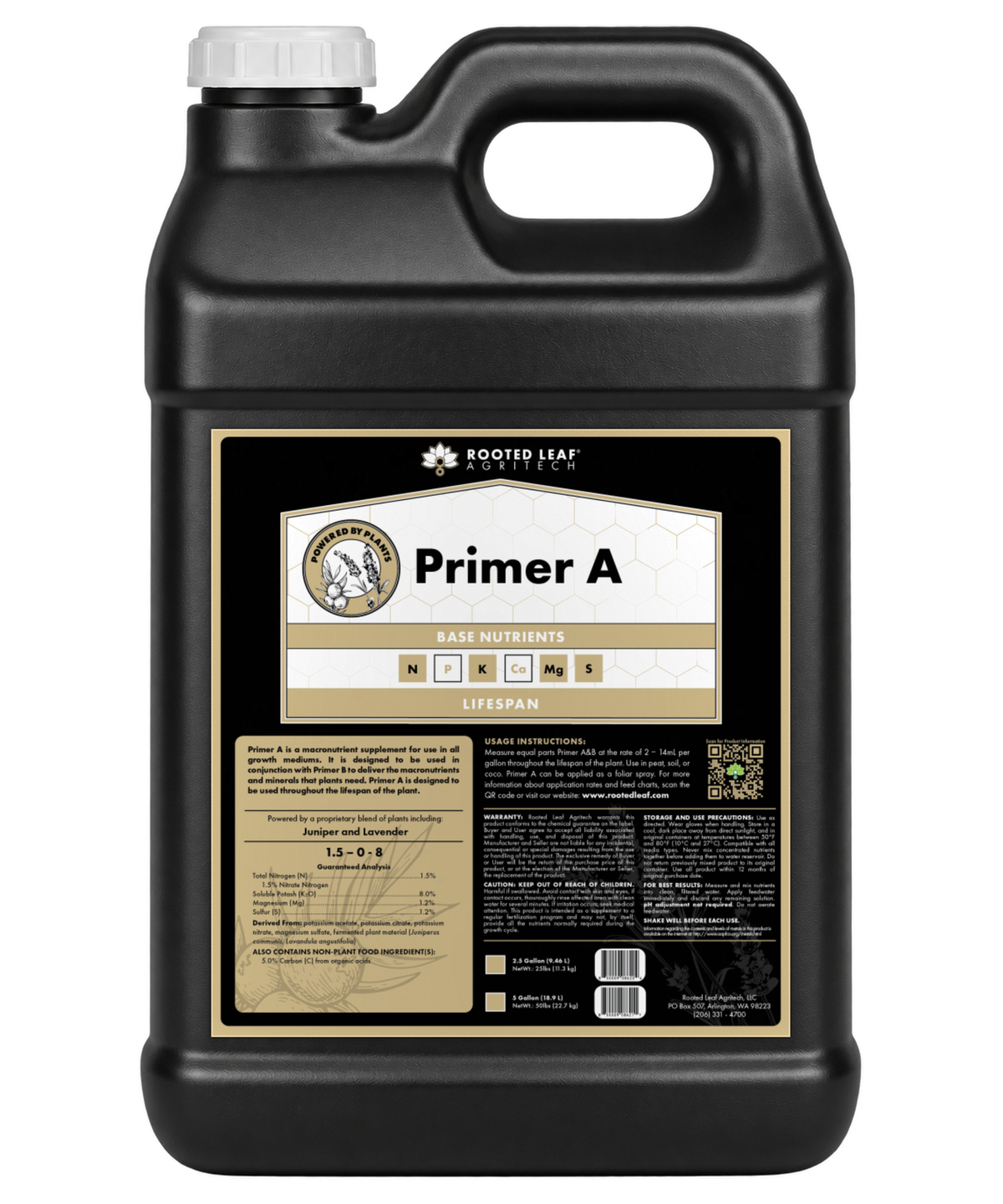
The label below shows what is in it.
Evidence Maathuis (2009) and Igamberdiev (2018)
Powered By Plants
Two stories about the plants Primer A is fermented from.
LavenderLavandula angustifolia
In a 2010 study, researchers soaked seeds of a wild Mediterranean lavender, Lavandula stoechas, for a day in a solution made from smoke. At full strength, 100 percent of the seeds germinated, against 50 percent of untreated seeds, and half of the treated seeds germinated within about 4 days instead of 47. Smoke from burning plants contains compounds called karrikins that affect the germination of many plants. Another experiment on the same species found no effect, so results vary with the seeds and the method.
JuniperJuniperus communis
Eastern redcedar is not a true cedar: it is a juniper, Juniperus virginiana, and in the United States cedarwood oil has been distilled from the wood of junipers. In 2017, U.S. Navy chemists published a way to turn that oil into fuel. They hydrogenated commercial cedarwood oil, rich in thujopsene and cedrene, and the result held more than 12 percent more energy per gallon than JP-8, the military's kerosene-based jet fuel. It is a laboratory fuel, and it is much thicker than JP-8 in the cold.
How the potassium arrives
Primer A is the potassium-and-magnesium half of our two-part base system. It combines organic-acid potassium forms, including citrate and acetate, within a functional carbon matrix.
8%
soluble potash (K₂O)
Primer A is designed for programs where potassium remains a focus as nitrogen inputs are managed across flowering and fruiting stages.
Organic acids, including citrate and acetate forms, contribute to Primer A's functional carbon matrix and carbon-forward formulation approach.
Formulated to run in typical reservoir pH ranges without a separate pH-adjustment step, one less input to manage when dosing Part A and Part B together.
Dosed at 2 to 14 mL/gal at the roots or 1 to 2 mL/gal as a foliar spray, in equal parts alongside Part B, the calcium and phosphate half, Primer A completes a full two-part base program across veg through bloom.
Potassium inputs can be supplied through several salt and organic-acid forms. Primer A combines potassium sources within an organic-acid carbon matrix as one part of our two-part base system.
Single potassium salt (e.g. potassium nitrate)
Potassium source chemistry varies by formulation.
Organic-acid potassium (citrate, acetate)
Includes organic-acid potassium forms within a functional carbon matrix.
Comparison is of ingredient class and label NPK ratio, not of crop results.
A complete base feed is more nutrition than one concentrate can hold, so we split it into two parts. The ratio in each part is chosen for chemical compatibility in the bottle and for what plants need. Dose them together in equal parts, 2 to 14 mL/gal each at the roots or 1 to 2 mL/gal each as a foliar spray, from veg through bloom.
Primer A is designed for potassium-focused nutrition while growers manage nitrogen inputs through Part B and the rest of their feed program. Follow the label and monitor crop and reservoir conditions.
Primer A is formulated to run within typical reservoir pH ranges and does not require a dedicated pH-adjustment step for most feed programs. Always confirm against your own reservoir readings.
No. Part of its potassium is supplied as potassium nitrate, alongside organic-acid potassium in citrate and acetate forms. The N:K balance keeps that nitrogen contribution minimal relative to the potassium.
Yes. Primer A is designed to run alongside Part B and the rest of the RLA program across the veg-to-bloom cycle; follow the label rate for each product you combine it with.
Cool and dark, in the original container, between 50F and 80F. Use it within 12 months of purchase. Gently swirl before use.
Unopened products can be returned within 15 days of delivery for a refund of the item price; original shipping isn't refunded. Email info@rootedleaf.com first for a return authorization. Opened products can't be returned. If your order arrives damaged, email us pictures and we'll send a replacement within 1-2 business days of confirming it.
That's what GNOME is for: it knows the whole Rooted Leaf line, plant science, plant nutrition science, and feed programs for 150+ crops. Tap the Ask GNOME button below and ask away. Prefer a person? Email info@rootedleaf.com or call (206) 331-4700.
The Rooted Leaf lineup
Policies and reference
Guidance from GNOME and this page is educational and general. Plant results vary with crop, environment, water, and program, and nothing here is a guarantee of specific results.
100% made by us, from whole plant to final bottle. We manufacture all of our own chelates and complexes from scratch, and quality-check every batch. If an order arrives damaged or is not right, contact us and we will make it right.
Shipping policy · Refund and returns · Terms of service · Safety data sheet · Heavy metals test results
Guaranteed Analysis Total Nitrogen (N) 1.5%
1.5% Nitrate Nitrogen
Soluble Potash (K₂O) 8.0%
Magnesium (Mg) 1.2%
Sulfur (S) 1.2%
Derived From: fermented plant material (Juniperus communis, Lavandula angustifolia), potassium acetate, potassium citrate, potassium nitrate, magnesium sulfate
Also contains non-plant food ingredient(s) 5% Carbon (from organic acids)
1 Gallon (3.78L) 128oz. Net weight 10.0 lbs (4.5kg).
This product is intended as a supplement to a regular fertilization program and may not, by itself, provide all the nutrients normally required during the growth cycle.
Storage and use Store in a cool, dark place away from direct sunlight, in the original container, between 50°F and 80°F (10°C and 27°C). Compatible with all media types.
Mixing Never mix concentrated nutrients together before adding them to the reservoir. pH adjustment is not required. Do not aerate feedwater. Gently swirl before each use. Apply immediately and discard any remaining solution.
Use all product within 12 months of the original purchase date.
Processing Orders ship within 1-2 business days and typically arrive within 5 days in the US. We ship to the US, Canada and the other countries listed at checkout.
Methods Standard, 2-Day and Overnight shipping, with the rate for your address shown at checkout. International orders ship with duties and import taxes paid at checkout.
Storage Store in a cool, dry place away from direct sunlight. Shelf life: 12 months.
Note With Standard, 2-Day or Overnight shipping, the 5 gal size ships as two 2.5 gal jugs. With Freight, offered at checkout on larger orders, it ships as one 5 gal jug.
Shipping, returns, and product questions: the fastest answer is GNOME. Tap the Ask GNOME button below.
Shipping
Orders ship within 1-2 business days and typically arrive within 5 in the US. Choose Standard, 2-Day or Overnight shipping at checkout. International orders ship with duties and import taxes paid at checkout.
With Standard, 2-Day or Overnight shipping, the 5 gal size ships as two 2.5 gal jugs. With Freight, offered at checkout on larger orders, it ships as one 5 gal jug.
Returns & Damaged Orders
Unopened products: return within 15 days of delivery for a refund of the item price; original shipping isn't refunded. Email us first for a return authorization. If your order arrives damaged, email pictures and we'll send a replacement within 1-2 business days of confirming it.
Talk to Us
Ask GNOME in the chat for instant answers, or reach the team at info@rootedleaf.com / (206) 331-4700.
Primer A
Grown with Primer A? Tell other growers how it went.
Be the first grower to say how Primer A worked for you. We'll email you a review link for your order.