
Did you know? A Resin Bloom story8 min readJump to the deep dive

About 5,700 years ago, someone at Syltholm, on the Danish island of Lolland, chewed a small lump of birch pitch and left it behind. Archaeologists found the lump in 2015, and a team at the University of Copenhagen sequenced a complete human genome from the DNA preserved inside it. The genome belonged to a female. The same lump also held DNA from bacteria and a virus typical of the human mouth, and from hazelnut and mallard duck.

A lump of pitch from a reclaimed fjord

The lump turned up in 2015 during an excavation at Syltholm, east of Rødbyhavn in southern Denmark. Museum Lolland-Falster ran the excavations in connection with the construction of the Fehmarn tunnel, on land that was once a fjord and has since been reclaimed. Theis Jensen of the University of Copenhagen's Globe Institute, the study's first author, called Syltholm the biggest Stone Age site in Denmark and said that almost everything there is sealed in mud, which keeps organic remains in exceptional condition.

So far, no human remains have been recovered from the site. That made any human DNA in the lump especially valuable to the researchers.

What birch pitch is, and what it was for

Birch pitch, also called birch tar, is a black-brown substance made by heating birch bark. People have made it for a very long time: a 2023 study of two pieces from Königsaue in Germany describes birch tar as the oldest synthetic substance made by early humans, with the earliest pieces associated with Neanderthals. That study found that the Königsaue tar had been made in an underground setup that restricted the flow of oxygen. A 2019 experiment showed a simpler method: birch bark burning next to a stone leaves tar on the stone, which can be scraped off and used.

People used birch pitch as an adhesive and to fix stone points and blades into handles and shafts. Small lumps of it are common on archaeological sites in Scandinavia, and many of them carry tooth marks. Fresh pitch hardens as it cools, and one explanation is that people chewed it to make it soft and workable again before using it. Researchers have also suggested medicinal uses, and ethnographic records describe people using birch pitch for tooth complaints and other ailments.

The study in numbers

the approximate age of the chewed pitch, by radiocarbon dating
5,700yrs
million DNA sequence reads generated from the sample
390M
more than this share of the sample's DNA was human
30%
the average number of times each position in the genome was read
2.3×

Dating the lump

Radiocarbon dating placed the Syltholm pitch between 5,858 and 5,661 calibrated years before present, at the start of the Neolithic period in Denmark. In Denmark this was the change from the Ertebølle culture of hunter-gatherers, known for flaked stone tools and T-shaped antler axes, to the Funnel Beaker culture, with its pottery, polished flint tools and domesticated plants and animals.

The team also checked what the lump was made of. Infrared spectroscopy gave a spectrum very similar to that of modern birch pitch, and gas chromatography with mass spectrometry found betulin and lupeol, two compounds characteristic of birch pitch.

A complete genome without a bone

The researchers generated about 390 million DNA sequence reads from the sample. More than 30 percent of the DNA was human, a level comparable to well-preserved teeth and to the petrous bone of the skull. From those reads they assembled a complete human genome, sequenced to an average depth of 2.3, which means that each position in the genome was read about 2.3 times on average. They also assembled her mitochondrial genome, read about 91 times over, which belongs to the maternal lineage K1e. Contamination from modern human DNA was estimated at about 1 to 3 percent.

Chewed pitch had yielded human DNA before. In May 2019, a team led by Natalija Kashuba reported genome-wide data for three people from chewed pitch found at Huseby Klev in western Sweden, dated to between 9,880 and 9,540 calibrated years before present. The Copenhagen team described the Syltholm result as the first time an entire ancient human genome had been extracted from anything other than human bone. The study's senior author, Hannes Schroeder, also noted that the team recovered DNA from oral microbes and from several important human pathogens.

It is amazing to have gotten a complete ancient human genome from anything other than bone.

Hannes Schroeder, University of Copenhagen

Chewed pitch and ancient DNA

  1. About 9,700 years ago

    Huseby Klev

    People in western Sweden chew lumps of birch pitch and leave them behind.

  2. About 5,700 years ago

    Syltholm

    A girl or woman on Lolland chews a lump of birch pitch at the start of the Neolithic in Denmark.

  3. 2015

    The find

    Museum Lolland-Falster's excavation for the Fehmarn tunnel recovers the lump.

  4. May 2019

    Huseby Klev results

    Kashuba and colleagues report genome-wide data for three people from the Swedish pitch.

  5. December 2019

    Syltholm results

    Jensen and colleagues publish a complete human genome from the Syltholm pitch.

What her DNA shows

The ratio of DNA from the X and Y chromosomes showed that the person who chewed the pitch was female. Using 41 genetic markers linked to pigmentation, the team predicted that she likely had dark skin, dark brown hair and blue eyes. The same combination has been found in other European hunter-gatherers, which suggests that it was widespread in Mesolithic Europe and that light skin spread through European populations later in prehistory.

She carried the older, ancestral form of two genetic markers linked to digesting milk sugar in adulthood, so she was most likely unable to digest lactose as an adult. That fits the evidence that lactase persistence evolved in Europe only fairly recently, after dairy farming arrived.

Her ancestry was closer to the western hunter-gatherers of mainland Europe than to the hunter-gatherers of central Scandinavia, and the analysis found no detectable ancestry from the Neolithic farmers who were spreading across Europe at the time. The authors write that this suggests the genetic impact of farming communities in southern Scandinavia may not have been as rapid or widespread as once thought.

Museum Lolland-Falster chose a name for her: Lola. It is a modern name, not her own. The museum also published a reconstruction drawing by the artist Tom Björklund, based on the predicted traits. It is an artist's interpretation of the genetic predictions, not a portrait.

Bacteria, a virus and a possible meal

About 69 percent of the sequence data did not match the human genome, and a large share of it came from microbes typical of the human mouth, such as Neisseria subflava and Rothia mucilaginosa. The team also identified three bacteria that are grouped together because they are associated with severe gum disease: Porphyromonas gingivalis, Tannerella forsythia and Treponema denticola. They found DNA from Streptococcus pneumoniae, a major human pathogen, and identified 26 of its known virulence factors in the sample. They also found 593 sequence reads from Epstein-Barr virus, one of the most common human viruses, which infects more than 90 percent of the world's adults.

The lump held plant and animal DNA too: silver birch, Betula pendula, which the authors attribute to the pitch itself; hazelnut; and more than 50,000 reads from mallard duck. The authors propose that the hazelnut and mallard DNA may come from a recent meal, which fits the animal and plant remains found at the site, dominated by wild species including ducks and hazelnuts. They also note a limit on what a lump of pitch can show: unlike dental calculus, which builds up over many years, chewed pitch most likely records the microbes present at the time it was chewed.

What the chewed pitch held

Schematic: a lump of black-brown chewed birch pitch, with a magnified view of the DNA inside it: strands from a human, from mouth bacteria and a virus, from hazelnut and from mallard duck. Below, a bar divides the about 390 million DNA sequence reads: over 30 percent human and about 69 percent not human. Chewed birch pitch Human, over 30%Not human, about 69%About 390 million reads
  • Human DNA: more than 30 percent of the DNA in the lump, enough to assemble her complete genome
  • DNA from bacteria typical of the human mouth, from Streptococcus pneumoniae and from Epstein-Barr virus
  • Hazelnut DNA, which may come from a recent meal
  • Mallard duck DNA, more than 50,000 reads, which may come from the same meal
Schematic, not to scale, except the bar, which shows the shares of the sequence data. The magnified view shows the kinds of DNA found, not their amounts. The lump also held DNA from silver birch, which the authors attribute to the pitch itself.

Rooted Leaf Deep Dive

Birch bark and the pitch made from it

Rooted Leaf Deep Dive: birch bark and the pitch made from it

Birch bark has two distinct layers, the outer bark and the inner bark, and the outer bark is far richer in extractable compounds. The main one is betulin, a white compound that fills the cavities of the cork cells in the outer bark and gives birch bark its white color. Betulin can make up 20 to 30 percent of the outer bark's dry mass, and in some birches almost 45 percent, depending on the species and where it grows. In silver birch the outer bark also contains lupeol and betulinic acid, together about 10 to 20 percent of the amount of betulin. The roots and leaves contain much less betulin than the outer bark.

Betulin was first isolated in the 18th century, when the chemist Johann Tobias Lowitz heated birch bark and collected a white compound by sublimation, the process in which a solid turns to vapor and back to a solid without melting. Betulin has antifungal and antibacterial properties, and it helps protect the birch from fungal and bacterial damage through its bark.

Heating birch bark turns it into pitch, and the Syltholm lump still contained betulin and lupeol, along with a range of dicarboxylic and saturated fatty acids that are also part of birch pitch. The authors explain why DNA lasted so long inside it: when someone chews pitch, DNA from the mouth becomes trapped in it, and the pitch is aseptic and hydrophobic, meaning it repels water. Together these properties inhibit both microbial and chemical decay.

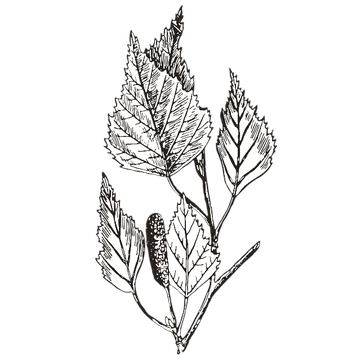
Tap a number to explore the twig.
  1. The stem and its bark

    Birch outer bark is rich in betulin, a white compound that can make up 20 to 30 percent of its dry mass. Heating the bark produces birch pitch.

  2. The leaves

    Birch leaves and roots contain much less betulin than the outer bark. The Syltholm pitch also held DNA from silver birch, which the authors attribute to the pitch itself.

From birch bark to preserved DNA

  1. Outer bark

    Rich in betulin, with lupeol and betulinic acid alongside it.

  2. Heat

    Heating the bark produces a black-brown pitch that hardens as it cools.

  3. Chewing

    Chewing may have made the pitch workable again, and DNA from the mouth became trapped inside it.

  4. Preservation

    The pitch is aseptic and repels water, and these properties inhibit microbial and chemical decay.

Birch and Resin Bloom

Birch has been part of human life for thousands of years, and its bark still has stories to tell. Our own connection is through the leaf: we ferment birch leaf alongside jasmine for Resin Bloom. This is a tree we're glad to keep getting to know.

Shop Resin Bloom
Resin Bloom
Resin Bloom
From $12.97

About 5,700 years ago, someone at Syltholm, on the Danish island of Lolland, chewed a small lump of birch pitch and left it behind. Archaeologists found the lump in 2015, and a team at the University of Copenhagen sequenced a complete human genome from the DNA preserved inside it. The genome belonged to a female. The same lump also held DNA from bacteria and a virus typical of the human mouth, and from hazelnut and mallard duck.

A lump of pitch from a reclaimed fjord

The lump turned up in 2015 during an excavation at Syltholm, east of Rødbyhavn in southern Denmark. Museum Lolland-Falster ran the excavations in connection with the construction of the Fehmarn tunnel, on land that was once a fjord and has since been reclaimed. Theis Jensen of the University of Copenhagen's Globe Institute, the study's first author, called Syltholm the biggest Stone Age site in Denmark and said that almost everything there is sealed in mud, which keeps organic remains in exceptional condition.

So far, no human remains have been recovered from the site. That made any human DNA in the lump especially valuable to the researchers.

What birch pitch is, and what it was for

Birch pitch, also called birch tar, is a black-brown substance made by heating birch bark. People have made it for a very long time: a 2023 study of two pieces from Königsaue in Germany describes birch tar as the oldest synthetic substance made by early humans, with the earliest pieces associated with Neanderthals. That study found that the Königsaue tar had been made in an underground setup that restricted the flow of oxygen. A 2019 experiment showed a simpler method: birch bark burning next to a stone leaves tar on the stone, which can be scraped off and used.

People used birch pitch as an adhesive and to fix stone points and blades into handles and shafts. Small lumps of it are common on archaeological sites in Scandinavia, and many of them carry tooth marks. Fresh pitch hardens as it cools, and one explanation is that people chewed it to make it soft and workable again before using it. Researchers have also suggested medicinal uses, and ethnographic records describe people using birch pitch for tooth complaints and other ailments.

Dating the lump

Radiocarbon dating placed the Syltholm pitch between 5,858 and 5,661 calibrated years before present, at the start of the Neolithic period in Denmark. In Denmark this was the change from the Ertebølle culture of hunter-gatherers, known for flaked stone tools and T-shaped antler axes, to the Funnel Beaker culture, with its pottery, polished flint tools and domesticated plants and animals.

The team also checked what the lump was made of. Infrared spectroscopy gave a spectrum very similar to that of modern birch pitch, and gas chromatography with mass spectrometry found betulin and lupeol, two compounds characteristic of birch pitch.

A complete genome without a bone

The researchers generated about 390 million DNA sequence reads from the sample. More than 30 percent of the DNA was human, a level comparable to well-preserved teeth and to the petrous bone of the skull. From those reads they assembled a complete human genome, sequenced to an average depth of 2.3, which means that each position in the genome was read about 2.3 times on average. They also assembled her mitochondrial genome, read about 91 times over, which belongs to the maternal lineage K1e. Contamination from modern human DNA was estimated at about 1 to 3 percent.

Chewed pitch had yielded human DNA before. In May 2019, a team led by Natalija Kashuba reported genome-wide data for three people from chewed pitch found at Huseby Klev in western Sweden, dated to between 9,880 and 9,540 calibrated years before present. The Copenhagen team described the Syltholm result as the first time an entire ancient human genome had been extracted from anything other than human bone. The study's senior author, Hannes Schroeder, also noted that the team recovered DNA from oral microbes and from several important human pathogens.

What her DNA shows

The ratio of DNA from the X and Y chromosomes showed that the person who chewed the pitch was female. Using 41 genetic markers linked to pigmentation, the team predicted that she likely had dark skin, dark brown hair and blue eyes. The same combination has been found in other European hunter-gatherers, which suggests that it was widespread in Mesolithic Europe and that light skin spread through European populations later in prehistory.

She carried the older, ancestral form of two genetic markers linked to digesting milk sugar in adulthood, so she was most likely unable to digest lactose as an adult. That fits the evidence that lactase persistence evolved in Europe only fairly recently, after dairy farming arrived.

Her ancestry was closer to the western hunter-gatherers of mainland Europe than to the hunter-gatherers of central Scandinavia, and the analysis found no detectable ancestry from the Neolithic farmers who were spreading across Europe at the time. The authors write that this suggests the genetic impact of farming communities in southern Scandinavia may not have been as rapid or widespread as once thought.

Museum Lolland-Falster chose a name for her: Lola. It is a modern name, not her own. The museum also published a reconstruction drawing by the artist Tom Björklund, based on the predicted traits. It is an artist's interpretation of the genetic predictions, not a portrait.

Bacteria, a virus and a possible meal

About 69 percent of the sequence data did not match the human genome, and a large share of it came from microbes typical of the human mouth, such as Neisseria subflava and Rothia mucilaginosa. The team also identified three bacteria that are grouped together because they are associated with severe gum disease: Porphyromonas gingivalis, Tannerella forsythia and Treponema denticola. They found DNA from Streptococcus pneumoniae, a major human pathogen, and identified 26 of its known virulence factors in the sample. They also found 593 sequence reads from Epstein-Barr virus, one of the most common human viruses, which infects more than 90 percent of the world's adults.

The lump held plant and animal DNA too: silver birch, Betula pendula, which the authors attribute to the pitch itself; hazelnut; and more than 50,000 reads from mallard duck. The authors propose that the hazelnut and mallard DNA may come from a recent meal, which fits the animal and plant remains found at the site, dominated by wild species including ducks and hazelnuts. They also note a limit on what a lump of pitch can show: unlike dental calculus, which builds up over many years, chewed pitch most likely records the microbes present at the time it was chewed.

Rooted Leaf Deep Dive: birch bark and the pitch made from it

Birch bark has two distinct layers, the outer bark and the inner bark, and the outer bark is far richer in extractable compounds. The main one is betulin, a white compound that fills the cavities of the cork cells in the outer bark and gives birch bark its white color. Betulin can make up 20 to 30 percent of the outer bark's dry mass, and in some birches almost 45 percent, depending on the species and where it grows. In silver birch the outer bark also contains lupeol and betulinic acid, together about 10 to 20 percent of the amount of betulin. The roots and leaves contain much less betulin than the outer bark.

Betulin was first isolated in the 18th century, when the chemist Johann Tobias Lowitz heated birch bark and collected a white compound by sublimation, the process in which a solid turns to vapor and back to a solid without melting. Betulin has antifungal and antibacterial properties, and it helps protect the birch from fungal and bacterial damage through its bark.

Heating birch bark turns it into pitch, and the Syltholm lump still contained betulin and lupeol, along with a range of dicarboxylic and saturated fatty acids that are also part of birch pitch. The authors explain why DNA lasted so long inside it: when someone chews pitch, DNA from the mouth becomes trapped in it, and the pitch is aseptic and hydrophobic, meaning it repels water. Together these properties inhibit both microbial and chemical decay.

Birch and Resin Bloom

Birch has been part of human life for thousands of years, and its bark still has stories to tell. Our own connection is through the leaf: we ferment birch leaf alongside jasmine for Resin Bloom. This is a tree we're glad to keep getting to know.

Sources

Jensen, T. Z. T., Niemann, J., Iversen, K. H., and colleagues, with Schroeder, H. A 5700 year-old human genome and oral microbiome from chewed birch pitch. Nature Communications 10 (2019): 5520. Read the paper

The University of Copenhagen's release on the Syltholm pitch, as carried by Futurity, 2019. The quotation from Hannes Schroeder and the remarks by Theis Jensen are from this release.

Museum Lolland-Falster: the story of Lola, with the reconstruction drawing by Tom Björklund.

Kashuba, N., and colleagues. Ancient DNA from mastics solidifies connection between material culture and genetics of mesolithic hunter-gatherers in Scandinavia. Communications Biology 2 (2019): 185. Read the paper

On birch tar: Schmidt, P., and colleagues, Birch tar production does not prove Neanderthal behavioral complexity, PNAS (2019); Schmidt, P., and colleagues, Production method of the Königsaue birch tar documents cumulative culture in Neanderthals, Archaeological and Anthropological Sciences (2023).

On birch bark and betulin: Demets, O. V., and colleagues, Methods of betulin extraction from birch bark, Molecules (2022).
Back to Resin Bloom

Leave a comment

Please note, comments need to be approved before they are published.

This site is protected by hCaptcha and the hCaptcha Privacy Policy and Terms of Service apply.

Keep reading

View all

Fresh tea leaves and a bundle of pruned tea twigs on a laboratory bench beside an arc-plasma chamber glowing violet, with a glass dish of black activated carbon granules

Tea's Plasma Plot Twist

Researchers used arc plasma to make a carbon-dioxide adsorbent from tea-twig waste. This article explains how the carbon was made and describes the microscopic surfaces inside it.

Read moreabout Tea's Plasma Plot Twist

A magnified lavender oil gland on the calyx surface: a golden pool of oil held under a clear cuticle dome, above a row of secretory cells on a short stalk

Lavender's Hidden Laboratories

Microscopic lavender glands make aromatic compounds and store oil above their secretory cells. Follow the research from flower anatomy and scent-making enzymes to a standardized oral lavender-oil preparation studied in a human trial.

Read moreabout Lavender's Hidden Laboratories

A scouting circuit around a potted plant with four numbered checks: leaf undersides under a hand lens, the growing tip, a yellow sticky card and the roots.

Common pests and diseases: prevention and first response

Preventing problems, scouting for them and responding gently first.

Read moreabout Common pests and diseases: prevention and first response