Did you know? A Solar Rain story3 min readJump to the deep dive

In 2026, researchers used arc plasma to turn tea-twig waste into activated carbon with 1,236 square meters of surface per gram. Most of that surface lies inside microscopic pores, where carbon dioxide molecules can collect. The team compared a ten-minute plasma run with two hours of furnace heating at the same temperature.

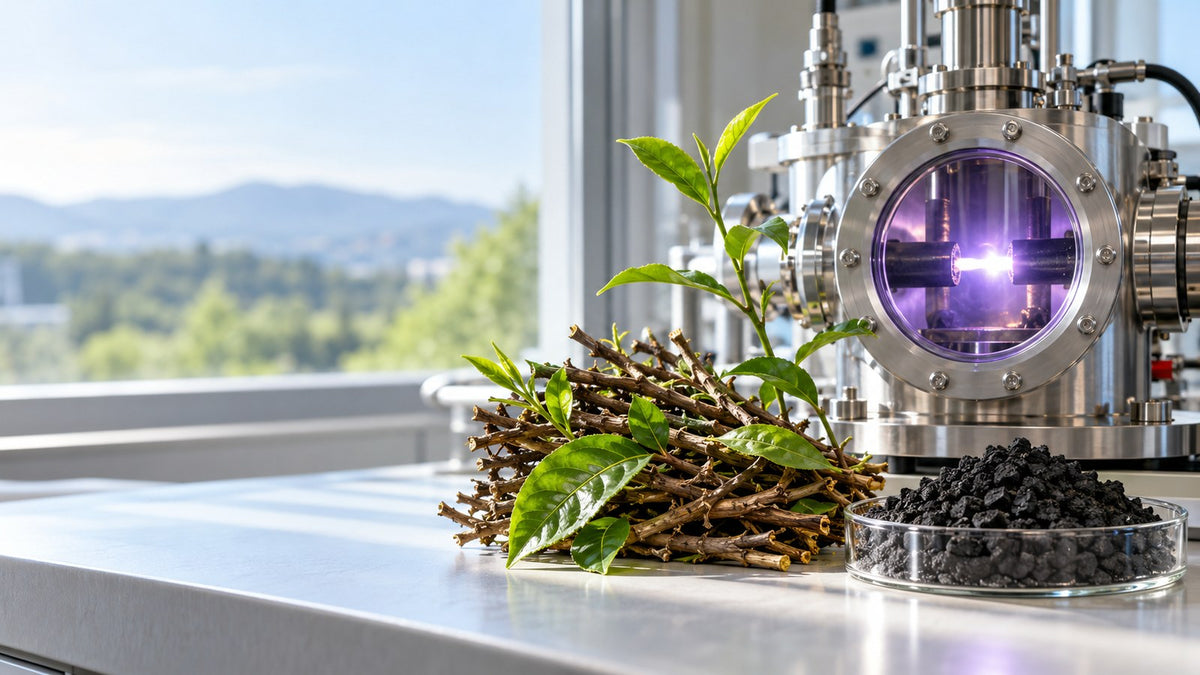
The tea twigs used in the experiment

Ary Mauliva Hada Putri and colleagues started with waste twigs from Camellia sinensis, the tea plant. They treated the material with potassium hydroxide before heating it. Their study appeared in Chemical Engineering Journal Advances.

An electric arc produces plasma

Plasma contains free electrons and positively charged ions. Supplying enough energy to a gas separates some electrons from their atoms, creating charged particles that can conduct electricity.

Scientists produce plasma with electricity, lasers or electromagnetic fields. Plasma also occurs in the Sun and in the aurora. The tea researchers used an electric arc with argon as the working gas.

The tea-twig study in numbers

specific surface area of the plasma-activated carbon
1,236m²/g
CO₂ adsorption, up to this value at 40 °C and 1 bar
6.6mmol/g
processing temperature for both heating methods
700°C

Ten minutes at 700 °C

The selected plasma run operated at 70 amperes and 700 °C for ten minutes. The furnace comparison ran at 700 °C for two hours. Plasma processing removed non-carbon components and developed small pores in the remaining carbon.

Carbon dioxide collects on a surface

Adsorption is the accumulation of molecules on a solid surface. In activated carbon, pores expose surfaces inside each particle as well as on its exterior. Chemical and physical processing can create pores or enlarge existing ones, increasing the surface available within a small mass of carbon.

The material that the researchers measured

The plasma-activated sample had a specific surface area of 1,236 square meters per gram. Using temperature-programmed desorption, the researchers reported carbon dioxide adsorption of up to 6.6 millimoles per gram at 40 °C and one bar.

Processing time at 700 °C

Conventional furnace

120 minutes

Argon arc plasma

10 minutes

Heating durations in Putri and colleagues, 2026. The plasma run used 70 amperes.

Rooted Leaf Deep Dive

Rooted Leaf Deep Dive: from a cell wall to a porous solid

A tea twig contains lignocellulose, plant material built from cellulose, hemicellulose and lignin. Cellulose consists of linked glucose molecules; lignin is a large, complex polymer that strengthens woody tissue.

Turning woody material into activated carbon creates a solid with a different internal structure. The pores extend into its particles, so a measurement of specific surface area includes the walls inside those openings. A carbon granule can therefore expose a large surface without being large itself. Carbon dioxide molecules adsorb on those internal walls.

Tea-twig waste is treated with potassium hydroxide and arc plasma to make porous carbon. Carbon dioxide molecules collect on the walls of an enlarged pore. Read from top to bottom: tea twigs, chemical treatment and a plasma chamber, then prepared carbon and an enlarged pore. The drawing is schematic and is not to scale. 1. Tea-twig waste 2. Potassium hydroxide, then arc plasma 3. Porous activated carbon CO₂ molecules collect on pore walls
Drawn schematic, not to scale.
Tap a number to explore the plant tissue.
  1. The young shoot

    Tea leaves and stems are plant tissues built from cells with cell walls.

  2. A leaf

    Cellulose is a polymer of linked glucose molecules that strengthens plant cell walls.

  3. The stem

    Woody tea-twig waste was the lignocellulosic starting material in the 2026 carbon study.

Tea and Solar Rain

Green tea and aronia berry are the two source plants Solar Rain is fermented from. Explore Solar Rain's ingredients, guaranteed analysis and application directions on its product page.

Shop Solar Rain
Solar Rain
Solar Rain
From $13.97

In 2026, researchers used arc plasma to turn tea-twig waste into activated carbon with 1,236 square meters of surface per gram. Most of that surface lies inside microscopic pores, where carbon dioxide molecules can collect. The team compared a ten-minute plasma run with two hours of furnace heating at the same temperature.

The tea twigs used in the experiment

Ary Mauliva Hada Putri and colleagues started with waste twigs from Camellia sinensis, the tea plant. They treated the material with potassium hydroxide before heating it. Their study appeared in Chemical Engineering Journal Advances.

An electric arc produces plasma

Plasma contains free electrons and positively charged ions. Supplying enough energy to a gas separates some electrons from their atoms, creating charged particles that can conduct electricity.

Scientists produce plasma with electricity, lasers or electromagnetic fields. Plasma also occurs in the Sun and in the aurora. The tea researchers used an electric arc with argon as the working gas.

Ten minutes at 700 °C

The selected plasma run operated at 70 amperes and 700 °C for ten minutes. The furnace comparison ran at 700 °C for two hours. Plasma processing removed non-carbon components and developed small pores in the remaining carbon.

Carbon dioxide collects on a surface

Adsorption is the accumulation of molecules on a solid surface. In activated carbon, pores expose surfaces inside each particle as well as on its exterior. Chemical and physical processing can create pores or enlarge existing ones, increasing the surface available within a small mass of carbon.

The material that the researchers measured

The plasma-activated sample had a specific surface area of 1,236 square meters per gram. Using temperature-programmed desorption, the researchers reported carbon dioxide adsorption of up to 6.6 millimoles per gram at 40 °C and one bar.

Rooted Leaf Deep Dive: from a cell wall to a porous solid

A tea twig contains lignocellulose, plant material built from cellulose, hemicellulose and lignin. Cellulose consists of linked glucose molecules; lignin is a large, complex polymer that strengthens woody tissue.

Turning woody material into activated carbon creates a solid with a different internal structure. The pores extend into its particles, so a measurement of specific surface area includes the walls inside those openings. A carbon granule can therefore expose a large surface without being large itself. Carbon dioxide molecules adsorb on those internal walls.

Tea and Solar Rain

Green tea and aronia berry are the two source plants Solar Rain is fermented from. Explore Solar Rain's ingredients, guaranteed analysis and application directions on its product page.

Sources

Putri and colleagues, 2026: activated carbon from tea-twig waste. Preparation, surface area and gas-test conditions are also in the Universitas Indonesia author-university abstract.

U.S. Department of Energy: plasma, its charged particles and how it forms.

U.S. Environmental Protection Agency: activated carbon's internal pores and surface area.

U.S. Department of Energy: cellulose, lignin and lignocellulose.
Back to Solar Rain

Leave a comment

Please note, comments need to be approved before they are published.

This site is protected by hCaptcha and the hCaptcha Privacy Policy and Terms of Service apply.

Keep reading

View all

Fresh tea leaves and a bundle of pruned tea twigs on a laboratory bench beside an arc-plasma chamber glowing violet, with a glass dish of black activated carbon granules

Tea's Plasma Plot Twist

Researchers used arc plasma to make a carbon-dioxide adsorbent from tea-twig waste. This article explains how the carbon was made and describes the microscopic surfaces inside it.

Read moreabout Tea's Plasma Plot Twist

A magnified lavender oil gland on the calyx surface: a golden pool of oil held under a clear cuticle dome, above a row of secretory cells on a short stalk

Lavender's Hidden Laboratories

Microscopic lavender glands make aromatic compounds and store oil above their secretory cells. Follow the research from flower anatomy and scent-making enzymes to a standardized oral lavender-oil preparation studied in a human trial.

Read moreabout Lavender's Hidden Laboratories

A scouting circuit around a potted plant with four numbered checks: leaf undersides under a hand lens, the growing tip, a yellow sticky card and the roots.

Common pests and diseases: prevention and first response

Preventing problems, scouting for them and responding gently first.

Read moreabout Common pests and diseases: prevention and first response