




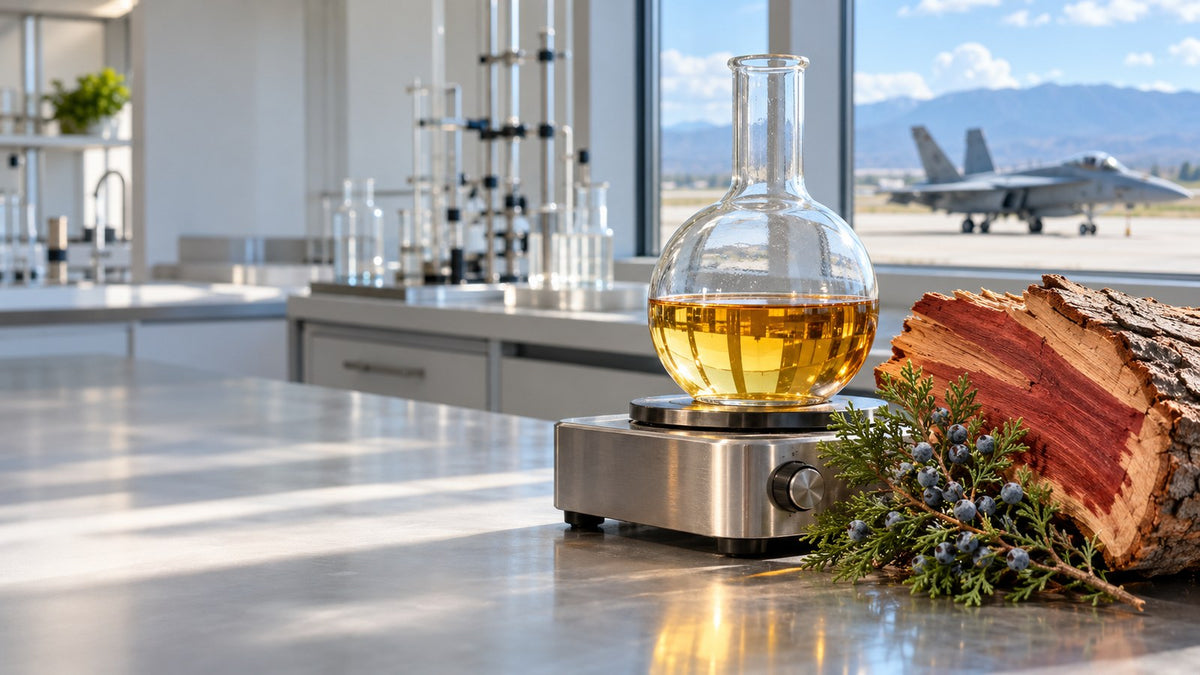


In 2017, two chemists at the U.S. Navy's Naval Air Warfare Center Weapons Division, Kale Harrison and Benjamin Harvey, published a way to make dense fuel from cedarwood oil, an oil distilled from the wood of trees called redcedar. Hydrogenated, the oil held more than 12 percent more energy per gallon than JP-8, the military's kerosene-based jet fuel. Eastern redcedar, one of the trees cedarwood oil comes from in the United States, is a juniper. This article covers the experiment, where cedarwood oil comes from and, in a Rooted Leaf deep dive, the carbon chemistry of juniper and the anatomy of a juniper berry.
A juniper called redcedar
Eastern redcedar, Juniperus virginiana, is not a true cedar. It belongs to the genus Juniperus, in the cypress family. True cedars, the genus Cedrus, belong to the pine family, are native to the Himalayan and Mediterranean regions and do not grow wild in North America. Eastern redcedar grows to about 50 feet tall. Its red, aromatic wood is used for chests, closets, pencils and posts, and its female cones are fleshy and berrylike, about a quarter inch long, dark blue and covered with a white, waxy coating.
Cedarwood oil
In 1987, the domestic sources of cedarwood oil in the United States were two junipers: Juniperus ashei in central Texas, whose oil is sold as Texas cedarwood oil, and Juniperus virginiana in the eastern states, whose oil is sold as Virginia cedarwood oil. That year, in a study in Economic Botany, the botanist Robert P. Adams of Baylor University described the Texas process at the time: the trees are cut, chipped and trucked to distillation units at Junction, Texas, where the wood oils are steam distilled. He measured the oil in the heartwood of eleven kinds of juniper. By dry weight, the heartwood of J. ashei held 4.04 percent oil and that of J. virginiana 3.18 percent.
The main compounds in the oil are thujopsene, cedrol and alpha-cedrene, in proportions that vary by species. In Adams's samples, thujopsene made up 60.4 percent of the oil of J. ashei and 27.6 percent of the oil of J. virginiana, and alpha-cedrene 27.2 percent of the oil of J. virginiana. Cedarwood oil is used in fragrances and to scent soaps, room sprays and disinfectants. Cedrol was once thrown away as waste, because in 1941 there was no market for it; by 1986 it sold for more per pound than the oil itself.
Why the Navy wants denser fuel
The Navy patent behind this research explains the reason. The energy a fuel releases per gallon, called its volumetric net heat of combustion, limits the range, loiter time and payload of aircraft, missiles and unmanned aerial vehicles, and a denser fuel with more energy per gallon can significantly increase them. The patent compares its fuels with two military fuels: JP-8, a kerosene-based fuel, and JP-10, a gas turbine fuel for missiles, with a density of 0.935 grams per milliliter.
The chemists turned to sesquiterpenes, a class of compounds that plants make and that can be extracted from plants by steam distillation or with solvents. Cedarwood oil is mostly sesquiterpenes.
The experiment
Harrison and Harvey bought distilled cedarwood oil from a commercial supplier, Penta Manufacturing. Their sample was 51 percent thujopsene, 32 percent alpha-cedrene and 7 percent beta-cedrene. The patent describes cedarwood oil as derived from redcedar and does not give the tree species the sample came from.
The chemists hydrogenated the oil: they reacted it with hydrogen over a platinum oxide catalyst, in acetic acid at 400 pounds per square inch, first for 18 hours at room temperature and then for 18 hours at 120 °C. The product, which they called hydrogenated cedarwood oil, had a density of 0.917 grams per milliliter, 13 percent higher than JP-8. Its net heat of combustion was 140.4 thousand British thermal units per gallon, more than 12 percent higher than JP-8 and only 0.8 percent lower than JP-10.
Two more fuels from the same oil
The team also made fuels from single compounds. Starting from cedrol, they removed water from the molecule with p-toluenesulfonic acid and hydrogenated the product to make cedrane. Cedrane had a density of 0.923 grams per milliliter and released 141.6 thousand British thermal units per gallon, but its derived cetane number, a measure used for diesel fuel, was only 18.
Then they treated cedrane with aluminum chloride, which rearranged its carbon framework into alkyl adamantanes, the molecules the paper's title calls alkyl diamondoids. After distillation, the fraction was 90 percent adamantanes. This fuel was less dense, at 0.896 grams per milliliter, and released 135.6 thousand British thermal units per gallon, still 8.5 percent more than JP-8. Its derived cetane number rose to 46, and its viscosity at minus 20 °C was 18 square millimeters per second, less than a third of the hydrogenated oil's.
What the measurements show, and what they do not
These numbers are measured properties of fuels made in a laboratory: density, energy per gallon, viscosity and cetane number. The 12 percent comparison is energy per unit of volume, not engine efficiency or a measured flight range. The hydrogenated oil also had a drawback in the cold: at minus 20 °C its viscosity was more than 54 square millimeters per second, substantially higher than either JP-8 or JP-10. The patent also discusses blending such fuels with conventional or renewable fuels to improve a low cetane number like the hydrogenated oil's 31 for diesel use.
Rooted Leaf Deep Dive: carbon rings in juniper chemistry
Thujopsene, the cedrenes and the scent compounds of juniper berries all belong to one large family of plant compounds, the terpenes, which can be described as built from units of five carbon atoms called isoprene units. Two units make a monoterpene, with 10 carbon atoms; three make a sesquiterpene, with 15. Thujopsene and alpha- and beta-cedrene are tricyclic sesquiterpenes: 15 carbon atoms joined into three rings. Hydrogenated, those ring-built molecules gave the Navy chemists a fuel 13 percent denser than JP-8.
Juniper berries carry the smaller monoterpenes. In an analysis of a commercial juniper berry oil from Bulgaria, made from Juniperus communis, monoterpene hydrocarbons made up 80.4 percent of the oil and sesquiterpene hydrocarbons 9.6 percent. The largest single compound was alpha-pinene, at 51.4 percent, followed by myrcene at 8.3 percent, sabinene at 5.8 percent, limonene at 5.1 percent and beta-pinene at 5.0 percent.
Inside a juniper berry
Common juniper, Juniperus communis, is the most widespread conifer in the world, native to temperate Eurasia and to North America north of Mexico. It grows from low shrubs that lie along the ground to small trees up to 12 meters tall. Its leaves are needles 4 to 25 mm long, set in alternating whorls of three, and each carries a single band of stomata on its upper face.
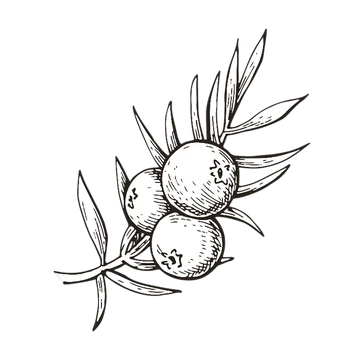
A juniper berry is a seed cone. It forms from one or two whorls of three bract-scale complexes that fuse completely, with no visible seams, into a soft, pulpy ball 4 to 13 mm across, purplish red to blackish brown and often with a dark, waxy bloom. Each cone holds one to three seeds and grows in the angle between a leaf and the stem, on almost no stalk. Dried, the cones are the juniper berries used as a seasoning and to flavor gin, whose name comes from the French word for juniper.
Juniper and Primer A and B
We ferment common juniper, Juniperus communis, alongside lavender for Primer A and Primer B. Its blue-black cones, often called berries, reward a closer look. Getting to know the wider juniper family is one of the pleasures of working with these plants.
Sources
Harrison, K. W., and Harvey, B. G. Renewable high density fuels containing tricyclic sesquiterpanes and alkyl diamondoids. Sustainable Energy & Fuels 1 (2017): 467 to 473. Read the paper
Harvey, B. G., and Harrison, K. W. High density turbine and diesel fuels from tricyclic sesquiterpenes. U.S. Patent 9,777,234, assigned to the United States Department of the Navy, granted October 3, 2017. The process, the fuel measurements and the comparisons with JP-8 and JP-10 are from this patent. Read the patent
Adams, R. P. Investigation of Juniperus species of the United States for new sources of cedarwood oil. Economic Botany 41 (1987): 48 to 54. Read the paper, hosted by Oregon State University
Eastern redcedar: Missouri Department of Conservation field guide. Common juniper: The Gymnosperm Database. Juniper berry oil: Höferl and colleagues, Antioxidants (2014). Terpenes and isoprene units: Chemistry LibreTexts.
Share:
Signals from the Smoke
Aloe Joins the Circuit