




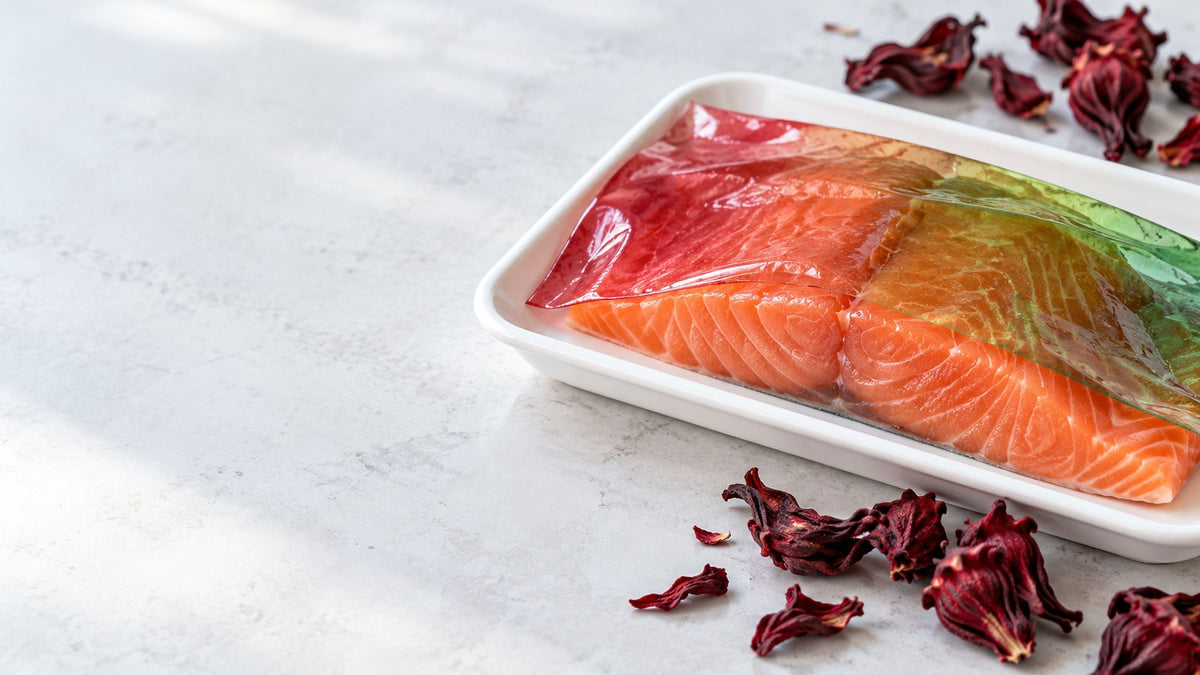
In a study published in January 2025, food scientists in Iran made a thin packaging film from gluten and carboxymethyl cellulose, colored with pigments from roselle, the hibiscus grown for its tart red calyces. They stored salmon with the film and recorded its color as the fish spoiled: the film changed from red to green. The pigments respond to the alkaline gases that spoiling fish releases, so a familiar plant color became a visible measure of freshness.
Roselle, the hibiscus grown for its calyx
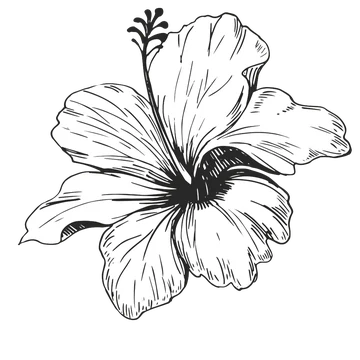
Hibiscus sabdariffa, known as roselle, is an upright, bushy plant that can grow to about 2.4 meters tall, with smooth, typically red stems. Its flowers grow singly where the leaves join the stem. Each flower has five petals, pale yellow or pale pink, with a dark purple spot at the base, and the flowers turn pink as they wither at the end of the day.
The part people harvest develops after the flower fades. At the base of each flower is the calyx: five sepals with a collar of 8 to 12 slim, pointed bracts. After flowering, the calyx enlarges into a fleshy, crisp, juicy cup 3.2 to 5.7 centimeters long, typically red, wrapped around the seed capsule. The calyces are acidic, and the botanist Julia Morton compared their flavor to cranberry. They contain about 4 percent citric acid.
Red drinks, jellies and food coloring
Where roselle first grew is not settled. The Plant Resources of South-East Asia handbook describes it as most probably African in origin, while Morton gave its native range as India to Malaysia. Morton records that its seeds are said to have been brought to the Americas by enslaved Africans, and that roselle was grown in Brazil in the 17th century and in Jamaica in 1707.
In the West Indies and tropical America, roselle is prized mainly for a cool, lemonade-like drink made from the calyces, and in Jamaica a traditional Christmas drink is made by steeping roselle in an earthenware jug. The calyces make a firm jelly with no added pectin. In 1959 and 1960, when there was widespread alarm about coal-tar food dyes, roselle drew new interest as a source of food coloring.
Why fish needs watching
The study's authors begin with a plain fact: fish is one of the most perishable foods. As fish spoils, bacteria use a compound in its flesh, trimethylamine oxide, in their respiration and produce trimethylamine. Food scientists measure trimethylamine together with dimethylamine and ammonia as total volatile basic nitrogen, a standard chemical indicator of spoilage.
These volatile nitrogen compounds are released slowly from stored fish, and they are alkaline. A film that absorbs them and changes color as it does shows the progress of spoilage on the package itself.
The experiment
The team, from Islamic Azad University's Najafabad branch and Shahid Chamran University of Ahvaz, made the film from two biodegradable polymers: gluten, a protein, and carboxymethyl cellulose, a material made from cellulose. Into it they mixed stabilized anthocyanins from Hibiscus sabdariffa, the red pigments of roselle.
They then stored salmon under two conditions: at 25 °C, about room temperature, for 16 hours, and at 4 °C, refrigerator temperature, for 12 days. They tracked chemical and microbial changes in the fish and the color of the film.
Red to green
As the salmon spoiled, the film changed from red to green. The authors attribute the change to the volatile nitrogen compounds released during spoilage, which the film absorbed. Their measurements also show how long the fish stayed fresh: at 25 °C it was acceptable for less than 12 hours, and at 4 °C it stayed within the standard limit for mesophilic bacteria, the group that grows best at moderate temperatures, for 6 days. By the end of storage, bacterial counts had reached 8.26 log colony-forming units per gram at 4 °C and 8.65 at 25 °C, which is more than 100 million bacteria able to form colonies in each gram of fish. The authors concluded that the film is a suitable indicator for continuous monitoring of salmon spoilage.
The study has limits worth stating. It was a laboratory test on one kind of fish. The film responds to a change in chemistry that spoilage causes; it does not identify particular bacteria, and it is not a guaranteed food-safety test.
Rooted Leaf Deep Dive: why anthocyanins change color with pH
Roselle's red comes from anthocyanins, and the calyces are the plant's major source of them. The two main anthocyanins in roselle extracts are delphinidin-3-sambubioside and cyanidin-3-sambubioside. Anthocyanins are glycosides: each is a core molecule, an anthocyanidin, with sugar attached.
The color of an anthocyanin depends on the acidity around it, because the molecule takes different forms at different pH. In acidic conditions it exists mostly as the flavylium cation, which is red. At neutral pH it forms quinonoid structures, which are purple, and in alkaline conditions anthocyanins can appear blue. As the pH rises further, colorless forms called the carbinol pseudobase and the chalcone appear. In one indicator film made with red cabbage anthocyanins, acidic, neutral and alkaline buffers turned the film red, blue and green. The roselle film's change from red to green comes from the same chemistry, as the alkaline gases from the fish reach the pigment.
Hibiscus and Cryo Sil
Roselle's tart calyces and shifting colors are a lovely reminder of how much chemistry lives in familiar plants. We love exploring those details. Hibiscus is also one of the botanical ingredients we work with, fermenting it with safflower for Cryo Sil.
Sources
Fallah, N., Aarabi, A., Zaki Dizaji, H., and Ghashang, M. Development of a colorimetric intelligent film based on biodegradable polymers incorporated with Hibiscus sabdariffa anthocyanins for monitoring salmon fish spoilage. Food and Bioprocess Technology 18 (2025): 4632 to 4648, published online January 7, 2025. Read the paper
The plant and its history: Julia F. Morton, Roselle, from Fruits of Warm Climates (1987), hosted by Purdue University; Hibiscus sabdariffa in the Plant Resources of South-East Asia handbook.
The pigments: a study measuring anthocyanins in roselle extracts (Khan and colleagues, Heliyon, 2022); a review of anthocyanins and how their color changes with pH (Khoo and colleagues, Food and Nutrition Research, 2017); an anthocyanin film for monitoring fish freshness (Nadi and colleagues, Food Science and Nutrition, 2023).
Fish spoilage: a study of total volatile basic nitrogen in stored fish (Prabhakar and colleagues, Frontiers in Sustainable Food Systems, 2021).
Share:
A Pretty Sweet Secret About Stevia
Safflower’s Golden Touch