




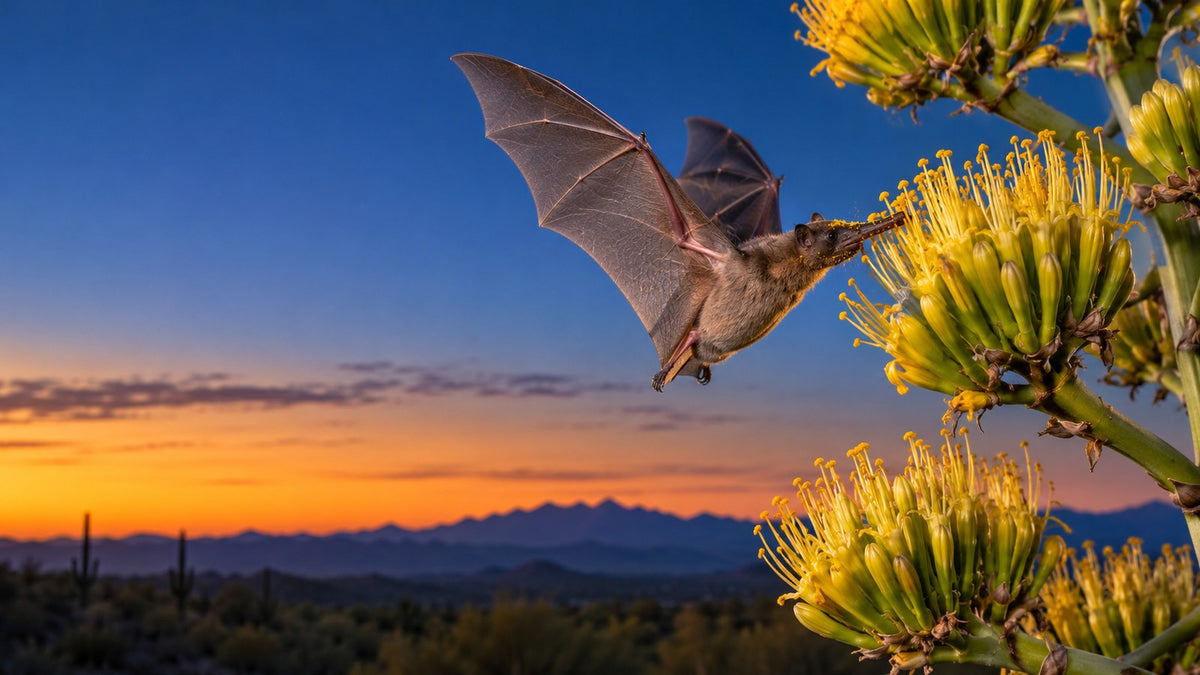
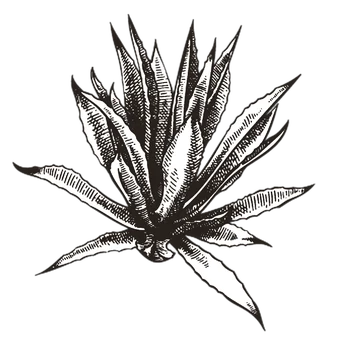

After dark, nectar-feeding bats fly from agave flower to agave flower, drinking nectar and carrying pollen between plants. In several agave species, the bats are the main pollinators. The blue agave grown for tequila, however, is usually harvested before it can flower and is replanted from offshoots, so most cultivated plants never bloom. Since 2016, researchers and a group of tequila and mezcal brands have been letting some of their agaves flower again, to feed the bats.
The plant behind tequila
Tequila can be made from only one plant: Agave tequilana Weber, blue variety, the blue agave. The Mexican official standard for tequila, NOM-006, requires it. Agaves are an important and very diverse group of plants in Mexico, and people there have made five traditional alcoholic drinks from them: tequila, mezcal, bacanora, raicilla and pulque.
The crop is large. In 2020, according to a 2022 study, 374 million liters of tequila were produced from the carbohydrates stored in about 1.4 million tons of mature agave stems.
A plant that flowers once
The blue agave is monocarpic: it flowers only once in its life, and then it dies. Growers keep each plant in the field for at least six years and cut off any flowering stalk that forms, so the plant does not reproduce from seed. At harvest, once the stem has grown large and built up its store of fructans, the stem is cut at soil level.
New plants come from the offshoots that grow from the roots of the parent plant from the crop's second year onward. Every offshoot is a clone of its parent. Researchers have long assumed that this has narrowed the crop's genetic diversity and left it more vulnerable to disease, although a 2022 study did find some variation in genetic markers among asexually propagated blue agaves.
Night visitors
Agaves and nectar-feeding bats have evolved together. The most important agave pollinators are bats of the genus Leptonycteris: the lesser long-nosed bat, Leptonycteris yerbabuenae, and the greater long-nosed bat, Leptonycteris nivalis. Other nectar-feeding bats, including Choeronycteris mexicana, also visit agave flowers.
Bats are not the only visitors. Researchers have recorded 32 species of insects, birds and bats on the flowers of the tequila agave, and they estimate that bats pollinate more than 500 plant species in all.
The lesser long-nosed bat
The lesser long-nosed bat ranges from southern Mexico to southern Arizona and New Mexico, feeding on the nectar of agaves and of saguaro and organ pipe cacti. When the United States listed it as endangered in 1988, fewer than 1,000 were known, at 14 roosts.
By 2018, the U.S. Fish and Wildlife Service estimated about 200,000 of the bats at 75 roosts in the U.S. Southwest and Mexico. Mexico had removed the bat from its own endangered species list in 2015, and on April 17, 2018, it became the first bat ever removed from protection under the U.S. Endangered Species Act because it had recovered. In announcing the decision, the Fish and Wildlife Service noted that tequila producers in Mexico were adopting bat-conscious cultivation and marketing bat friendly tequila.
Leaving some agaves in bloom
In 2016, Roberto-Emiliano Trejo-Salazar, Luis Eguiarte and David Suro-Piñera asked what would happen if producers let a small share of their agaves flower. Using pollination data and a linear projection based on Agave angustifolia, a close relative of the blue agave, they estimated that if 5 percent of the plants on one hectare, about 222 agaves, were allowed to flower, at least 89 bats could feed each night while those plants bloomed. Across 5 percent of all the blue agave plants of flowering age, they estimated food for about 2.3 million nectar-feeding bats a month. These are projections from a model, not counts of bats.
The same year, Rodrigo Medellín and colleagues at Mexico's National Autonomous University (UNAM) created the Bat Friendly project. Producers in the project let a small percentage of their agaves flower so that the bats can feed. By 2026, eight tequila and mezcal brands with producers in Jalisco, Michoacán and Oaxaca had taken part, and the project had expanded beyond the blue agave to Agave angustifolia, Agave inaequidens and Agave cupreata.
Rooted Leaf Deep Dive: carbon taken in at night, stored as fructans
Agaves use crassulacean acid metabolism, or CAM, a water-conserving form of photosynthesis in which the plant takes in carbon dioxide at night. In well-watered plants of Agave angustifolia, the blue agave's close relative, carbon dioxide taken up in the dark supplied about 75 percent of the plant's daily carbon gain.
The main products of agave photosynthesis are fructans: chains of fructose units, often with a single glucose unit. The blue agave stores them in its stem. In a 2012 field study of plants from two to seven years old, fructans were by far the most abundant soluble carbohydrate, at 328 to 711 milligrams per gram. The chains changed as the plants aged. Plants of two to five years stored mainly short fructan chains, plants of six and seven years stored mainly long ones, and the seven-year-old plants held mostly highly branched fructans called agavins.
Those branches set agave apart from the artichoke. Artichoke inulin is a straight chain of fructose units joined by one kind of link. Agave fructans join their fructose units with two kinds of link, and that produces branches; in eight-year-old blue agaves, the chains ranged from 3 to 29 sugar units. A 2003 study concluded that the blue agave's fructans are not an inulin type, as had previously been thought.
Agave and Peak Bloom
We love how much of agave's story is held in a single plant: years of stored sugars, one great flowering, and the bats that arrive after dark. Agave is also one of the plants we work with, fermenting it with artichoke for Peak Bloom.
Sources
Trejo-Salazar, R.-E., Eguiarte, L. E., and Suro-Piñera, D. Save Our Bats, Save Our Tequila: Industry and Science Join Forces to Help Bats and Agaves. Natural Areas Journal 36, no. 4 (2016). Read the paper's abstract
Tiburcio Cortés, M., Reyes Guerra, M. A., and Medellín, R. A. Proyecto Bat Friendly: conservación sustentable del tequila, el mezcal y sus polinizadores. Oikos=, Instituto de Ecología, UNAM, 2026.
U.S. Fish and Wildlife Service: Bi-national success: lesser long-nosed bat has recovered, April 17, 2018.
Chávez-Sánchez, C., and colleagues. Asexually propagated Agave tequilana var. azul exhibits variation in genetic markers and defence responses to Fusarium solani. AoB Plants (2022). Read the paper
Winter, K., Garcia, M., and Holtum, J. A. M. Nocturnal versus diurnal CO2 uptake: how flexible is Agave angustifolia? Journal of Experimental Botany 65 (2014): 3695 to 3703. Read the paper
Mellado-Mojica, E., and López, M. G. Fructan metabolism in A. tequilana Weber Blue variety along its developmental cycle in the field. Journal of Agricultural and Food Chemistry 60 (2012): 11704 to 11713. Read the paper
López, M. G., Mancilla-Margalli, N. A., and Mendoza-Díaz, G. Molecular structures of fructans from Agave tequilana Weber var. azul. Journal of Agricultural and Food Chemistry 51 (2003): 7835 to 7840. Read the paper
On inulin and agavins: a 2025 review of inulin and agavin fructans in Molecules.
Share:
Artichokes & Organized Crime
Money Really Did Grow on Trees