




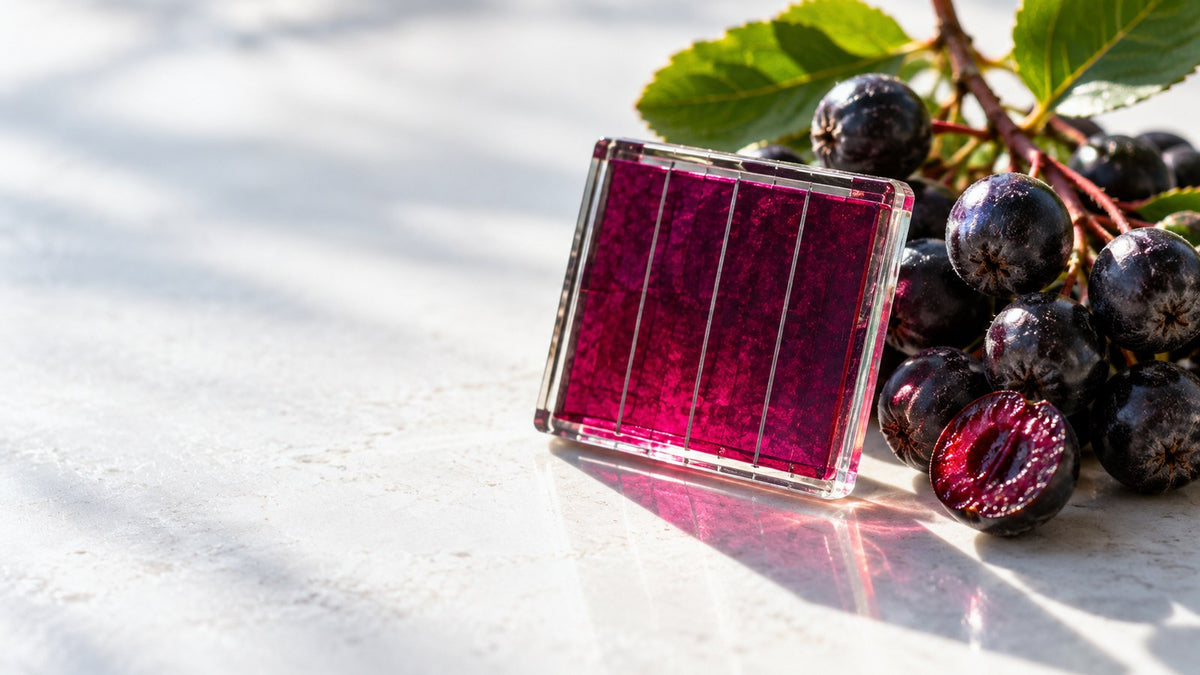
In 2021, researchers in Poland built experimental solar cells colored with extracts of black chokeberry, the aronia berry: one from its juice, one from its pomace and one from its leaves. They set them beside a cell made with a synthetic dye and measured the environmental cost of making each one. The berry's near-black color comes from pigments that absorb light, and in this kind of solar cell, a light-absorbing dye is the part that starts the electric current. This article explains the experiment, what it found and, in a Rooted Leaf deep dive, what makes the berry so dark.
A dark berry from eastern North America
Aronia melanocarpa, the black chokeberry, is a shrub of the rose family native to the eastern parts of North America. It grows four to eight feet tall. Between May and July it opens rounded clusters of seven to eighteen flowers, each with five white or pink-tinged petals. The fruit is a small pome, the same kind of fruit as an apple: bluish black, a quarter to half an inch across, with the tips of the flower's calyx still attached. Raw, it tastes astringent or bitter, an effect of its tannins.
Cultivation of black chokeberry for the food industry in Europe began in Russia in the early 1900s.
Where the color comes from
The dark color of the berry comes from anthocyanins, the water-soluble pigments that give many fruits and vegetables their red, purple and blue colors. In 2004, chemists at the U.S. Department of Agriculture's Agricultural Research Service measured the anthocyanins in black currants, red currants, gooseberries, elderberries and chokeberries. Chokeberry had the highest total, about 1,480 milligrams per 100 grams of fresh fruit, the highest the authors reported for any berry. The gooseberry with the least, the variety Careless, held 0.07 milligrams.
One analysis cited in a 2017 review found that about 65 percent of the chokeberry's anthocyanins are cyanidin 3-galactoside and about 30 percent are cyanidin 3-arabinoside.
How a dye turns light into current
A dye-sensitized solar cell works differently from a silicon panel. In 1991, Brian O'Regan and Michael Grätzel described a cell built on a transparent film of titanium dioxide, about 10 micrometers thick and made of particles only a few nanometers across, coated with a single layer of dye molecules. Under simulated sunlight it converted 7.1 to 7.9 percent of the light's energy into electricity.
The dye absorbs the light. When a dye molecule absorbs light, it becomes excited and injects an electron into the titanium dioxide, and that electron flows out through the circuit as current. A dissolved chemical pair in the cell's liquid electrolyte then returns an electron to the dye, so that the dye can absorb light again, and a counter electrode coated with platinum or carbon completes the circuit.
Anthocyanins can serve as the dye. They carry hydroxyl and carbonyl groups that let them attach to the surface of titanium dioxide, and in 1997 a team that included Grätzel published a study of a titanium dioxide electrode sensitized with anthocyanin dye. Cells made with natural dyes generally convert less light into electricity than cells made with synthetic dyes: a 2017 study in Scientific Reports notes that most reported natural-dye cells convert less than one percent.
The 2021 study
The study was led by Alfred Błaszczyk at the Poznań University of Economics and Business, with colleagues there and at the Silesian University of Technology, and published in the journal Solar Energy in February 2021. The team built three dye-sensitized cells with natural dyes: from black chokeberry juice, from its pomace, which is the skins and pulp left after the juice is pressed, and from its leaves. They built a fourth with the synthetic dye N719.
They then ran a life cycle assessment, an accounting of the environmental impact of making each cell, across a range of impact categories.
What the comparison showed
The module with the synthetic N719 dye had the lowest environmental impact in every category the team analyzed. Among the three chokeberry cells, the one made with juice had the best environmental performance.
Natural dyes are non-toxic, easy to prepare and cheap to produce, which is why researchers test them, but they convert less light into electricity. In this study, being made from a plant did not make a cell the lower-impact choice. The chokeberry cells were laboratory devices built for comparison, not commercial panels.
A solar panel painted after Turner
The same year, aronia dyes were part of an exhibition in Finland. From September 8 to 29, 2021, the V2 gallery at Aalto University in Espoo showed an exhibition of plant-based solar cells and research material. One work was a hand-painted solar panel, 40 by 30 centimeters, based on a painting by the English artist J. M. W. Turner. Its glass solar cells were colored with dyes from the leaves, fruits and stems of the aronia plant, and those dyes absorbed the light that the cells turned into electricity.
The panel was made by the physicist Janne Halme and the artist Bartaku with Aamo, short for Aronia art morphing, a research group whose members came from Aalto's physics, electrical engineering, chemistry and arts departments.
Rooted Leaf Deep Dive: the pigment in the berry
An anthocyanin is built from two parts. The colored core is an anthocyanidin, and in black chokeberry that core is mostly cyanidin. Attached to it is a sugar, which makes the whole molecule a glycoside. Cyanidin 3-galactoside, the chokeberry's main anthocyanin, is cyanidin carrying one galactose sugar; cyanidin 3-arabinoside carries arabinose instead.
The color of an anthocyanin depends on acidity: in acidic conditions anthocyanins appear red, and as the pH rises they turn blue. The hydroxyl groups on the molecule are what let it attach to titanium dioxide in a solar cell.
Leaves catch light for photosynthesis with a different pigment, chlorophyll. A molecule of chlorophyll a, with the formula C55H72MgN4O5, contains one magnesium atom.
Aronia and Solar Rain
Aronia is one of those plants that makes us stop and look twice. Its deep purple-black berries are part of our own work, too: we ferment them alongside green tea for Solar Rain, our magnesium formula. There is a lot to discover inside that little berry.
Sources
Błaszczyk, A., Joachimiak-Lechman, K., Sady, S., Tański, T., Szindler, M., and Drygała, A. Environmental performance of dye-sensitized solar cells based on natural dyes. Solar Energy 215 (2021): 346 to 355. Read the paper
O'Regan, B., and Grätzel, M. A low-cost, high-efficiency solar cell based on dye-sensitized colloidal TiO2 films. Nature 353 (1991): 737 to 740. Read the paper
Cherepy, N. J., Smestad, G. P., Grätzel, M., and Zhang, J. Z. Ultrafast electron injection: implications for a photoelectrochemical cell utilizing an anthocyanin dye-sensitized TiO2 nanocrystalline electrode. The Journal of Physical Chemistry B 101 (1997): 9342 to 9351. The EPFL record of the paper
Ghann, W., and colleagues. Fabrication, optimization and characterization of natural dye sensitized solar cell. Scientific Reports 7 (2017): 41470. Read the paper
Wu, X., Gu, L., Prior, R. L., and McKay, S. Characterization of anthocyanins and proanthocyanidins in some cultivars of Ribes, Aronia and Sambucus and their antioxidant capacity. Journal of Agricultural and Food Chemistry 52 (2004): 7846 to 7856. Read the abstract
On the plant and its pigments: a 2017 review of black chokeberry in Molecules; Minnesota Wildflowers on black chokeberry; Oregon State University on the genus Aronia; a 2017 review of anthocyanidins and anthocyanins; cyanidin 3-galactoside, ChEBI; chlorophyll a, ChEBI.
Aalto University: exhibition handout, Towardless Plant-based Electrical and Art Energy, 2021.
Share:
Safflower’s Golden Touch
Signals from the Smoke