

Did you know? A Lush Green story6 min readJump to the deep dive

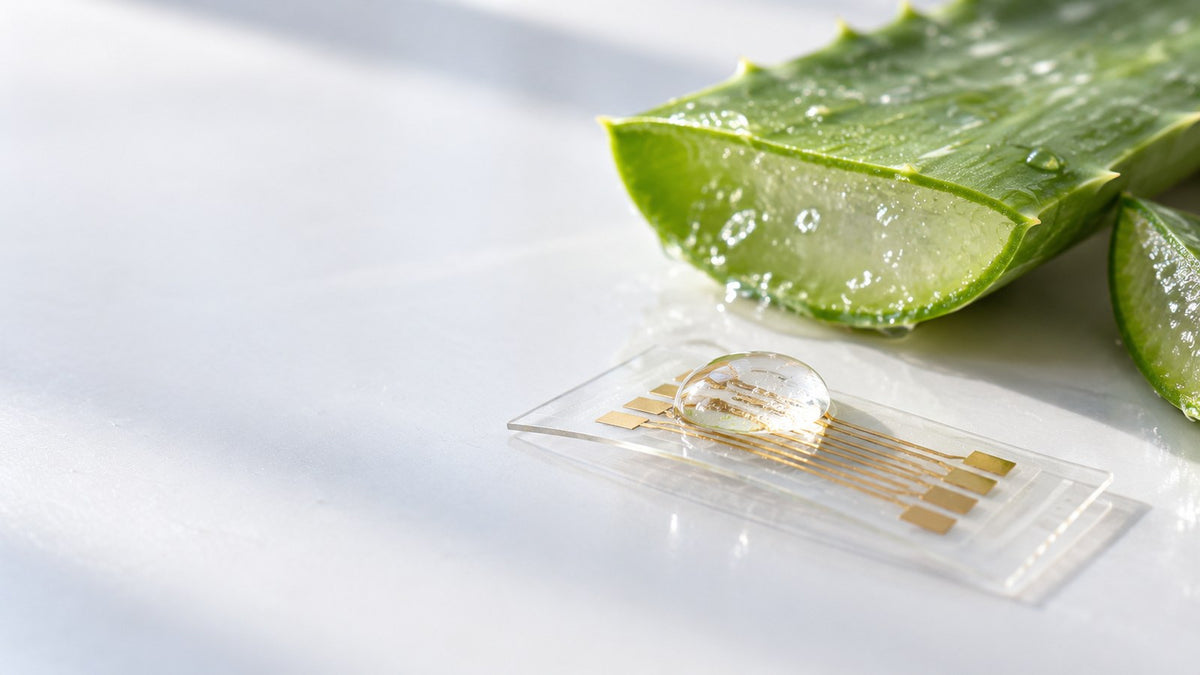
In January 2026, four researchers at the IMS laboratory in Bordeaux, France, published a study in which the electrolyte of a transistor was aloe vera gel, used unprocessed. The gel is mostly water and carries natural mineral ions: calcium, potassium, sodium and magnesium. Those ions carried the ionic part of the device's signal, and the transistors performed comparably to transistors gated with phosphate-buffered saline, a standard laboratory salt solution. Here is how the experiment worked, and what an aloe leaf is made of.

A transistor that works with ions

Conventional transistors, made from inorganic materials such as silicon, carry their signals with electronic charges alone. An organic electrochemical transistor, or OECT, uses ions as well. Its channel is a strip of conducting polymer, a kind of plastic that conducts electricity, laid between two electrodes called the source and the drain. A third electrode, the gate, is connected to the channel through an electrolyte: a material full of ions, the electrically charged atoms and molecules that form when salts dissolve in water.

When a small voltage is applied to the gate, ions move out of the electrolyte and into the polymer channel, and the current between source and drain changes. In PEDOT:PSS, the polymer most often used for these channels, positive ions entering the polymer reduce that current, and a very small change at the gate produces a large change in the channel. Because OECTs handle both ions and electrons and are made from soft materials, they are studied for recording signals from nerve and muscle cells, for chemical sensors and for circuits modeled on the connections between nerve cells. The first OECT was described in 1984.

How an OECT switches

  1. Source and drain

    A strip of conducting polymer between two electrodes carries a current.

  2. Gate and electrolyte

    A third electrode, the gate, connects to the channel through an electrolyte full of ions. In the Bordeaux study, the electrolyte was aloe gel.

  3. Ions move

    A small voltage on the gate moves ions into the polymer, and the current in the channel changes. In PEDOT:PSS channels, entering positive ions reduce the current.

What an electrolyte has to do

The Bordeaux team set out what an OECT needs from its electrolyte: ions that move easily, a soft and flexible texture, safety for living cells, and sustainability. In their paper they write that conventional water-based liquids, ionic liquids and synthetic hydrogels find it difficult to combine all four. Gels have one practical advantage over liquids: a 2025 study of gel electrolytes notes that solid-state gels are easier to build into devices and keep their performance more steadily than liquids do.

The gel in numbers

water in aloe's inner gel, approximately
99.5%
the gel's ionic conductivity: how easily ions carry current through it
6.1mS/cm
peak transconductance: how strongly the gate controls the channel current
11mS
or more of the original current, still flowing after 100 on-off cycles
96%

Aloe gel as the electrolyte

In the Bordeaux devices, aloe vera gel was the whole electrolyte. The paper's title calls the gel unprocessed, and the authors describe it as a single-component electrolyte, meaning nothing else was mixed into it. They chose it for two properties it already has: its high water content and its dissolved mineral ions.

Their measurements of how the gel flows showed a soft, viscoelastic network, a material that behaves partly like a solid and partly like a liquid. The authors call it a quasi-solid electrolyte. Solid electrolytes are usually expected to make a transistor switch slowly, and the authors report that the aloe gel did not.

What the aloe gel did in the transistor

Diagram of an organic electrochemical transistor in cross-section: a strip of conducting polymer between a source electrode and a drain electrode, covered by a dome of aloe gel that holds mineral ions, with a gate electrode dipped into the gel from above. Wires run from the gate, the source and the drain to the researchers' equipment, and arrows show ions moving from the gel into the channel. Source Drain Gate Equipment
  • Aloe vera gel, used unprocessed as the whole electrolyte
  • Mineral ions in the gel: calcium, potassium, sodium and magnesium
  • The channel, a strip of conducting polymer between the source and the drain
  • Ions moving from the gel into the channel when a small voltage is applied to the gate, which changes the current in the channel
  • Wires to the researchers' equipment, which supplied the voltages
Schematic, not to scale. The gel did not power the transistor: the voltages came from the researchers' equipment, and the gel's job was to carry ions between the gate and the channel.

What the measurements showed

The gel conducted ions at about 6.1 millisiemens per centimeter, a measure of how easily ions carry current through a material. Where the gel touched the electrodes, it held about 58.5 microfarads per square centimeter, a measure of how much charge that boundary stores for each volt applied.

In finished transistors, the aloe gel gave a peak transconductance of about 11 millisiemens, which measures how strongly a change at the gate changes the current in the channel, and an on-state current of about 6.5 milliamps. The authors report that these results are comparable to transistors gated with phosphate-buffered saline. The devices switched quickly, and after 100 on-off cycles they still carried more than 96 percent of their original current.

From the first OECT to aloe gel, 1984 to 2026

  1. 1984

    The first OECT

    White and colleagues describe the first organic electrochemical transistor.

  2. 2008

    The gel analyzed

    A review in Molecules sets out what aloe leaf gel is made of: about 99.5 percent water, with polysaccharides, minerals and organic acids.

  3. December 2025

    The abstract

    The Bordeaux team publishes its conference abstract on aloe gel as a transistor electrolyte.

  4. January 2026

    The paper

    The full study appears online in ACS Applied Materials and Interfaces.

  5. March 2026

    Barcelona

    Damien Thuau presents the work at the MATSUS Spring 2026 conference.

What the study shows, and what it does not

This was laboratory research on small experimental devices. The gel did not power the transistors: the voltages came from the researchers' equipment, and the gel's job was to carry ions between the gate and the channel. The results come from one laboratory. The team also presented the work at the MATSUS Spring 2026 conference in Barcelona.

The authors describe aloe gel as biocompatible and biodegradable, and they write that the result could lead toward sustainable, or green, bioelectronic systems. The study tested a plant material in an electronics laboratory. It is not a study of how plants grow.

Rooted Leaf Deep Dive

Inside an aloe leaf

Rooted Leaf Deep Dive: inside an aloe leaf

An aloe leaf has two main parts. The outer green rind contains the leaf's vascular bundles, its veins, and the cells next to those bundles produce a bitter yellow sap that contains anthraquinone compounds. Inside the rind is the inner leaf: large, thin-walled cells that hold water as a clear, thick, slippery mucilage. This water-storage tissue makes up most of the leaf's volume.

The gel inside those cells is about 99.5 percent water. The remaining half to one percent of solid material includes polysaccharides, minerals, vitamins, enzymes, phenolic compounds and organic acids, and the inner leaf also contains proteins and amino acids. Most of the dry matter is polysaccharide, and the main one is acemannan, a long chain built mostly from mannose sugar units carrying acetyl groups. Acemannan is mainly responsible for the gel's thick texture, and it helps the leaf hold water. In a 2019 study, aloe plants kept short of water increased the activity of the gene that builds acemannan's backbone.

Tap a number to explore the plant.
  1. The rind, the green outer skin

    It contains the leaf's veins, and cells beside them make a bitter yellow sap. Its pores, the stomata, open at night.

  2. The inner gel

    Clear water-storage tissue that fills most of the leaf. The gel is about 99.5 percent water, thickened mainly by acemannan.

  3. The base of the plant

    Aloe vera reproduces mostly through offshoots called pups. A farmed plant lives about twelve years.

Rooted Leaf Deep Dive: how aloe takes in carbon dioxide at night

Aloe vera uses crassulacean acid metabolism, or CAM, a form of photosynthesis found in more than 6 percent of plant species. Most plants open the pores on their leaves, the stomata, during the day to take in carbon dioxide, and they lose water through those pores while they are open. A CAM plant opens its stomata at night, when less water evaporates. It stores the carbon dioxide it takes in as malic acid, an organic acid, in the vacuoles of its leaf cells. During the day the stomata close, the malic acid releases its carbon dioxide inside the leaf, and the chloroplasts use that carbon dioxide to make sugars.

A 2019 review of CAM crops describes aloe vera as a farmed plant: it takes about two years to reach maturity and lives about twelve years, and once mature its leaves can be harvested four to six times a year. It reproduces mostly through offshoots called pups, and even a brief frost can kill most varieties.

How an aloe leaf handles carbon dioxide

  1. Night

    The stomata open. The leaf takes in carbon dioxide and stores it as malic acid in its cell vacuoles.

  2. Day

    The stomata close, which saves water. The malic acid releases its carbon dioxide inside the leaf.

  3. Sugar

    The chloroplasts use the released carbon dioxide to make sugars while the pores stay closed.

Aloe and Lush Green

There are other reasons we love working with aloe, beyond its unexpected role in electronics. Inside the rind is the clear, water-storing tissue explored above. That inner fillet is the part we ferment with sage for Lush Green.

The Bordeaux experiment explored fresh aloe gel as an electrolyte in small electronic devices.

Shop Lush Green
Lush Green
Lush Green
From $15.97

In January 2026, four researchers at the IMS laboratory in Bordeaux, France, published a study in which the electrolyte of a transistor was aloe vera gel, used unprocessed. The gel is mostly water and carries natural mineral ions: calcium, potassium, sodium and magnesium. Those ions carried the ionic part of the device's signal, and the transistors performed comparably to transistors gated with phosphate-buffered saline, a standard laboratory salt solution. Here is how the experiment worked, and what an aloe leaf is made of.

A transistor that works with ions

Conventional transistors, made from inorganic materials such as silicon, carry their signals with electronic charges alone. An organic electrochemical transistor, or OECT, uses ions as well. Its channel is a strip of conducting polymer, a kind of plastic that conducts electricity, laid between two electrodes called the source and the drain. A third electrode, the gate, is connected to the channel through an electrolyte: a material full of ions, the electrically charged atoms and molecules that form when salts dissolve in water.

When a small voltage is applied to the gate, ions move out of the electrolyte and into the polymer channel, and the current between source and drain changes. In PEDOT:PSS, the polymer most often used for these channels, positive ions entering the polymer reduce that current, and a very small change at the gate produces a large change in the channel. Because OECTs handle both ions and electrons and are made from soft materials, they are studied for recording signals from nerve and muscle cells, for chemical sensors and for circuits modeled on the connections between nerve cells. The first OECT was described in 1984.

What an electrolyte has to do

The Bordeaux team set out what an OECT needs from its electrolyte: ions that move easily, a soft and flexible texture, safety for living cells, and sustainability. In their paper they write that conventional water-based liquids, ionic liquids and synthetic hydrogels find it difficult to combine all four. Gels have one practical advantage over liquids: a 2025 study of gel electrolytes notes that solid-state gels are easier to build into devices and keep their performance more steadily than liquids do.

Aloe gel as the electrolyte

In the Bordeaux devices, aloe vera gel was the whole electrolyte. The paper's title calls the gel unprocessed, and the authors describe it as a single-component electrolyte, meaning nothing else was mixed into it. They chose it for two properties it already has: its high water content and its dissolved mineral ions.

Their measurements of how the gel flows showed a soft, viscoelastic network, a material that behaves partly like a solid and partly like a liquid. The authors call it a quasi-solid electrolyte. Solid electrolytes are usually expected to make a transistor switch slowly, and the authors report that the aloe gel did not.

What the measurements showed

The gel conducted ions at about 6.1 millisiemens per centimeter, a measure of how easily ions carry current through a material. Where the gel touched the electrodes, it held about 58.5 microfarads per square centimeter, a measure of how much charge that boundary stores for each volt applied.

In finished transistors, the aloe gel gave a peak transconductance of about 11 millisiemens, which measures how strongly a change at the gate changes the current in the channel, and an on-state current of about 6.5 milliamps. The authors report that these results are comparable to transistors gated with phosphate-buffered saline. The devices switched quickly, and after 100 on-off cycles they still carried more than 96 percent of their original current.

What the study shows, and what it does not

This was laboratory research on small experimental devices. The gel did not power the transistors: the voltages came from the researchers' equipment, and the gel's job was to carry ions between the gate and the channel. The results come from one laboratory. The team also presented the work at the MATSUS Spring 2026 conference in Barcelona.

The authors describe aloe gel as biocompatible and biodegradable, and they write that the result could lead toward sustainable, or green, bioelectronic systems. The study tested a plant material in an electronics laboratory. It is not a study of how plants grow.

Rooted Leaf Deep Dive: inside an aloe leaf

An aloe leaf has two main parts. The outer green rind contains the leaf's vascular bundles, its veins, and the cells next to those bundles produce a bitter yellow sap that contains anthraquinone compounds. Inside the rind is the inner leaf: large, thin-walled cells that hold water as a clear, thick, slippery mucilage. This water-storage tissue makes up most of the leaf's volume.

The gel inside those cells is about 99.5 percent water. The remaining half to one percent of solid material includes polysaccharides, minerals, vitamins, enzymes, phenolic compounds and organic acids, and the inner leaf also contains proteins and amino acids. Most of the dry matter is polysaccharide, and the main one is acemannan, a long chain built mostly from mannose sugar units carrying acetyl groups. Acemannan is mainly responsible for the gel's thick texture, and it helps the leaf hold water. In a 2019 study, aloe plants kept short of water increased the activity of the gene that builds acemannan's backbone.

Rooted Leaf Deep Dive: how aloe takes in carbon dioxide at night

Aloe vera uses crassulacean acid metabolism, or CAM, a form of photosynthesis found in more than 6 percent of plant species. Most plants open the pores on their leaves, the stomata, during the day to take in carbon dioxide, and they lose water through those pores while they are open. A CAM plant opens its stomata at night, when less water evaporates. It stores the carbon dioxide it takes in as malic acid, an organic acid, in the vacuoles of its leaf cells. During the day the stomata close, the malic acid releases its carbon dioxide inside the leaf, and the chloroplasts use that carbon dioxide to make sugars.

A 2019 review of CAM crops describes aloe vera as a farmed plant: it takes about two years to reach maturity and lives about twelve years, and once mature its leaves can be harvested four to six times a year. It reproduces mostly through offshoots called pups, and even a brief frost can kill most varieties.

Aloe and Lush Green

There are other reasons we love working with aloe, beyond its unexpected role in electronics. Inside the rind is the clear, water-storing tissue explored above. That inner fillet is the part we ferment with sage for Lush Green.

The Bordeaux experiment explored fresh aloe gel as an electrolyte in small electronic devices.

Sources

Kassahun, G., El Attar, R., Abbas, M., and Thuau, D. Unprocessed aloe vera gel as quasi-solid-state electrolyte for high-performance organic electrochemical transistors. ACS Applied Materials and Interfaces 18 (2026): 8520 to 8528. Read the paper; the PubMed record with the abstract; the MATSUS Spring 2026 conference abstract.

How OECTs work: a review of PEDOT:PSS bioelectronic devices in Advanced Healthcare Materials (2021); a study of gel electrolytes in OECTs in Gels (2025).

The aloe leaf: Hamman, Composition and applications of Aloe vera leaf gel, Molecules (2008); a study of acemannan and water stress in Phytochemistry (2019); a study of water storage in aloe leaves in Physiologia Plantarum (2024). CAM photosynthesis: a review in Trends in Plant Science (2014); a review of CAM crops in the Journal of Experimental Botany (2019).
Back to Lush Green

Leave a comment

Please note, comments need to be approved before they are published.

This site is protected by hCaptcha and the hCaptcha Privacy Policy and Terms of Service apply.

Keep reading

View all

Fresh tea leaves and a bundle of pruned tea twigs on a laboratory bench beside an arc-plasma chamber glowing violet, with a glass dish of black activated carbon granules

Tea's Plasma Plot Twist

Researchers used arc plasma to make a carbon-dioxide adsorbent from tea-twig waste. This article explains how the carbon was made and describes the microscopic surfaces inside it.

Read moreabout Tea's Plasma Plot Twist

A magnified lavender oil gland on the calyx surface: a golden pool of oil held under a clear cuticle dome, above a row of secretory cells on a short stalk

Lavender's Hidden Laboratories

Microscopic lavender glands make aromatic compounds and store oil above their secretory cells. Follow the research from flower anatomy and scent-making enzymes to a standardized oral lavender-oil preparation studied in a human trial.

Read moreabout Lavender's Hidden Laboratories

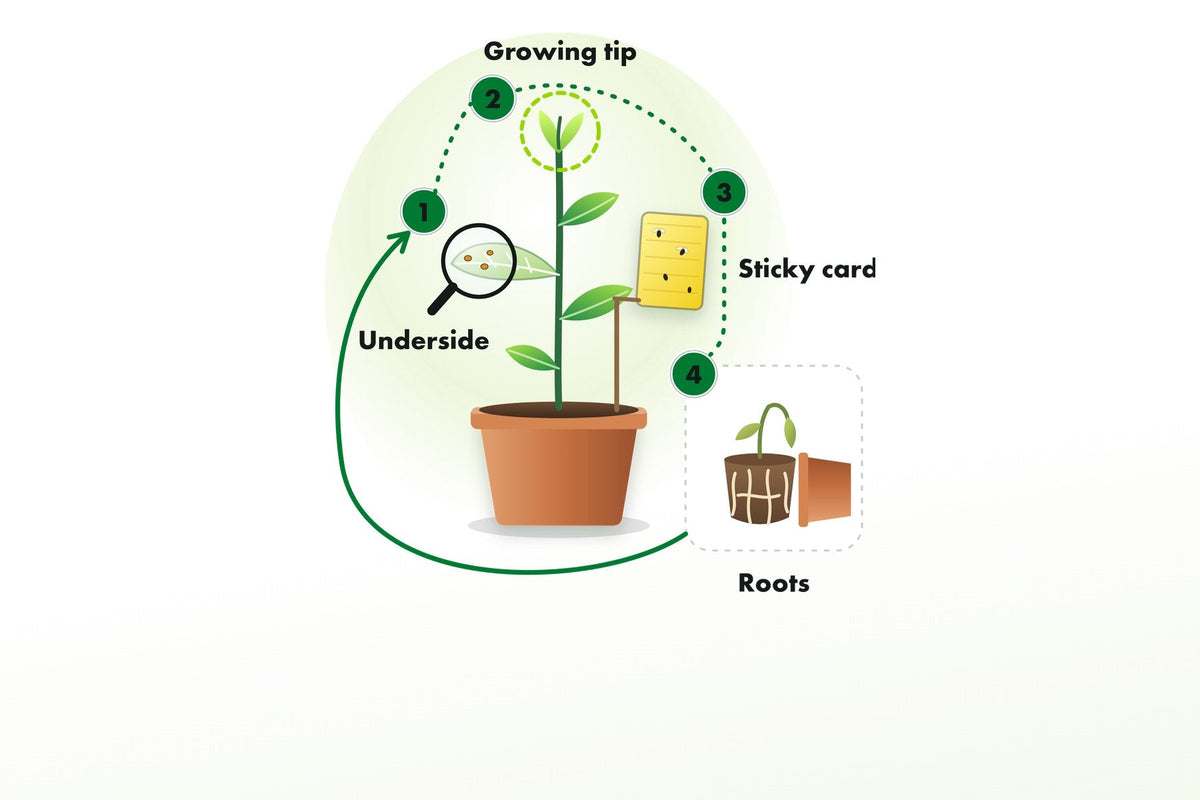
A scouting circuit around a potted plant with four numbered checks: leaf undersides under a hand lens, the growing tip, a yellow sticky card and the roots.

Common pests and diseases: prevention and first response

Preventing problems, scouting for them and responding gently first.

Read moreabout Common pests and diseases: prevention and first response